






Built for Real-Time Quantum Execution
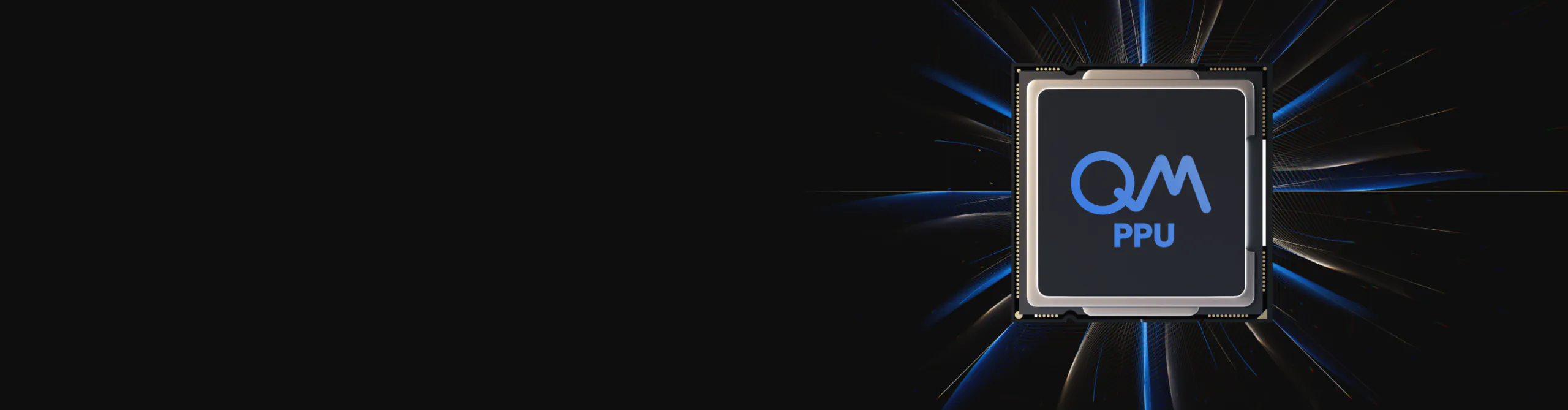
The Pulse Processing Unit (PPU) is an advanced classical processor central to Quantum Machines’ Hybrid Control approach. By positioning classical computing resources as close as possible to the quantum hardware, the PPU enables real-time execution of quantum control protocols with minimal overhead, ensuring rapid comprehensive and frictionless operation.
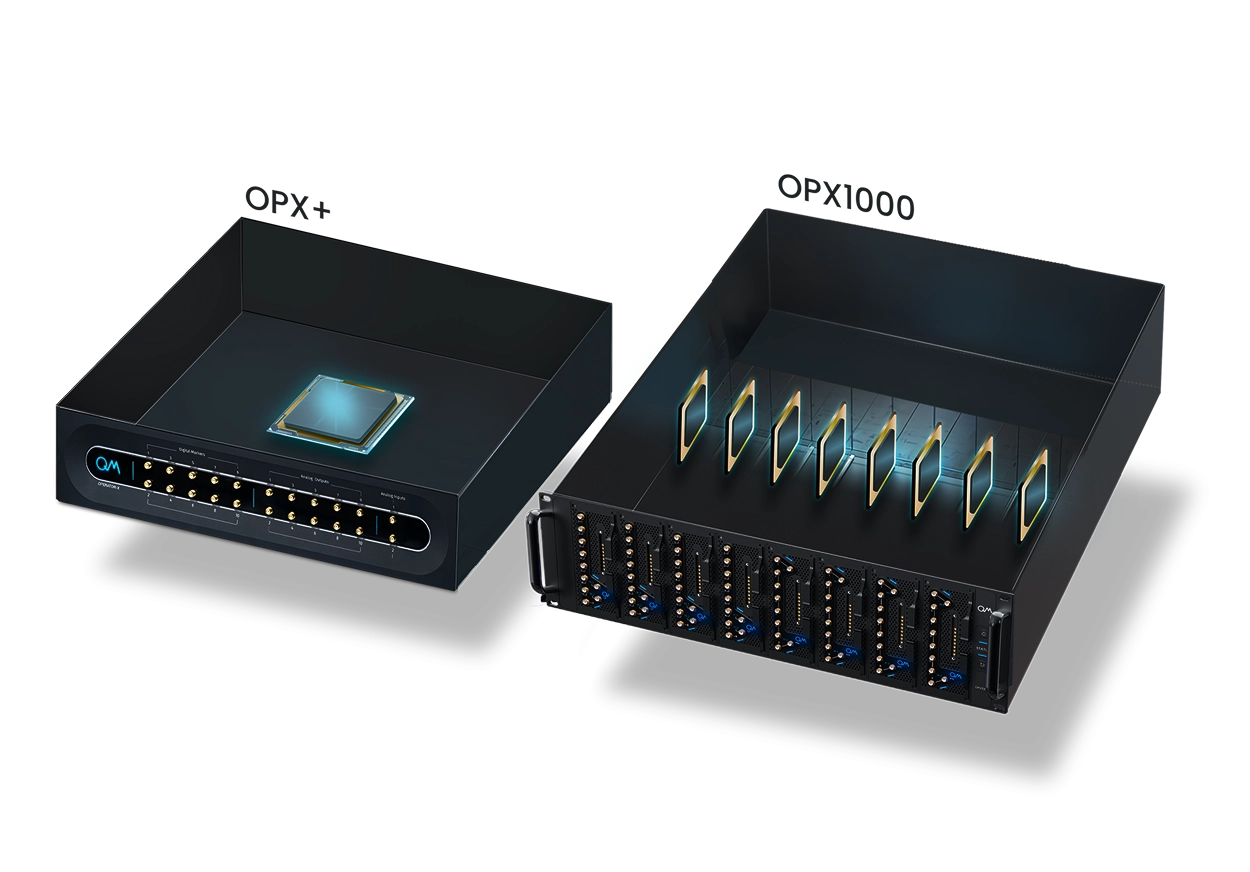
Built into every OPX1000 front-end module (LF-FEM and MW-FEM) and OPX+ system, multiple PPUs operate as one, orchestrating control, readout, and calculations, handling data sharing and synchronization.
Unmatched Real-Time Processing Capabilities
The PPU is a 16-core classical processor designed for parallel, real-time quantum control operations. These cores can simultaneously generate and manipulate pulses to control, receive and process data from qubits, and execute real-time Turing-complete classical calculations. The result is ultra-fast feedback loops, enabling real-time adaptive control based directly on measurement outcomes. With the PPU technology at their core, OPX hybrid controllers can execute the most complex dynamic protocols and deliver unmatched performance. They significantly reduce sequence execution times, achieving speeds tens or even hundreds of times faster than other controllers.
- Active reset latency < 160 ns
- QPU utilization in Cross-Entropy Benchmarking (XEB) >97%
Unique External Acceleration
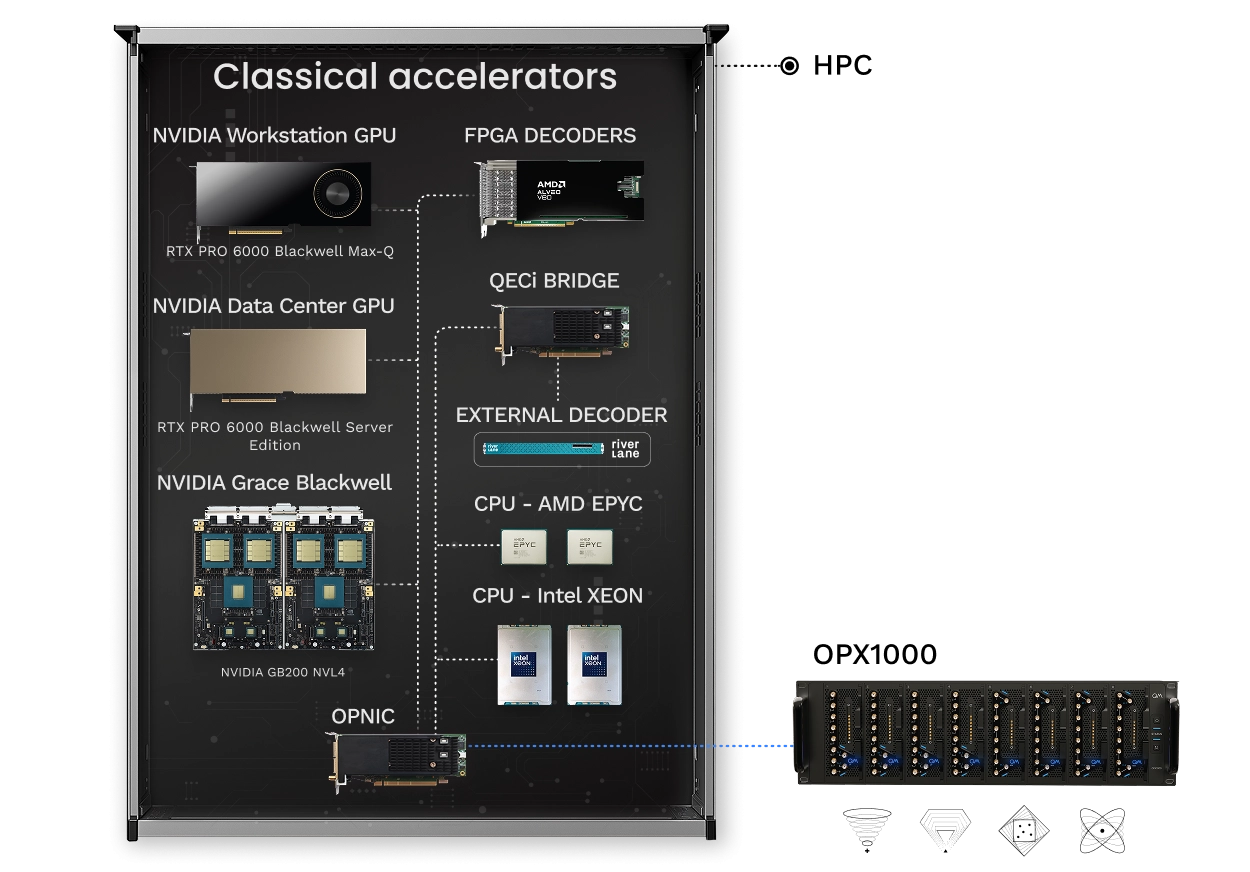
The Open Acceleration Stack solution, co-developed with NVIDIA, establishes a direct high-bandwidth, ultra-low latency connection between GPU/CPU resources and the PPU. NVIDIA DGX Quantum is the first implementation of bounded-latency integration between CPU/GPU servers and QPUs, with full compatibility with NVIDIA NVQLink, the open architecture for hybrid quantum-classical supercomputing. This ultra-fast data link provides communication between the PPU and the CPU/GPU via QM’s OP-NIC, acting as real-time interconnect at speeds that are at least 1,000 times faster than conventional interfaces. Such integration significantly enhances advanced hybrid workflows critical for scaling quantum systems – including quantum error correction, accelerated calibration protocols, and emerging hybrid quantum-classical algorithms.
- GPU/CPU – PPU data round trip latency <4 µs
Easy as Pseudo Coding
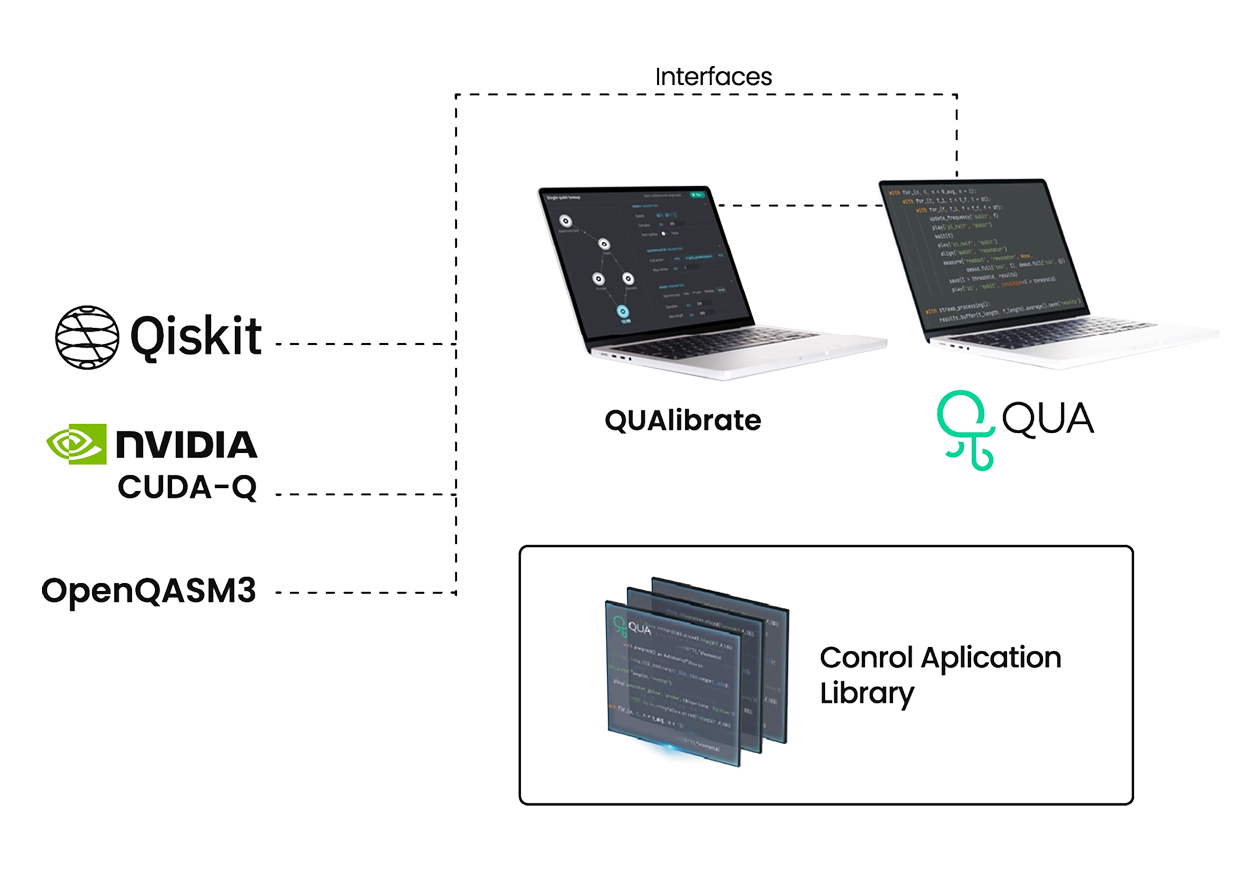
PPUs are programmed with QUA – an open-source programming language designed specifically to combine quantum control with classical computation and intuitive control flow. QUA provides pulse-level programming while remaining super easy to use and understand as pseudo coding. QUA is central to Quantum Machines’ hybrid development platform which includes a comprehensive library of ready-to-use control applications that significantly reduce development time. As part of this platform, QUA programs can also be seamlessly integrated and controlled through QUAlibrate, Quantum Machines’ automated, scalable calibration solution for quantum computers powered by OPX hybrid controllers.
Benefits

The New Possible
Unprecedented capabilities that enable researchers to explore what was previously unreachable.

Seamlessly Scale
Run ever-growing experiments via synchronized control, readout, and real-time processing.

Leverage Powerful Unique GPU/CPU Acceleration
Built-in acceleration for hybrid quantum-classical computing via NVIDIA GPUs.

Fast, Frictionless Development
Build, test, and iterate quickly with tools that reduce overhead and complexity.








Replacing 3 devices with one synchronized, orchestrated machine tremendously simplified lab workflow. Now our pulse sequences run in a fraction of the time of any other device combo. Plus, we can “talk” to the FPGA in human-speak, to run real-time calculations that were too complicated before! Along with the yoga-level.
Dr. Amit Finkler
Professor
Weizmann Institute of Science
Using high-fidelity rapid readout and real-time state assignment, we were able to do an active reset and generate this noiseless plot (100,000 times averaging) in 20 seconds. Without active reset (assuming 400us between sequences) it would have taken roughly an hour to get a similar quality plot.” Dr. Eunjong Kim Painter Lab, Institute for Quantum Information and Matter (IQIM), Caltech Simultaneous control and reset at scale – 10-qubit device example X180

Dr. Eunjong Kim
Researcher
Seoul National University
The Quantum Machines OPX control system has been an enabling technology for our research. It provides unparalleled flexibility and ease of use for experiments requiring real-time quantum feedforward control. With the integrated high-resolution time tagging, this platform is a no-brainer for advanced quantum networking experiments.

Prof. Andrei Faraon
Optical and Quantum Engineer
Caltech
Diraq is delighted to partner with Quantum Machines, and credits their OPX control system, with its real-time capabilities, as instrumental in achieving the results outlined in our research. The ease of programming sequences in QUA significantly streamlined the experimental process

Prof. Andrew Dzurak
Professor / CEO
Diraq
Having tried several instruments in the past, I am very impressed by Quantum Machines' OPX. It finally removes the need for us to develop any skills in FPGA programming while still benefiting from advanced FPGA capabilities in our experiments.

Prof. Benjamin Huard
Professor
Ecole Normale Superieure Lyon
The OPX+ has allowed us to tune up complex multi-qubit measurements with multiplexed control and readout signals for studying quasiparticle poisoning and correlated errors in superconducting qubit arrays. The on-board processing has been quite useful for analyzing qubit data streams on the fly.

Prof. Britton Plourde
Professor
University of Wisconsin-Madison
We are very impressed to see how simple yet powerful the OPX controller is, as we rebuilt our noise spectrometer for NV centers in a fraction of the time it took us with other instruments. Now, a student with no experimental experience can run the system autonomously, even programming new and advanced dynamical decoupling sequences which include real-time computation. QM's controller is easy to use, and its unique capabilities enable fast and steady progress in our lab.

Prof. Chandrasekhar Ramanathan
Professor
Dartmouth College
OPX has been a powerful enabler in our lab, helping us quickly characterize the performance of our recently discovered qubits. The hardware removes time wasted in uploading and waiting during pulse programming. QUA has substantially reduced the complexity of writing quantum protocols, allowing us to code dynamical decoupling and RB sequences in just a few lines. It remarkably saves our time in optimizing the processes and visualizing the results, allowing us to focus more on understanding the physics of our new qubits.
Prof. Dafei Jin
Professor
University of Notre Dame