
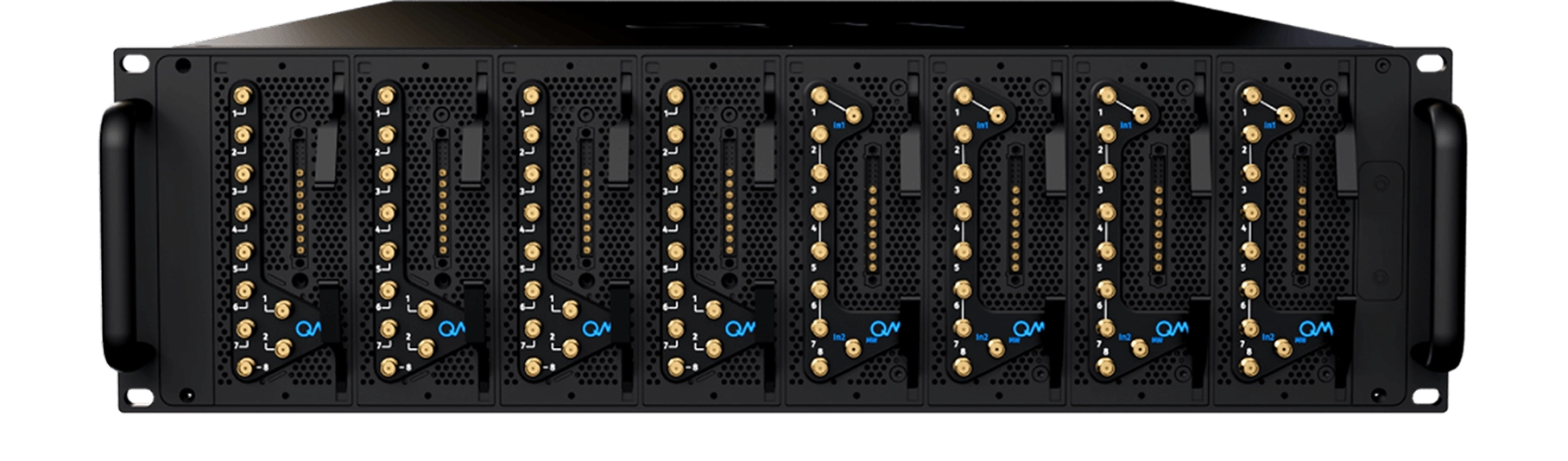
OPX1000: Modular High-Density Hybrid Control Platform
Smooth Operation at Scale | Qubit-led Analog Excellence | Easy-to-Use | HPC Ready
Overview
Trusted by the builders of the world’s most advanced quantum computers, OPX1000 is the industry’s leading hybrid control platform, delivering unmatched agility, flexibility, and ease of use while supporting all quantum processor modalities. Powered by Quantum Machines’ unique Pulse Processing Units (PPUs), OPX1000 brings classical resources as close as possible to the qubits – eliminating latencies, enabling real-time adaptive protocols, and accelerating quantum breakthroughs. With OPX1000, quantum computer builders can seamlessly scale systems, push the boundaries of quantum-classical integration, and unlock new possibilities – previously impossible.
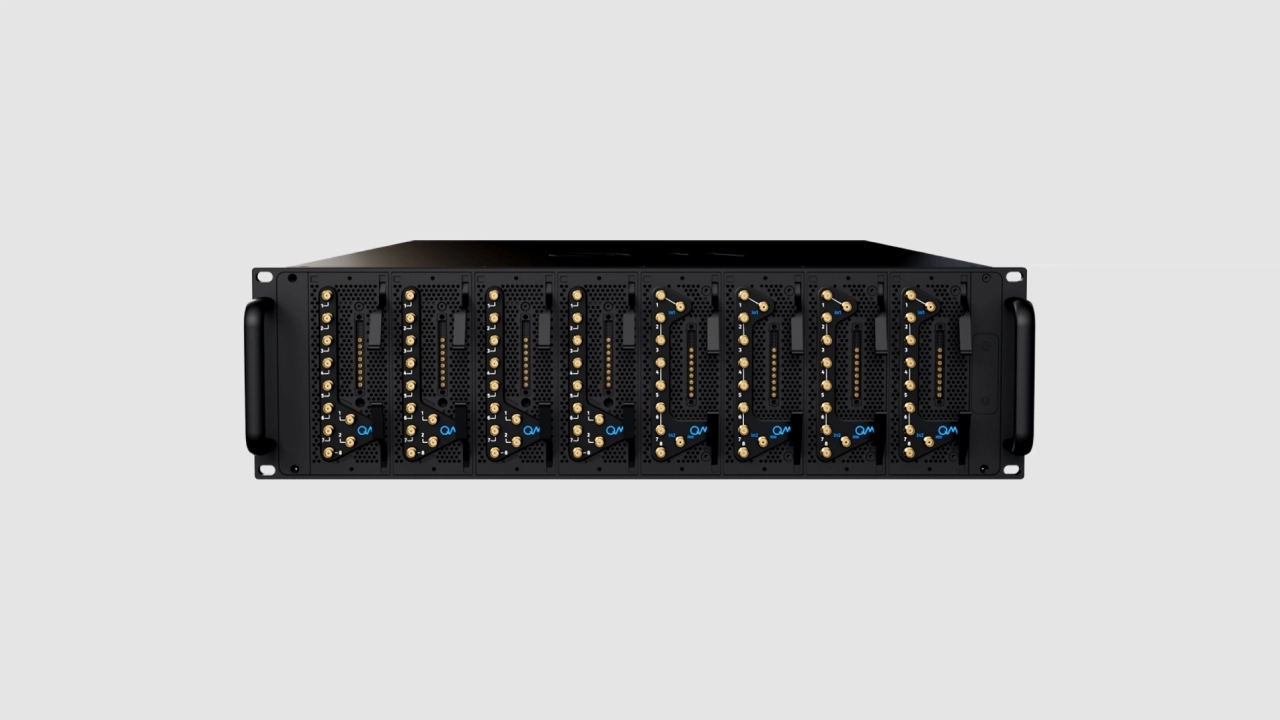
Highlights
Engineered for precision. Built for scale. Designed to give you complete control over every layer of your quantum system.
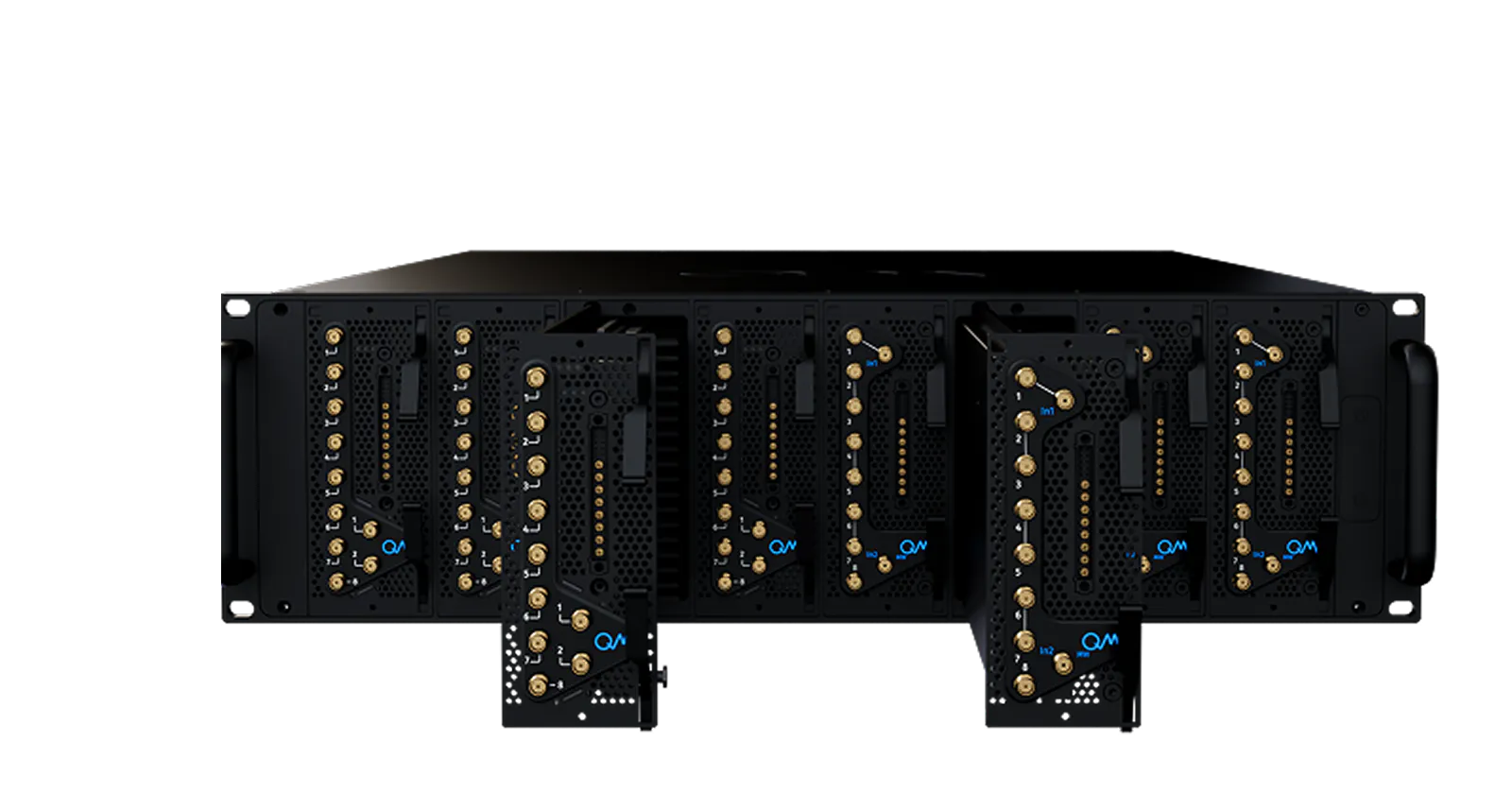
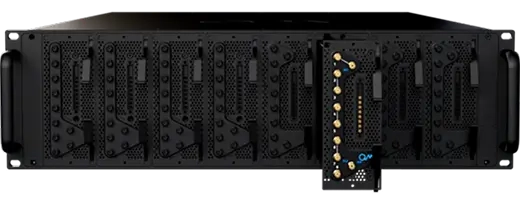
- Modular with any combination of low-frequency and microwave modules and any number of OPX1000 units – programmed together and operating as one.
- Unmatched real-time processing power and the fastest feedback.
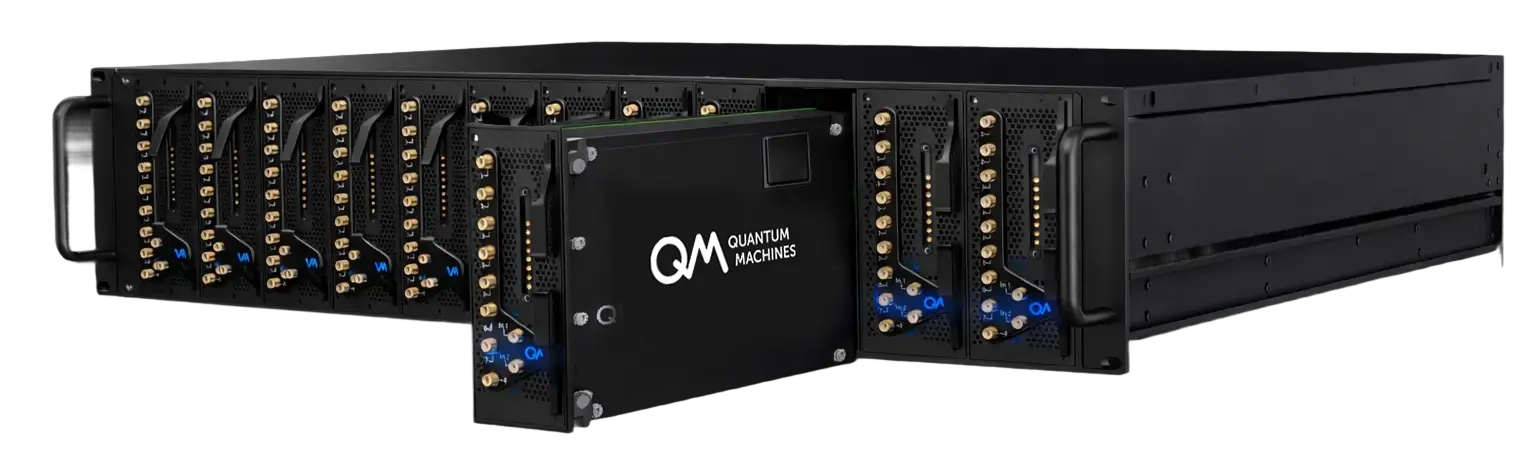
- Highest channel density in the industry – 80 analog channels / 3U.
- Cutting-edge analog front-end at scale.
- Unison quantum and classical programming in a comprehensive, easy-to-learn hybrid development platform.
Microwave Front-End Module (MW-FEM)
The MW-FEM is a breakthrough in quantum control, combining all-digital microwave signal generation with a powerful Pulse Processing Unit (PPU) for unmatched precision, flexibility, and real-time processing.
Powered by cutting-edge Direct Digital Synthesis (DDS) technology and a qubit-led analog front end, it generates high-fidelity microwave signals up to 10.5 GHz directly from digital waveforms – eliminating complex calibration processes while ensuring ultra-low phase noise and superior spectral purity.
- 8 complex (I, Q) cores Pulse Processing Unit (PPU)
- Advacned Direct Digital Synthesis technology (DDS) technology
- 8x analog output, 50 MHz – 10.5
GHz - Jitter < 150 fs @ 6 GHz (external clock)
- 2x analog input, 1.8 – 10.5 GHz
- Phase noise < -125 dBc/Hz (@ 6 GHz with 10 kHz offset)
- 8x digital markers
- Active reset < 160 ns
- SFDR > 75 dBc
- Up to 8x MW-FEMs per OPX1000 chassis
Low-Frequency Front-End Module (LF-FEM)
The LF-FEM combines a high-performance, qubit-led baseband front end with a powerful Pulse Processing Unit (PPU) for unmatched precision, flexibility, and real-time processing power. Powered by an ultra-low-noise analog front end, it delivers fast rise times and precise voltage control up to 5Vpp, with built-in distortion compensation filters and crosstalk minimization matrices ensuring clean, high-fidelity signal delivery.
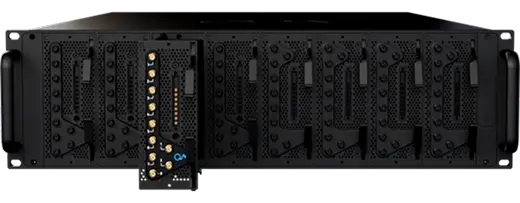
- 16 cores Pulse Processing Unit (PPU)
- 5 Vpp, low voltage noise < 30 nV/√Hz @ 100 kHz
- 8x analog output, DC – 750 MHz
- Rise time < 500 ps @ 0.8 Vpp step
- 2x analog input, DC – 750 MHz
- Built-in FIR/IIR filters and crosstalk matrices
- 8x digital markers
- Up to 8x LF-FEMs per OPX1000 chassis






QM's control electronics provide the best real-time features along with an intuitive and well-documented programming interface. At TII, we successfully controlled a 25-q chip and conducted multiplexed characterization of all qubits using QM’s OPX and Octave. What we appreciate most, however, is the QM’s unwavering support and commitment to helping us achieve our targets, even going so far as to send some of their best scientists when needed.

Alvaro Orgaz
Lead QC Control
TII, Abu Dhabi
Thanks to the super-fast on-board data processing of the OPX we could resolve the nonlinear phenomena of our superconducting quantum circuits. With conventional AWGs and electronics this would have taken an impractical long time. The OPX is extremely easy to operate and substantially changes the paradigm of data acquisition and analysis procedures in quantum labs.

Dr. Byoung-moo Ann
Researcher
KRISS
Using high-fidelity rapid readout and real-time state assignment, we were able to do an active reset and generate this noiseless plot (100,000 times averaging) in 20 seconds. Without active reset (assuming 400us between sequences) it would have taken roughly an hour to get a similar quality plot.” Dr. Eunjong Kim Painter Lab, Institute for Quantum Information and Matter (IQIM), Caltech Simultaneous control and reset at scale – 10-qubit device example X180

Dr. Eunjong Kim
Seoul National University Assistant Professor
Seoul National University Assistant Professor
QOP is our main tool when doing error correction. It provides us with very fast feedback. It enabled us to perform advanced procedures … in a very short time. We could just purchase the technology that is tailor-made for… that we want to use.

Dr. Serge Rosenblum
QuamCore Chief Scientist
Weizmann Institute of Science
Quantum Machines' OPX played a key role in our roadmap. It enabled us to get the best control electronics out there [FPGA] without having to learn how to program them. QM provides a very scalable, very easy to use and very powerful hardware, which allows us to focus on the quantum science.

Dr. Théau Peronnin
CEO & Co-Founder
Alice & Bob
Diraq is delighted to partner with Quantum Machines, and credits their OPX control system, with its real-time capabilities, as instrumental in achieving the results outlined in our research. The ease of programming sequences in QUA significantly streamlined the experimental process

Prof. Andrew Dzurak
Professor / CEO, Diraq
Diraq
Having tried several instruments in the past, I am very impressed by Quantum Machines' OPX. It finally removes the need for us to develop any skills in FPGA programming while still benefiting from advanced FPGA capabilities in our experiments.

Prof. Benjamin Huard
Professor
Ecole Normale Superieure Lyon
OPX has been a powerful enabler in our lab, helping us quickly characterize the performance of our recently discovered qubits. The hardware removes time wasted in uploading and waiting during pulse programming. QUA has substantially reduced the complexity of writing quantum protocols, allowing us to code dynamical decoupling and RB sequences in just a few lines. It remarkably saves our time in optimizing the processes and visualizing the results, allowing us to focus more on understanding the physics of our new qubits.
Prof. Dafei Jin
Professor
University of Notre Dame
We are very pleased with the QOP control solution. It’s remarkably easy to use, reliable, and flexible, supporting our advanced quantum research needs. The QOP dramatically expedites our research. Moreover, the Quantum Machines customer team has been instrumental in addressing all our needs to help us to maximize the full potential of the solution. We already use two systems and strongly recommend it.

Prof. Eli Levenson-Falk
Professor
University of Southern California
The OPX’s fast feedback and unique real-time processing capabilities were critical for our experiment. Combining these with the OPX’s intuitive programming and QM’s state-of-the-art cryogenic electronics allowed us to do something that we have dreamt of doing for years.

Prof. Ferdinand Kuemmeth
Professor
Niels Bohr Institute, U. of Copenhagen
OPX played a crucial role in our advanced quantum experiments. This platform is the most flexible and user-friendly system in our lab. It saved us a significant amount of time, enabling us to concentrate on quantum science and make progress much faster compared to writing our own code. Furthermore, the Quantum Machines customer success team has been extremely helpful in addressing our needs and maximizing the solution's full potential.

Prof. Johannes Fink
Professor
IST Austria
My group is completely satisfied with the multiple OPX systems we’ve purchased. Qubit bring-up is fast and easy, as is optimization of high-fidelity microwave and z-pulse gates. The technical support team at Quantum Machines is outstanding.

Prof. Robert F. McDermott
Professor
University of Wisconsin-Madison, USA
We were extremely surprised by the flexibility that OPX offers and by how much easier it makes our experiments. Moreover, OPX provides extreme speed-ups. No more frustration due to long waiting times for unwanted results!

Prof. Tse-Ming Chen
Director, Center for Quantum Frontiers of Research & Technology (QFort)
National Cheng Kung University, Taiwan
Using the OPX has been simplifying our work in many respects due to the intuitive implementation of sequences within QUA. In addition, the support by QM helped us debugging possible issues with swift responses and an easy and informal way of getting in touch over Discord.

Prof. Yiwen Chu
Professor
ETH Zurich
The OPX+ and Octave are a dramatic improvement over the traditional homemade AWG plus DAQ systems. These QM instruments offer ease of use across several levels of abstraction: from implementing and optimizing individual pulses to realizing complex experiments with real time processing and feedback. Coding is user-friendly, which makes transmitting the know-how between group members much more straightforward.
Prof. Sorin Paraoanu
Associate Professor
Aalto University
An integrated control and measurement system for driving, manipulating, and reading qubits, designed according to Quantum Machines’ Hybrid Control approach
Unmatched Real-Time Processing
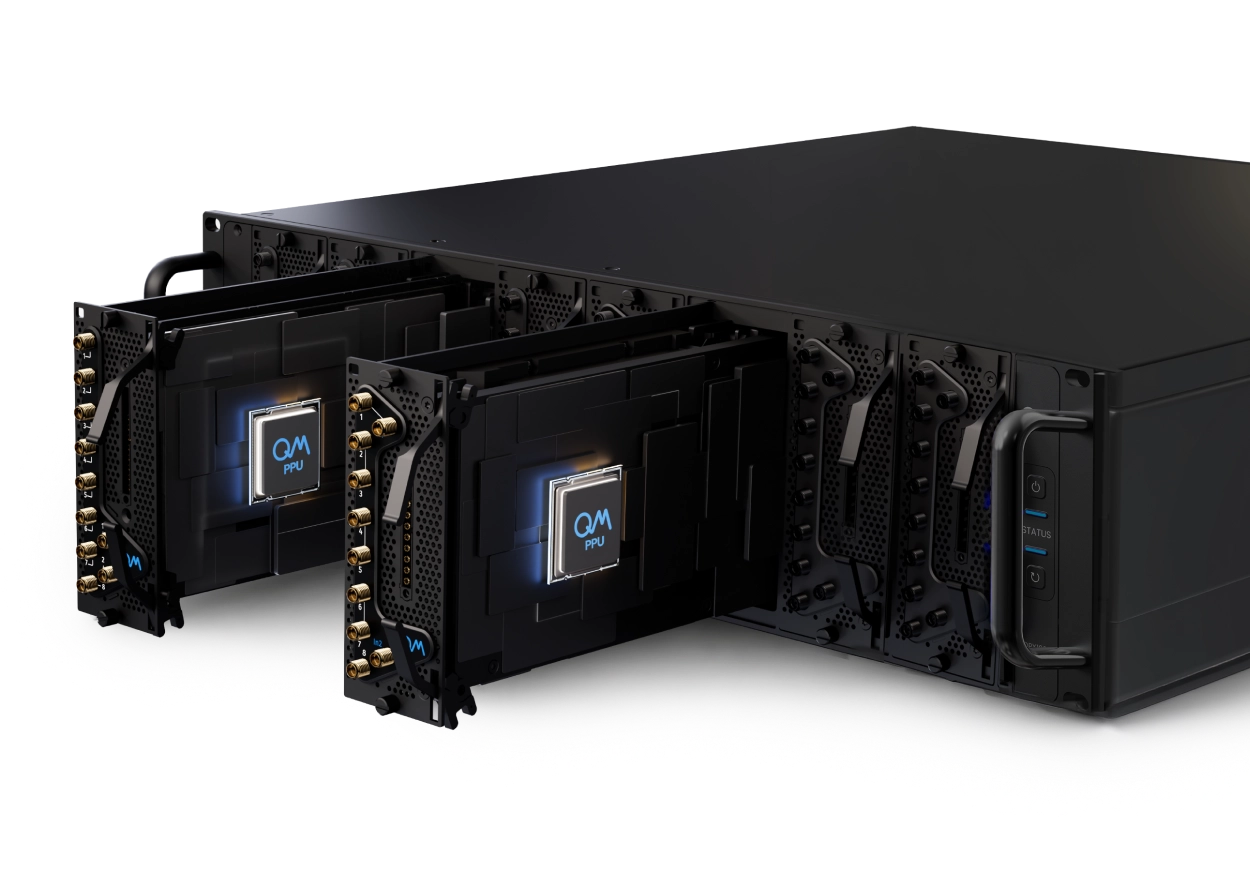
With up to 8 high-performance PPU (one per front-end module), the OPX1000 hybrid controller has the highest level of real-time classical processing resources available in any quantum controller. This enables robust computation during quantum sequences, which are critical for advanced dynamic algorithms such as VQAs, quantum error correction, fast calibration, and more.
Smooth Scalability
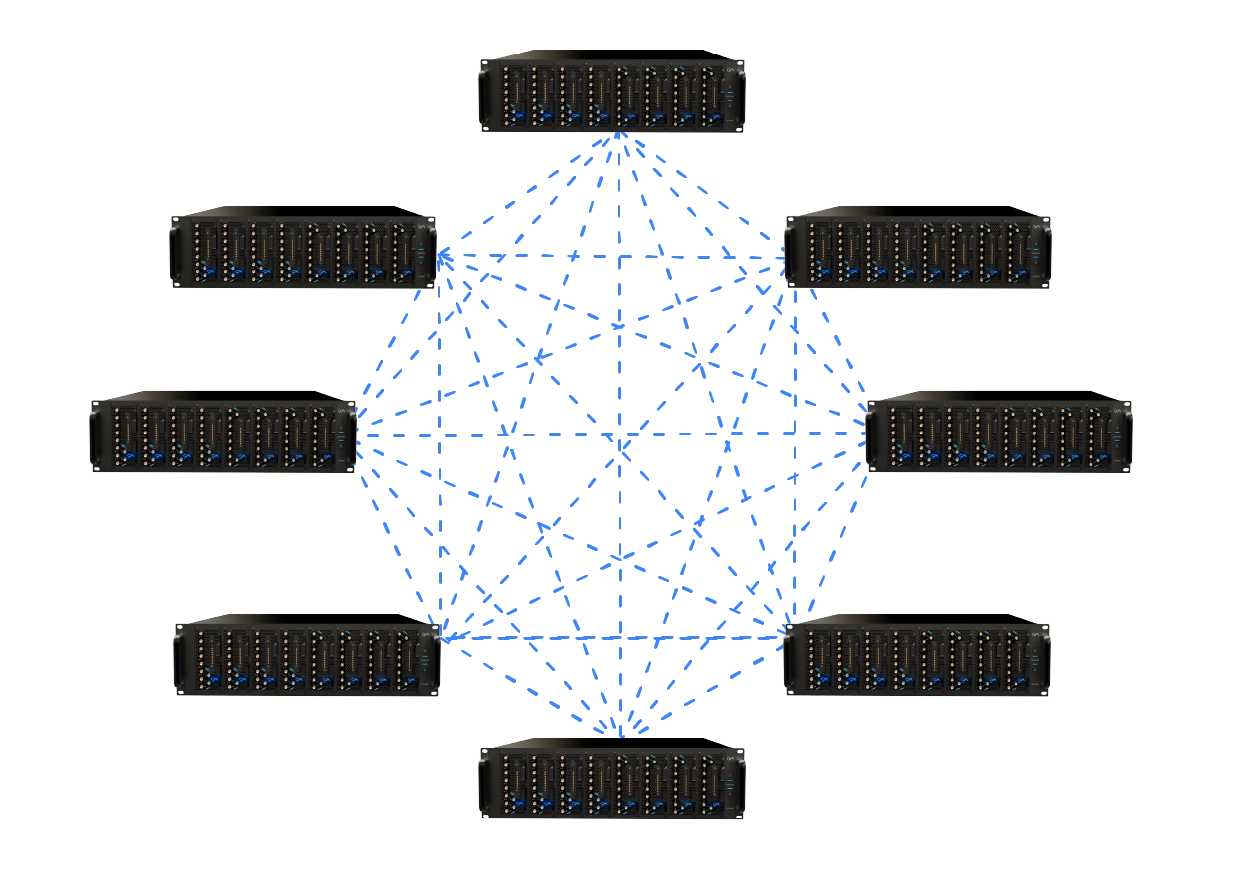
1,000 qubits at beyond! Push the limits of scale with QSync synchronization technology and any-to-any data sharing, ensuring seamless expansion as your quantum processor grows. Multiple OPX1000 units connect effortlessly, sharing measurements and computed results far beyond simple Boolean decisions to maintain precision at any scale. All connected OPX1000 units are programmed and operate as a single unified system, eliminating manual coordination and ensuring smooth, automatic synchronization. Just scale up – no complex software redesign.
Hybrid Programming
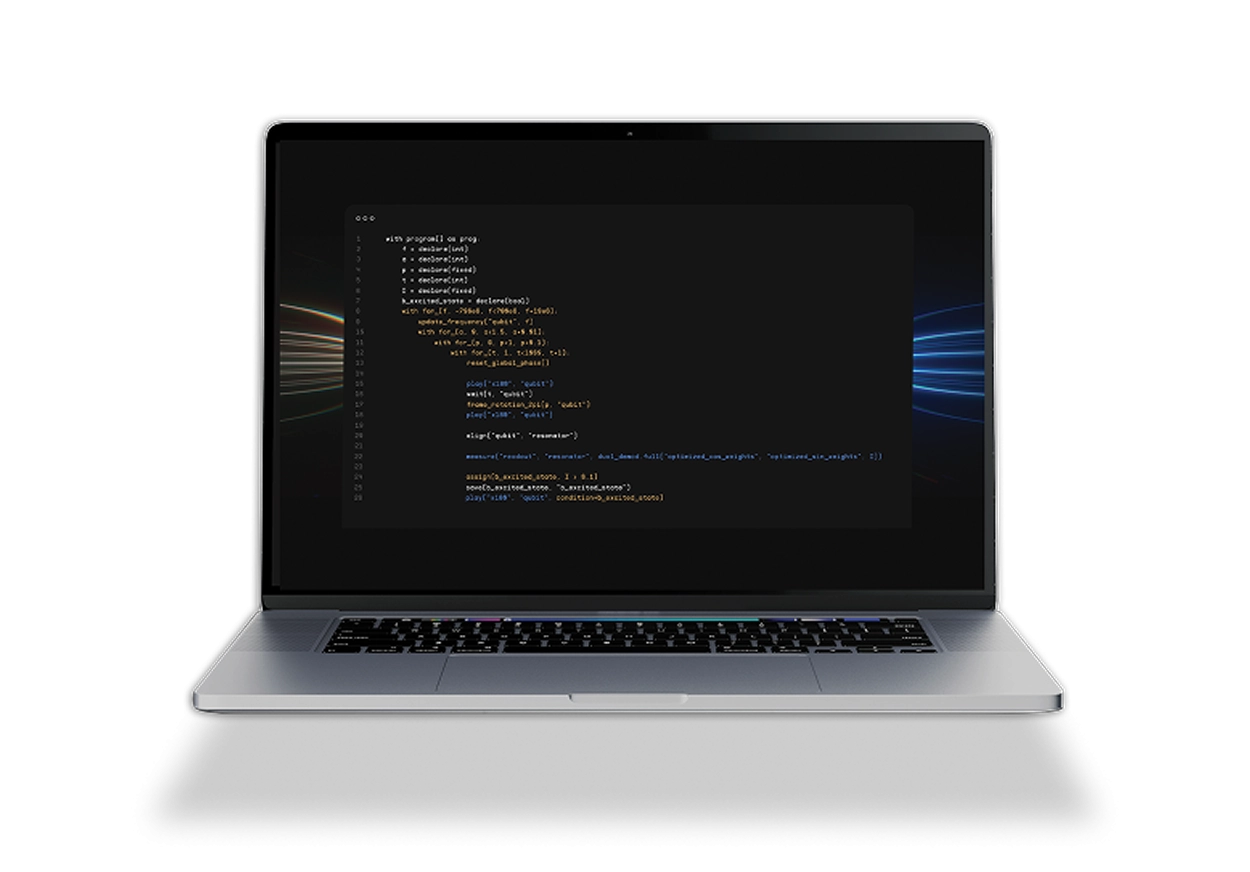
OPX1000 is programmed from a hybrid development platform, unifying quantum control, classical computation, and real-time adaptability. At its core, QUA – an open-source, pulse-level programming language – enables effortless quantum-classical programming with a pseudocode-like syntax, supporting real-time decision-making, adaptive feedback, and dynamic control flow. Unlike traditional approaches, control and readout pulses in QUA are generated and adjusted in real time, allowing for on-the-fly waveform manipulation and dynamic protocol execution. A comprehensive library of pre-built control applications further accelerates development and deployment. Seamlessly integrated within this ecosystem, QUAlibrate automates multi-qubit calibration and continuous optimization, ensuring peak performance across quantum processors.

Achieve Milestones Faster & Unlock the New Possible
Accelerate development and execute the most complex experiments with Hybrid Control – bringing classical resources as close as possible to the qubits, eliminating latency, reducing runtime, and optimizing performance.

Achieve Record Fidelities at Scale
Qubit-led analog front-end and fast compensation for parameter drifts ensure continuous top fidelities.

HPC-QC Deep Integration
Fastest gateway to classical GPU/CPU accelerators via NVIDIA DGX Quantum.

Smoothly Scale
Effortlessly add modules and units with exceptional phase synchronization, any-to-any data sharing (complete measurements and computed values, not just Booleans), and without software changes as the QPU scales.

High Uptime
Data center reliability (redundancy and hot-swappable critical parts), and fast calibration retuning.
Your experiments reside in a phase space. OPX1000: The only controller covering this space in real-time.
Pulse Processing Unit (PPU)
- 8 complex (I, Q) cores Pulse Processing Unit (PPU)
- 8x analog output,
50 MHz – 10.5 GHz - 2x analog input, 1.8 – 10.5 GHz
- 8x digital markers
- Up to 8x MW-FEMs per OPX1000 chassis
Analog Outputs
- Up to 64 channels
- 2 GSa/s, 16 bits
- DDS microwave signal generation
Analog Inputs
- Up to 16 channels
- 2 GSa/s
- 12 bits samples
Pulse Processing Unit (PPU)
- 8 complex (I, Q) cores Pulse Processing Unit (PPU)
- 8x analog output, 50 MHz – 10.5 GHz
- 2x analog input, 1.8 – 10.5 GHz
- 8x digital markers
- Up to 8x MW-FEMs per OPX1000 chassis




Real-Time Processing (Turing-Complete):
- Arithmetic and trigonometric functions
- Vector operations
- Casting of variable types
- Bayesian and error estimations
- Syndrome tracking and more
Comprehensive Control Flow
- If/else
- For loops
- While loops
- Switch case, pulse, sequence timing control
Fully Parametric Waveform Generation
- Loop over parameters in real-time: durations, frequencies, phase, amplitude, bandwidth, real-time chirp, etc.
- Built-in compensations for pulse imperfection and crosstalk
- Manipulate waveforms without memory loading
Waveform Acquisition and Manipulation
- High-resolution analog-to-digital conversion
- User-defined flexible integration and demodulation (weighted, accumulated, sliced, etc.)
- Time tagging and TTL counting (< 50 ps jitter)




OPX1000 New Microwave Module: Processor-Based Quantum Controller Revolutionizes Quantum Computing
Read more February 2024 | 5 min readWelcome OPX1000 – The Most Advanced Quantum Control Solution!
Read more August 2023 | 4 min readQuantum Networking at the Speed of Quantum Computation: Kilohertz Entanglement in a Heterogeneous Quantum System
Read more October 2026Real-Time Adaptive Filtering and the Boxcar Limit in Superconducting Qubit Readout
Read more September 2026