

Quantum Transducers
Synchronize microwave, RF, optical, and baseband control with real-time feedback and automated workflows. Quantum Machines helps teams characterize, stabilize, and optimize transduction experiments, from early device research to scalable quantum interfaces, including electro-optics, optomechanics, and spin-photon experiments.




Research
Quantum transducers, including electro-optical, optomechanical, electromechanical, and spin-photon devices, enable interactions between different quantum systems by connecting microwave, optical, mechanical, acoustic, and spin-based degrees of freedom. They are essential for hybrid quantum computing, communication, networking, and sensing, where preserving quantum-state integrity across domains requires precise synchronization, low-noise signal generation, and reliable real-time control.
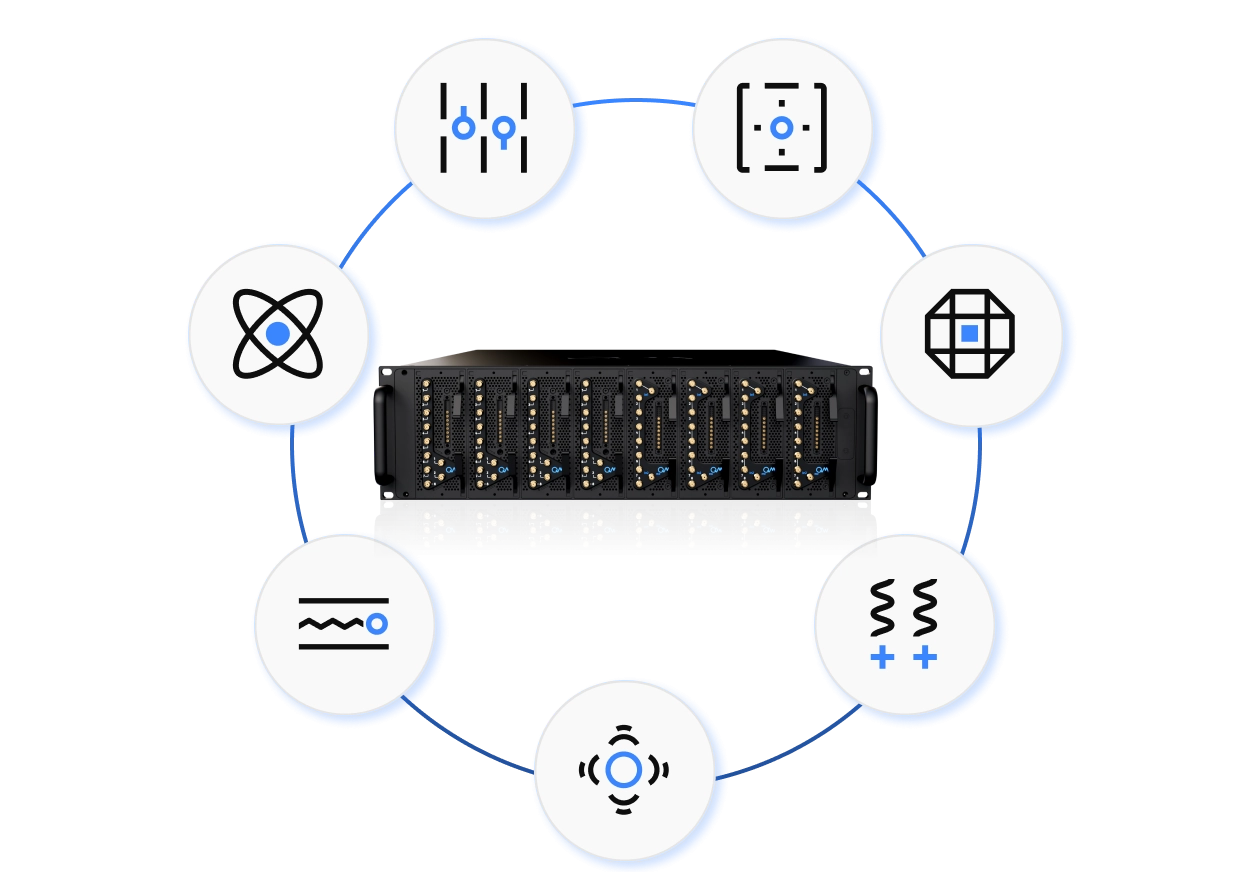
Quantum Machines’ Orchestration Platform supports transducer experiments with unified control for microwave and optically addressable systems, allowing researchers to coordinate pulses, readout, timing, and feedback from a single platform. Powered by OPX hybrid controllers and the Pulse Processing Unit, QM enables resonance tracking, stabilization, heralded protocols, and adaptive control flows that respond immediately to stochastic events. Together with QM’s software ecosystem, including QUA, researchers can quickly develop, automate, and optimize complex transduction protocols while focusing on device performance and quantum interface design.

All Qubit Modalities
Unified control solution for numerous qubit types, microwave and optically addressable.

Intuitive Programming
Experienced experimental physicists with a deep understanding of use cases will help you bring up your system, train your team, and solve challenges.

Best Analog Spec
Exceptionally low jitter, noise and phase noise, DDS microwave signals generation, up to 10.5 GHz, 2 GSa/s, 16-bit output and 12-bit input samples, and much more.

Make Quantum Breakthroughs
Run complex algorithms and transduction protocols that were previously impossible to run.
Unified Control Across Hybrid Quantum Interfaces
Quantum transducers, including electro-optical, optomechanical, electromechanical, and spin-photon devices, enable interactions between different quantum systems for computing, communication, networking, and sensing. QM’s Orchestration Platform provides unified control for microwave and optically addressable systems, helping researchers coordinate photons, phonons, spins, resonators, and qubits from one synchronized platform. By combining timing, waveform generation, readout, and control logic in a single workflow, QM simplifies complex transduction experiments so teams can focus on improving conversion efficiency, preserving quantum-state integrity, and building reliable hybrid quantum interfaces.
Real-Time Stabilization and Heralded Transduction
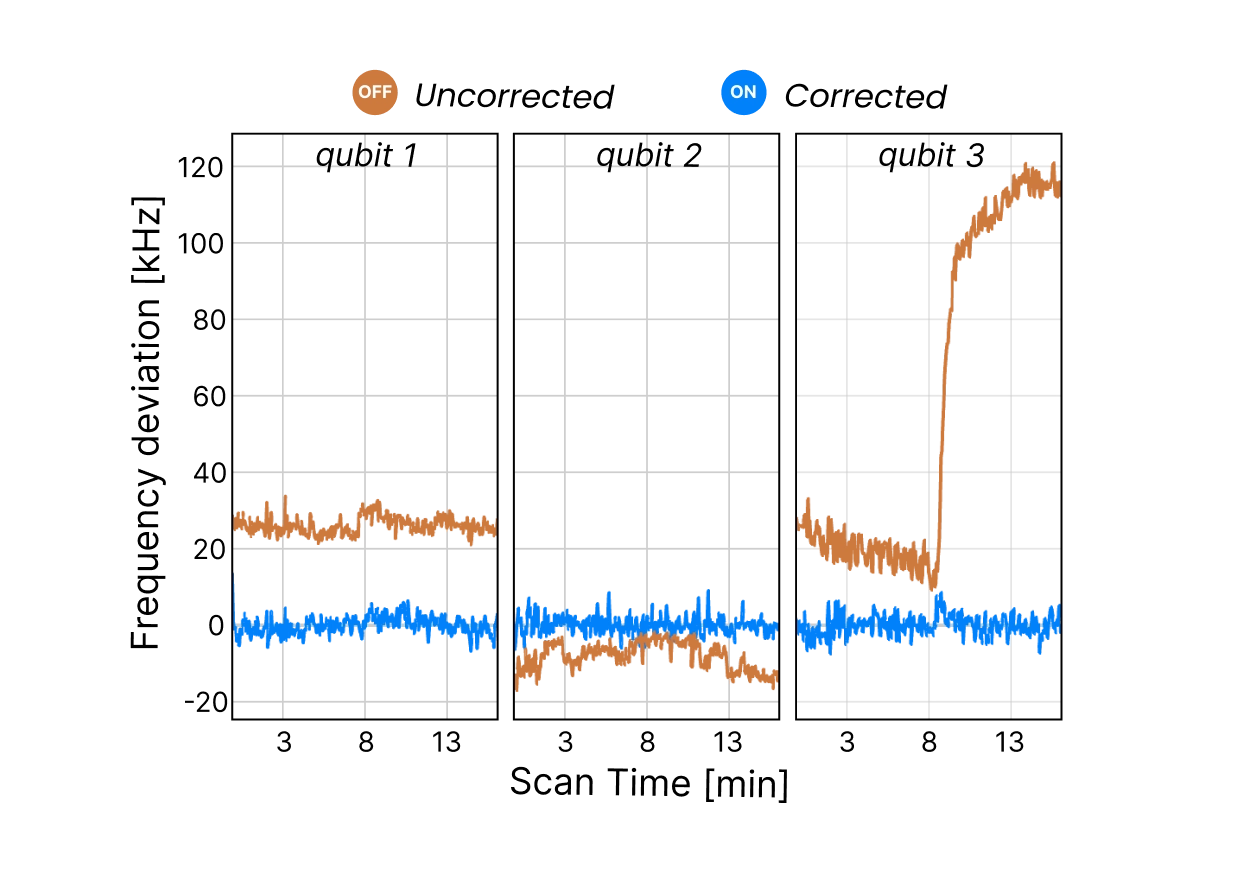
Transduction experiments are sensitive to drift, loss, changing resonance conditions, and stochastic events. Powered by QM’s Pulse Processing Unit, OPX hybrid controllers process data, branch, update frequencies, and apply feedback while the experiment is running. This enables resonance tracking, resonator stabilization, dynamic corrections, and high-fidelity quantum information transfer. For heralded protocols, such as detecting single-photon down-conversion before gating a microwave channel, QM’s Hybrid Control removes the need for heavy post-processing by reacting immediately: continuing or breaking loops, triggering pulses, coupling signals to qubits, and resetting the protocol in real time.
Flexible Programming and High-Performance Signal Control
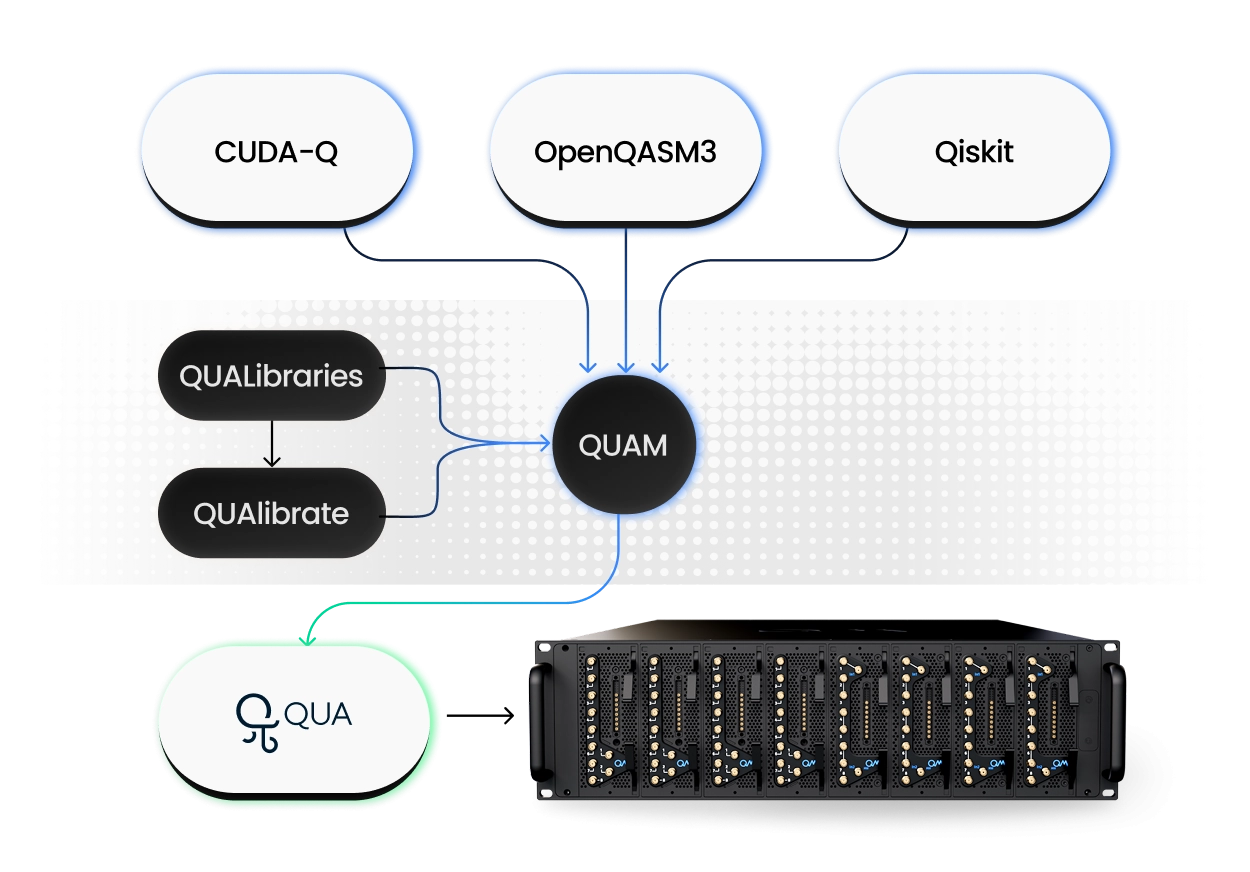
Transducer research requires rapid iteration across spectroscopy, conversion measurements, feedback routines, and conditional experiments. QM’s software ecosystem, centered around the Python-embedded QUA language, gives researchers intuitive pulse-level programming with real-time processing and control flow. Then, higher level SW components like QuAM and QUAlibrate make custom abstraction and calibrations a streamlined process and allow to write from any gate-level language and auto-compile into runnable sequences. Combined with high-performance analog capabilities, low jitter, low noise, phase-coherent microwave generation, time tagging, and synchronized readout, QM helps teams build and optimize advanced transduction protocols faster, accelerating the path to practical quantum interfaces.


The Quantum Machines OPX control system has been an enabling technology for our research. It provides unparalleled flexibility and ease of use for experiments requiring real-time quantum feedforward control. With the integrated high-resolution time tagging, this platform is a no-brainer for advanced quantum networking experiments.

Prof. Andrei Faraon
Optical and Quantum Engineer
Using the OPX has been simplifying our work in many respects due to the intuitive implementation of sequences within QUA. In addition, the support by QM helped us debugging possible issues with swift responses and an easy and informal way of getting in touch over Discord.

Prof. Yiwen Chu
Professor

Quantum Machines joins Roadrunner Quantum Lab in New Mexico
Read more October 2026 | 5 min readBuilding the Brain Around the Qubit: How Quantum Machines and AMD Are Scaling Quantum Computing
Read more September 2026 | 6 min readGate Dispersive Charge Detection in Ge/SiGe Quantum Dots
Read more October 2026Real-Time Adaptive Filtering and the Boxcar Limit in Superconducting Qubit Readout
Read more September 2026FAQs
How does the platform stabilize transduction experiments in real time?
Transduction is sensitive to drift, loss, and shifting resonance conditions, so the OPX uses the PPU to process data, branch, update frequencies, and apply feedback while the experiment runs. The PPU processes data and executes control sequences on the fly, providing the responsiveness needed to handle dynamic quantum environments and ensure high fidelity in quantum information transfer. A common pattern is a real-time macro that tracks cavity resonance and stabilizes the resonator continuously.
How does QM handle heralded transduction protocols?
Many transduction sequences are stochastic and only succeed when a heralding event occurs, and the OPX reacts to that event immediately rather than in post-processing. Detecting a heralding event such as the down-conversion of a single optical photon to gate a microwave channel eliminates background noise and increases transduction fidelity. The controller can continue or break loops, trigger pulses, couple signals to qubits, or reset the protocol the moment the herald is detected.
What signal quality does transduction require, and what does QM provide?
Preserving quantum-state integrity across domains demands low-noise, phase-coherent signal generation and tight timing. QM delivers high-performance analog with low jitter, low noise, phase-coherent microwave generation (via Direct Digital Synthesis), native time tagging, and synchronized readout across microwave, RF, optical, and baseband channels. Combining these in one deterministic timing engine is what keeps conversion measurements clean across long sequences.
How do researchers program transduction experiments on the platform?
Experiments are written in the Python-embedded QUA language, which gives pulse-level control with real-time processing. Its advanced control flow, for example for and while loops, if/else conditions, and switch cases, can be cascaded as needed, allowing quick iteration and optimization with no heavy post-processing. Higher-level components like QuAM and QUAlibrate then streamline custom abstractions and calibrations, including auto-compilation from gate-level descriptions.
