
QM logo
  • Products
    • Control Hardware
      • OPX1000
        Modular High-Density Quantum Control Platform
      • OPX+
        Ultra-Fast Quantum Controller
      • DGX Quantum
        Boost Quantum Control
with GPU/CPU Acceleration
      • QDAC-II Compact
        High-Density DAC
      • QDAC-II
        Ultra-Low-Noise 24-Channel DAC
    • Control Hardware Second Column
      • QSwitch
        Software-Controlled Breakout Box
      • Octave
        Up/Down Conversion Up to 18 GHz
      • QBox
        Highly Reliable 24-Channel Breakout Box
      • Cryogenic Electronics
    • Control Software
      • QUA
        Intuitive pulse-level programming
      • QUAlibrate
        Automated Calibration Software
  • Solutions
    • Use Cases
      • Advancing Quantum Research
      • Quantum Computing at Scale
      • Quantum for HPC
      • Quantum Control for Transducers
      • Quantum Sensing
      • Quantum Networks
    • Qubit Types
      • Superconducting
      • Semiconductor Spins
      • Optically Addressable
      • Neutral Atoms
    • OPX1000 Microwave Module
      The Microwave Frontend Module for OPX1000 sets a new benchmark for controllers.
  • Technology
    • Core Technologies
      • PPU
        Real-Time Quantum Control at the Pulse Level
      • Control Benchmarks
        Pulse-level benchmarking system
      • Ultra-Fast Feedback
        OPX feedback and feed-forward performance
      • Direct Digital Synthesis
        Microwave pulses directly from digital data
    • DDS for Large-Scale Quantum Computers
      How Direct Digital Synthesis (DDS) empowers the OPX1000 for quantum scalability & peak microwave control
  • Partner Program
  • Resource Center
    • left
      • Scientific Publications
      • Blog
      • Brochures
      • Podcasts
      • Videos
      • Seminars
      • Events
      • FAQ
    • Finally: A Practical way to Benchmark Quantum Controllers
      A framework for evaluating quantum control solutions
  • Company
    • left
      • About Us
      • Careers
      • Press Releases
      • In the Media
      • Visit IQCC
      • Newsletter
    • Quantum Machines to Establish Flagship Hub at the Illinois Quantum and Microelectronics Park
Contact Us
All Posts
Fabio Ansaloni
Fabio Ansaloni
  • Jump to:

All Posts

Listening to the Qubit’s Heartbeat: real-time tracking of T₁

February 18 | 2026

Who said T₁ is static? 

If you work with quantum hardware or superconducting qubit platforms, you’ve probably seen T₁, the qubit relaxation time, quoted as a single number in a calibration report, maybe measured once every few hours or days. In superconducting quantum processors, T₁ is the characteristic time over which a qubit loses energy and relaxes from its excited state back to its ground state. But how do we know that number does not change during an experiment? Would we even notice if it fluctuated on sub-second timescales?

Until recently, measurements of a superconducting qubit’s relaxation time T₁ were effectively long-exposure photographs, averaging fast dynamics into a single reassuring value. Each estimate took seconds or minutes, producing a stable number but offering little insight into how T₁ behaves moment to moment during quantum experiments. A new study from the Niels Bohr Institute (NBI), with collaborators from Leiden, Chalmers, and NTNU, shows that this picture is incomplete. Qubit T₁ fluctuations can occur on much shorter timescales, directly relevant for quantum algorithms, quantum error correction, and scalable quantum computing.

Using real-time adaptive Bayesian estimation on Quantum Machines’ OPX1000 hybrid controller, Dr. Fabrizio Berritta (MIT) and co-authors have been able to track qubit T₁ continuously with millisecond resolution on a superconducting quantum processing unit (QPU), uncovering decoherence dynamics that were previously invisible to conventional measurements and characterization methods.

The team showed that the qubit T₁ switches by an order of magnitude over the timescale of milliseconds instead of minutes or hours.

“We actually found out that the rate of energy loss can change by a factor of 10 in fractions of a second, so much faster than before, and this has completely changed the way we think about calibrations in superconducting devices,” says Dr. Berritta.

In the video below, enjoy a sneak peek into the SQuID Lab, with commentary directly from the authors.

When T₁ won’t sit still?

From a practical point of view, qubit T₁ is one of the most important numbers in a quantum computer: it limits how long quantum information can be stored, how many operations can be applied before errors accumulate, and how effective any quantum error-correction protocol can operate. In short, poor T₁ undermines the development of fault-tolerant quantum computers. A longer T₁, meanwhile, means higher gate fidelities and more room to run algorithms before decoherence takes over. For this reason, T₁ is often treated as a key performance metric during quantum device characterization and calibration. But this view hides an important subtlety: T₁ is not an intrinsic constant of the qubit. It reflects how the qubit interacts with its surrounding environment, and that environment can change, sometimes on very short timescales.

Imagine stepping into a shower while someone rapidly turns the tap from freezing cold to burning hot multiple times a second. Your slow thermometer might report a perfectly warm average temperature, but that will be far from the experience you will get alternating between extremes. In solid-state quantum devices, microscopic defects in materials near the qubit can exchange energy with it. Some of these defects can be modeled as two-level systems (TLS) that randomly switch between configurations. Based on their switching configuration and other noise sources, the qubit’s relaxation rate can suddenly increase or decrease, even though nothing obvious in the experiment has changed. If these fluctuations happen faster than they are measured, they remain invisible, folded into a single averaged T₁ relaxation time that masks the true dynamics of the quantum system.


Real-time adaptive Bayesian estimation

The central innovation of this work is the ability to track a qubit’s relaxation dynamics using real-time adaptive Bayesian estimation, implemented directly on the Pulse Processor Unit (PPU) of Quantum Machines’ OPX1000 controller.

“Traditional T1 measurements are done by uploading instructions, running them, offloading data, and analyzing it. The new approach involves uploading instructions to the control hardware, which learns about the quantum processor in real-time. This allows for rapid, real-time interrogation of the quantum processor,” says Prof. Morten Kjaergaard, Associate Professor at Niels Bohr Institute, University of Copenhagen. So instead of relying on fixed non-adaptive measurement sequences, analyzed offline on a host computer, the experiment adapts continuously on the fly, based on incoming single-shot outcomes – a capability enabled by low-latency quantum control hardware.
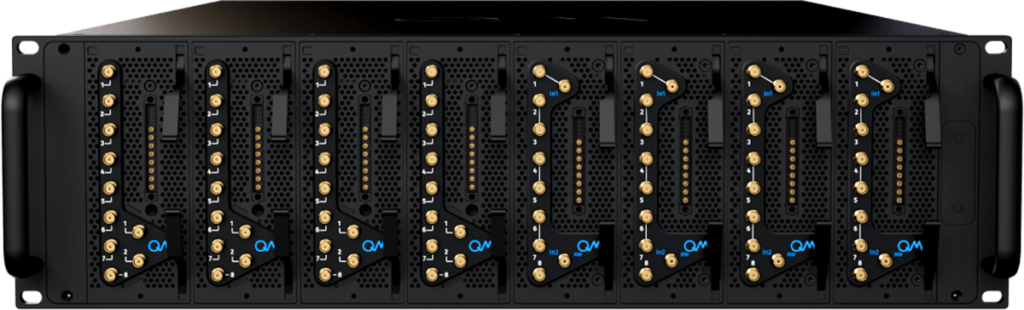


OPX1000 hybrid controller

These results were enabled by real-time quantum control on Quantum Machines’ OPX1000

At a high level, the adaptive loop works as follows:

  • The qubit is prepared in its excited state and measured after a variable waiting time. This waiting time is not predetermined offline, but rather dynamically chosen.
  • After each single-shot readout, the controller updates its estimate of the relaxation time T₁ using a Bayesian inference model.
  • Based on the updated estimate, the next waiting time is chosen adaptively as a fixed fraction of the current best estimate of T₁, ensuring that each subsequent measurement maximizes information gain.

What sets this approach apart is where this logic runs. The entire loop, including measurement, inference, and decision-making, executes directly on the OPX1000 PPU, rather than on an external CPU. Each Bayesian update takes only 2.2 microseconds, enabling closed-loop adaptation at timescales that are fundamentally inaccessible to architectures based on AWGs or host-side processing. This tight integration of quantum control and classical processing inside the OPX1000 is what makes this real-time tracking possible, illustrating a shift in quantum control architectures towards embedding intelligence directly into the hardware layer.

Measuring faster to unveil hidden dynamics

Using this adaptive, low-latency approach, Dr. Berritta and colleagues estimate T₁ in as little as 7–20 milliseconds, using only 30–100 single-shot measurements. This marks a measurement of T₁ more than two orders of magnitude faster than conventional methods, revealing dynamics usually hidden away by slow measurements.

At this speed, dynamics that are invisible to slow measurements emerge clearly. The extracted T₁ values show abrupt, telegraphic-like switching between discrete levels on sub-100-millisecond timescales, behavior that is normally averaged away. Analysis of the T₁ time series using power spectral density and Allan deviation reveals multiple Lorentzian components, pointing to distinct stochastic processes contributing to relaxation fluctuations. The team has observed switching rates of up to approximately 10 Hz, four orders of magnitude faster than previously reported. Long-duration measurements further show that these fast fluctuations coexist with slower drifts over minutes to hours, consistent with a heterogeneous TLS-dominated noise environment.

These observations demonstrate that qubit relaxation is not well described by a single, time-independent parameter measured over minutes or hours. Instead, it is governed by a hierarchy of stochastic processes spanning several orders of magnitude in timescale, meaning that the environment in which the qubits sit is complex, and the timescales of its impact span orders of magnitude.

Why this matters for scalable quantum computing?

In large-scale quantum processors, overall performance is often limited by the worst-performing qubits. If relaxation times fluctuate on sub-second timescales, static calibration is no longer sufficient. Coherence is not a fixed resource, but a moving target.

This work points toward a different paradigm, where qubit properties are monitored continuously and calibration becomes an adaptive, real-time process embedded directly into control workflows. In such a system, controllers respond to coherence fluctuations as they occur, adjusting gate parameters, scheduling operations, or rerouting workloads without interrupting the experiment.

Beyond the specific results, this study highlights the importance of quantum control co-design. When estimation algorithms are developed alongside low-latency control hardware, entirely new measurement regimes become accessible. By collapsing the loop between measurement, inference, and action to microsecond timescales, the OPX1000 enabled the observation of dynamics that were always present but previously invisible.

The next time a single T₁ value is quoted, it is worth remembering that behind it lies a rapidly fluctuating heartbeat, and that real-time quantum control now allows us to listen to it.

Fabio Ansaloni

Fabio Ansaloni

Fabio Ansaloni is a Research Scientist at Quantum Machines, working on quantum hardware and control. He has a background in condensed matter and solid-state physics, with experience spanning both experimental and theoretical approaches. Fabio studied at Radboud University Nijmegen and later worked in Copenhagen, focusing on the transport properties of materials and their role in advancing quantum and solid-state technologies. His work bridges physical insight and practical implementation, with a strong interest in building experimental systems that connect theory to real-world applications.

Never miss a Quark!
Sign up for the Newsletter

QM logo

Privacy Policy Terms of Use

Request a Demo


Let’s Keep in Touch

Subscribe to Quantum Machines news,
product updates, events, and more

  • Product
    • QUANTUM CONTROL SYSTEMS
      • OPX1000
      • OPX+
      • Octave
      • QDAC-II Compact
      • QDAC-II
      • QSwitch
      • QBox
      • NVIDIA DGX Quantum
    • CRYOGENIC CONTROL SYSTEMS
      • QCage
      • QBoard
      • QFilter
  • Solutions
    • USE CASES
      • Advanding Quantum Research
      • Quantum Computing at Scale
      • Quantum for HPC
      • Quantum Control for Transducers
      • Quantum Sensing
      • Quantum Networks
    • QUBIT TYPES
      • Superconducting
      • Optically Addressable
      • Semiconductor Spins
      • Neutral Atoms
  • Technology
    • Pulse Processing Unit (PPU)
    • QUA
    • Control Benchmarks
    • Ultra-Fast Feedback
  • Company
    • About Us
    • Careers
    • Press Releases
    • News
    • Contact Us
  • Legal
    • AML Policy
    • Code of Conduct
  • Resource Center
    • Scientific Publications
    • Blog
    • Brochures
    • Podcasts
    • Videos
    • Seminars
    • Events
    • FAQ

Terms Privacy

© Q.M Technologies Ltd. (Quantum Machines) — All Rights Reserved

Take the Next Step

Have a specific experiment in mind and wondering about the best quantum control and electronics setup?

Talk to an Expert

Want to see what our quantum control and cryogenic electronics solutions can do for your qubits?

Request a Demo