QUA
The Pulse-Level Language for Hybrid
Programming
Easily and quickly develop quantum-classical workflows
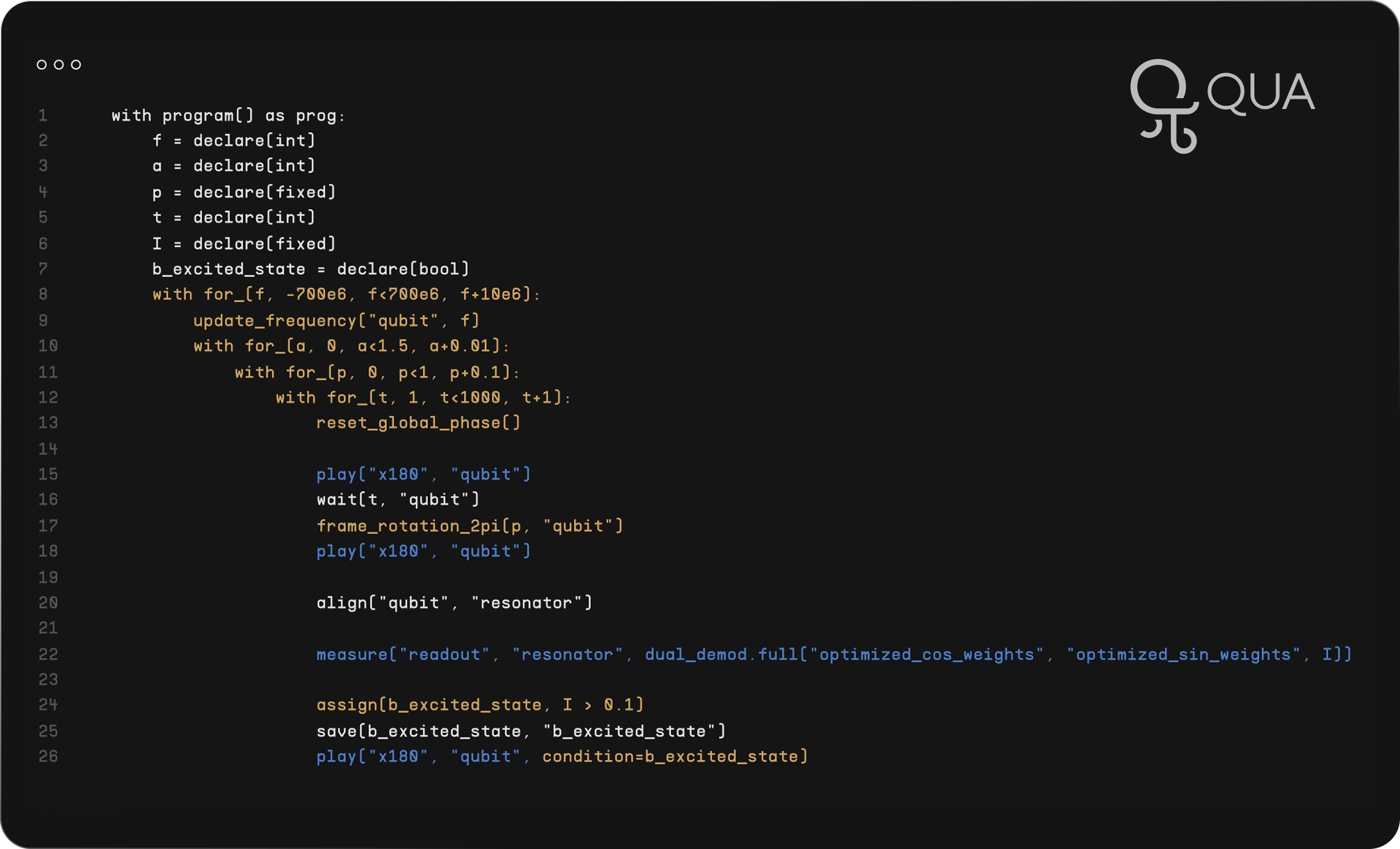
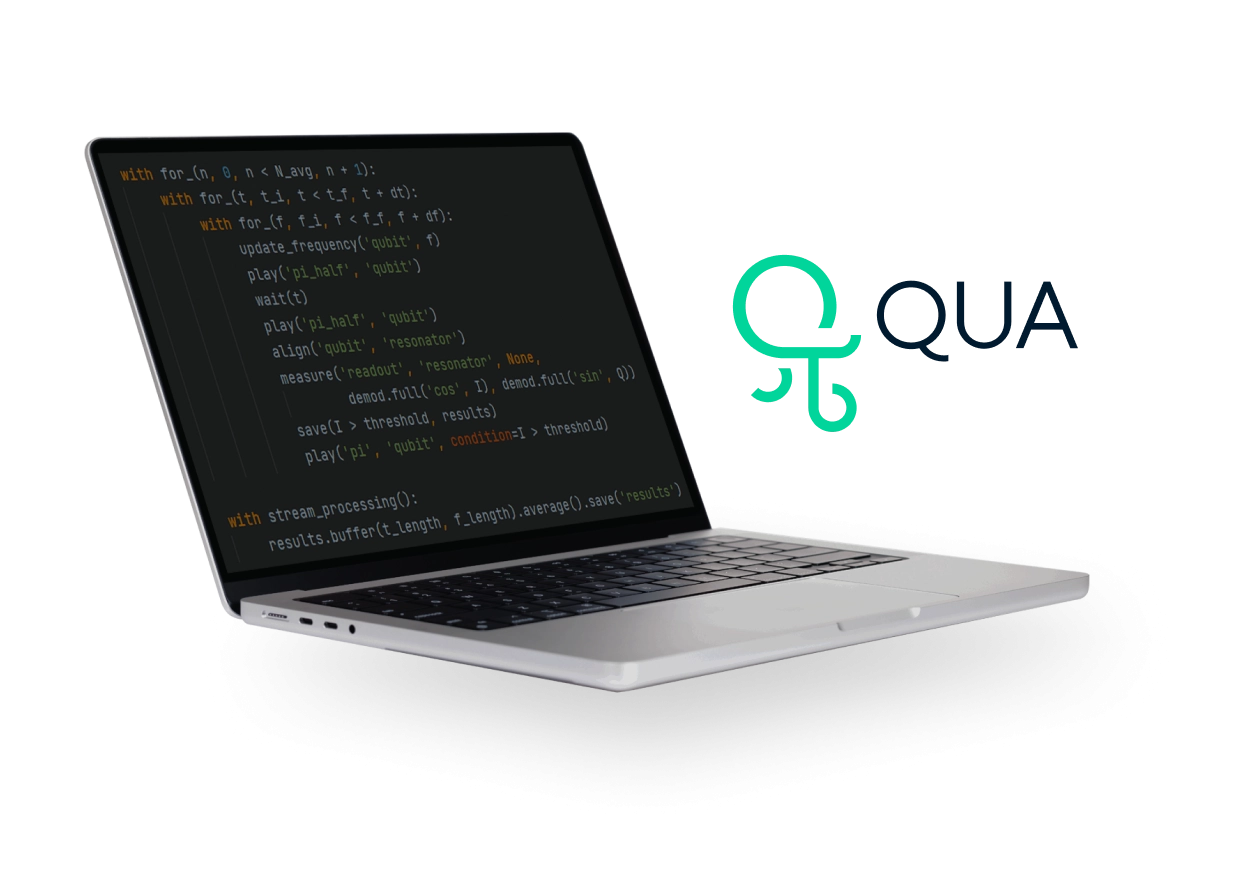
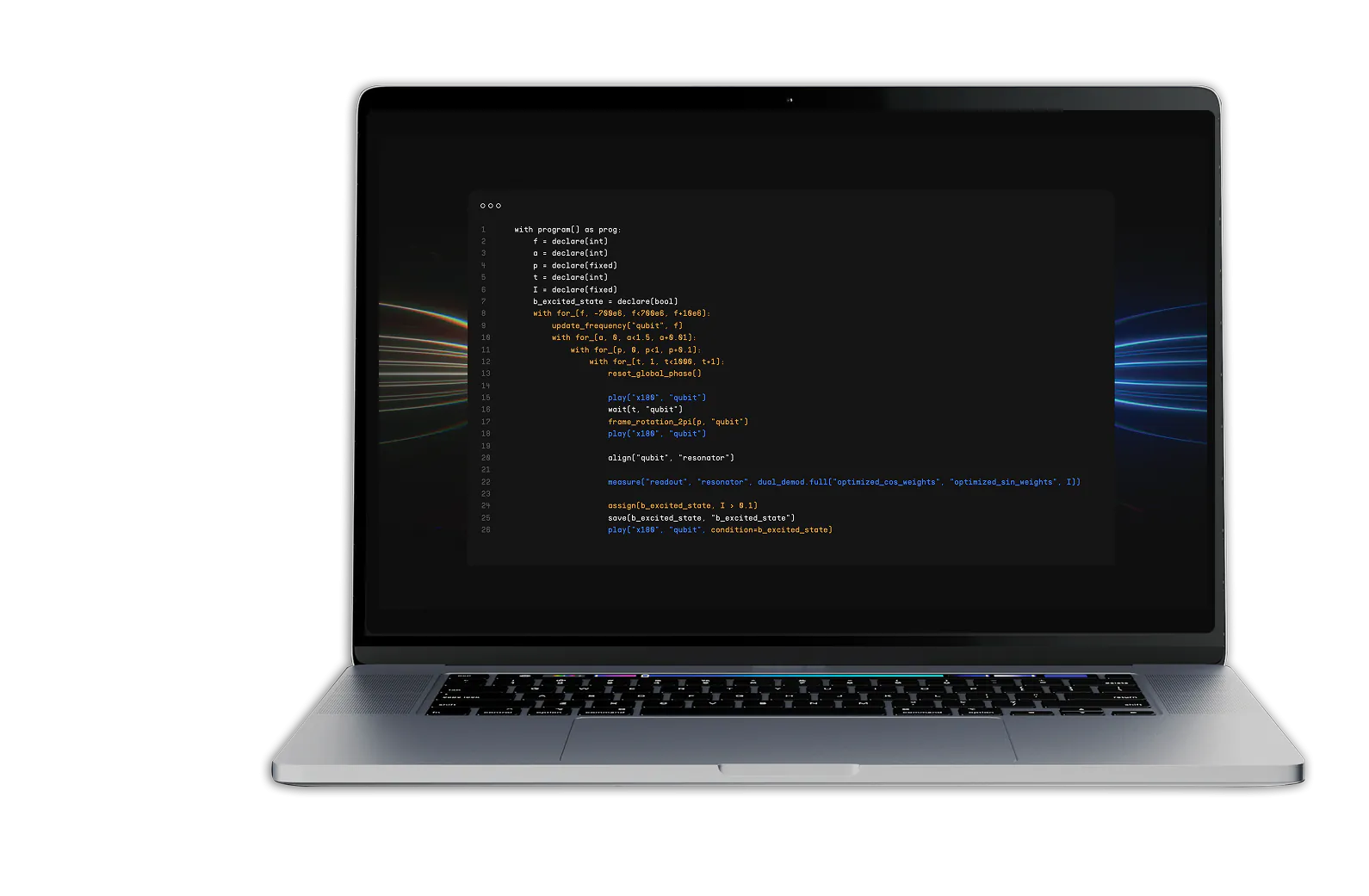
QUA is an intuitive pulse-level programming language used with Quantum Machines’ OPX hybrid controllers. It is the core of QM’s comprehensive hybrid development platform – which also features automated calibrations via QUAlibrate, and access to a vast library of control applications. QUA seamlessly merges quantum and classical programming. With QUA, quantum builders can easily program complex algorithms that were previously impossible, reaching milestones faster and accelerating the path to breakthrough results.
Comprehensive
QUA unifies quantum operations at the pulse level with classical resources, including Turing-complete computations and rich control flow (if/else, for, while loops and swith cahse, using real-time parameters). Unlike conventional programming models that separate quantum and classical code, QUA integrates both into a single, frictionless framework. This removes latency, optimizes performance, and enables real-time quantum-classical interaction – from simple pulse generation to the most advanced adaptive circuit execution. QUA further provides advanced upper-layer interfaces, ensuring smooth integration with industry-leading frameworks such as Qiskit, OpenQASM3 for circuit-level coding, and CUDA-Q (HPC-QC application development).
	def two_point_Ramsey_Tracking():
    with for_(n, 0, n < 2**any_power_of_two, n + 1):

        assign(f, f_res_corr + plus_delta)
        update_frequency("qubit", f)

        Ramsey(t_fixed)
        assign(state_1, I > ge_threshold)
        assign(
            state_1_avg,
            state_1_avg_avg + (Cast.to_fixed(state_1) >> any_power_of_two),
        )

        assign(f, f_res_corr + minus_delta)
        update_frequency("qubit", f)

        Ramsey(t_fixed)
        assign(state_2, I > ge_threshold)
        assign(
            state_2_avg,
            state_2_avg_avg + (Cast.to_fixed(state_2) >> any_power_of_two),
        )

    corr = calculate_freq_correction(state_1_avg, state_2_avg)


with program() as any_quantum_sequence:
    with for_(loops, 0, loops < loops_max, loops + 1):
        two_point_Ramsey_Tracking()
        your_advanced_sequence()
Expressive
Think it, do it! With Its Python-like sentex, program protocol as easily as writing pseudocode. Describe any quantum experiment natively, from active reset to AI-based multi-qubit calibration and quantum error correction.
	def Ramsey(t):
    play('pi_half', 'qubit')
    wait(t)
    play('pi_half', 'qubit')
    align('qubit', 'resonator')
    measure('qubit', 'resonator', ..., I)


with program() as 2D_Ramsey_Map:
    with for_(n, 0, n < N_avg, n + 1):
        with for_(f, f_min, f < f_max, f + df):
            update_frequency('qubit', f)

            with for_(t, t_min, t < t_max, t + dt):
                Ramsey(t)
                active_reset('qubit')
Scalable
QUA scales with your roadmap, allowing you to code a thousands of qubits as easily as a single one. No overhead, no rewriting codes – just seamless scaling by OPX controllers and updating your system configuration file. The QUA compiler will orchestrate all controllers as one, handling synchronization and data sharing.
	for qubit_n in qubits:
    measure(qubit_n, 'resonator', ..., I)
    play('pi', qubit_n, condition=I > threshold)

    with for_(t, t_min, t < t_max, t + dt):
        Ramsey(qubit_n, t)

align()
Open Source
QUA is an open-source software. It is used by thousands of users in academia, national labs, and commercial companies worldwide, for quantum research and development. Explore QUA’s capabilities and get started with real-world examples on GitHub.
What’s Possible with QUA?
- Quantum Sensing
- Quantum Technologies Research & Development
- Quantum Communication
- Quantum Computing
- Hybrid Quantum – Classical Algorithmics
- Quantum Computing
- Quantum Firmware Development

Hybrid Programming
QUA unifies quantum operations at the pulse level with classical resources, including Turing-complete computations and rich control flow.

Executed in Real Time
Pulse Processing Unit (PPU) executes QUA programs in quantum coherence time cale, ensuring optimal performance with precise synchronization and minimal latency.

Open Source
Researchers and developers from hundreds of academic labs and commercial companies around the world share code, reduce development time, and make the new possible.

Parametric Pulse Programming
No long upload times and only minimal memory usage. Pulses are generated and manipulated on the fly.

A Vast Library of control applications
From characterization to QEC and real-time Bayesian estimation, numerus out-of-the-box workflows.
All Common Qubit Modalities
Superconducting, quantum dots, defect centers and

All Common Qubit Modalities
Superconducting, quantum dots, defect centers and optically addressable qubits.





The QUA Python interface is great, everything you want to do is just three intuitive lines of code. The OPX is one of the only things in the lab that is working exactly as it should.

Dr. Josiah Sinclair
Assistant Professor in Physics
University of Wisconsin-Madison
Within only two days of unboxing the OPX and Octave, we were running randomized benchmarking, active reset, state tomography, and all the routine qubit control protocols. This was simply incredible. Furthermore, the easy-to-use QUA language allowed us to implement our pulse sequences in minutes. As a startup, speed of progress is a crucial element of our success. With QM, we are confident to accelerate our development and achieve results in days instead of months or even years

Nick Farina
CEO
EeroQ
Replacing 3 devices with one synchronized, orchestrated machine tremendously simplified lab workflow. Now our pulse sequences run in a fraction of the time of any other device combo. Plus, we can “talk” to the FPGA in human-speak, to run real-time calculations that were too complicated before! Along with the yoga-level
Prof. Amit Finkler
Professor
Weizmann Institute of Science
Diraq is delighted to partner with Quantum Machines, and credits their OPX control system, with its real-time capabilities, as instrumental in achieving the results outlined in our research. The ease of programming sequences in QUA significantly streamlined the experimental process

Prof. Andrew Dzurak
Professor / CEO
Diraq
OPX has been a powerful enabler in our lab, helping us quickly characterize the performance of our recently discovered qubits. The hardware removes time wasted in uploading and waiting during pulse programming. QUA has substantially reduced the complexity of writing quantum protocols, allowing us to code dynamical decoupling and RB sequences in just a few lines. It remarkably saves our time in optimizing the processes and visualizing the results, allowing us to focus more on understanding the physics of our new qubits.
Prof. Dafei Jin
Professor
University of Notre Dame
The OPX + QUA platform completely changed the way we control semiconductor quantum dot spin qubits. Key qubit control schemes we previously developed individually using time-consuming hardware description languages are now implemented in one box.

Prof. Dohun Kim
Professor
Seoul National University
Using the OPX has been simplifying our work in many respects due to the intuitive implementation of sequences within QUA. In addition, the support by QM helped us debugging possible issues with swift responses and an easy and informal way of getting in touch over Discord.

Prof. Yiwen Chu
Professor
ETH Zurich