
Why quantum-classical integration is the new frontier of supercomputing
Over the past decade, a lot of the buzz around quantum computing has been about creating qubits, the more the better. But the reality is much more complex, as it isn’t about just building a better processor; it’s about building a faster, more robust bridge between that processor and the classical world.
Qubits are quantum cousins of the perhaps more familiar digital bits. They can exist in superpositions of 0 and 1, just like atoms and subatomic particles, and can be created in a variety of ways. Take superconducting qubits, supercooled tiny wires on a chip, hiding in a golden ‘chandelier’s’ maze of cables and shut firmly in a cryostat chilled to temperatures below those in outer space. Or trapped ions – charged atoms missing one or a few electrons, suspended in midair in a vacuum chamber and controlled by precisely tuned laser beams. There are also qubits made of light, qubits made of neutral atoms, and even the elusive Majorana fermions that researchers are trying to make into stable qubits.
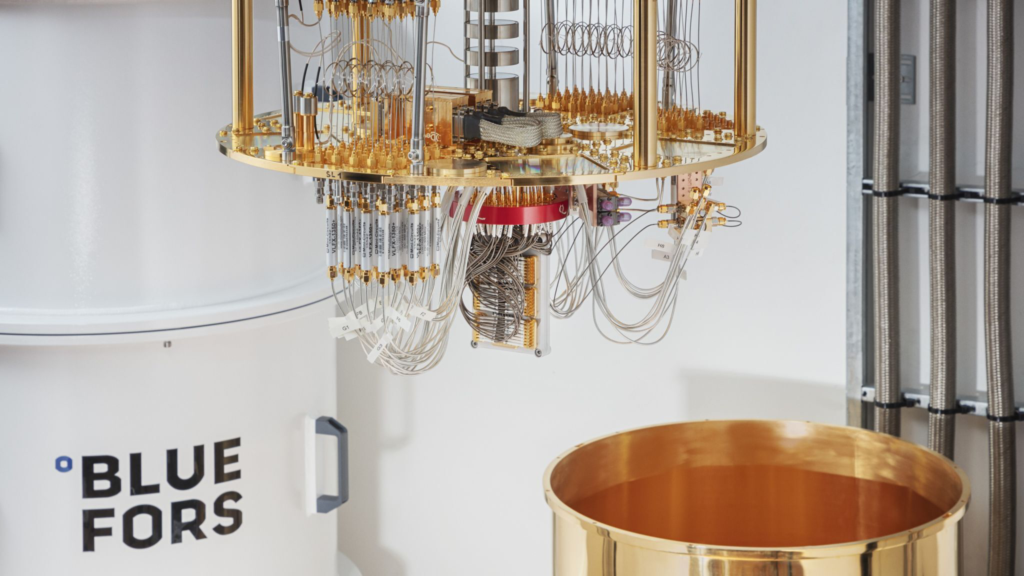
An example of a cryostat used for superconducting qubits
But here’s the thing. No matter how they are made, what’s critical is how well we can control them with classical hardware, integrating quantum and classical into one seamless hybrid setup. Quantum computing was never meant to exist in isolation, and top-notch quantum control systems are essential to build scalable quantum computers.
“Quantum-classical integration is becoming increasingly complex,” said Yonatan Cohen, Quantum Machines’ CTO, at a recent Quantum Machines’ online seminar with Shane Caldwell, Senior Product Manager at Nvidia and Andre Saraiva, Head of Theory at Diraq. The challenge is because a quantum processor (QPU) does not operate in a vacuum. It requires a constant, high-speed dialogue with classical accelerators, CPUs and GPUs, to perform even basic tasks.
Watch the online seminar here.
And the fundamental requirements that matter most? “Latency and bandwidth of this link between the quantum control system – essentially what talks to the qubits – and the classical accelerators,” said Cohen. Basically, we can’t just plug a quantum chip into a server and hope it works. We need to re-engineer the entire data path to support a hybrid workflow.
That challenge becomes even more acute at scale. As Saraiva put it, “some of the problems we’re interested in have very heavy compute and they also have the most stringent requirements in latency and bandwidth.” Error correction is a prime example of that. “We are building toward tens of millions of qubits, and you simply cannot take much more than a couple of seconds to calibrate each qubit. Otherwise, you would spend a year calibrating a system, and by the time that you’re done, your first qubit ran out of specs already.”
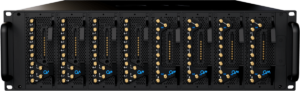
OPX1000, Quantum Machines’ flagship control system
While researchers have made major advances in qubit coherence and gate fidelity, the overhead required to manage large quantum systems remains enormous. The good news is that, regardless of qubit modality, the principles of quantum control and integration with classical hardware are largely the same. Control platforms such as Quantum Machines’ OPX systems provide low-latency feedback and adaptive control across multiple qubit technologies.
Essentially, the quantum control system acts as a translator. It converts classical code into precisely timed microwave or laser pulses that manipulate qubits, while classical accelerators – often GPUs – handle the heavy numerical workloads, such as analyzing measurement results. If the link between these layers is too slow, fragile qubits decohere before the classical system can respond.
Three latency regimes for hybrid quantum workloads
Not all quantum applications place the same demands on the quantum–classical link. One useful way to think about integration is to classify applications by their feed-forward latency requirements.
At the most demanding end are real-time tasks such as quantum error correction. Here, the system must measure qubits, process that information classically, and apply corrective operations often within microseconds or less. If the latency exceeds the relevant quantum timescales, the computation fails.
Other applications are more tolerant of latency but still place significant demands on classical compute and data movement. Hybrid algorithms such as variational methods involve tight feedback loops in which classical optimizers, often running on GPUs, update parameters that are repeatedly sent to the QPU. Even modest inefficiencies in this interaction can quickly limit performance as systems scale.
This need for tight, deterministic coupling between quantum control systems and classical accelerators is a key motivation behind platforms such as Nvidia DGX Quantum, developed by Nvidia and Quantum Machines, as well as Nvidia’s NVQLink. Rather than focusing solely on raw bandwidth, DGX Quantum, the first implementation of an NVQLink-compatible system, is designed to co-locate GPUs with quantum control hardware and enable low-latency, programmable interaction between the two – an essential requirement for advanced calibration, feedback, and future error-correction workflows. And NVQLink is aimed at reducing friction between quantum control hardware and classical accelerators, enabling more direct, low-latency interaction suited to real-time calibration, feedback, and future error-correction workflows.
A third class of workloads involves looser coupling, where quantum and classical systems operate more independently. In these cases, integration is less about real-time speed and more about orchestration, such as scheduling jobs, managing workflows, and coordinating resources within HPC environments.
Taken together, these use cases point toward a future in which quantum computers live inside high-performance computing environments. “We see quantum as a major evolution of accelerated computing,” said Caldwell. “Ultimately, we believe useful quantum computing will happen in connection with a supercomputer.” Rather than backing a single qubit technology, Nvidia’s strategy is to build a flexible platform, what Caldwell describes as “the soil from which the entire industry can grow.”
From this perspective, the true measure of a quantum computer’s power is not just its qubit count or coherence time, but the efficiency of its quantum–classical link. By focusing on latency, bandwidth, and programmability, companies like Quantum Machines and their partners are building the connective tissue needed to move quantum systems out of isolated labs and into data centers.
But it’s not only about performance, as programmability matters just as much. “A platform is nothing without its developers,” Caldwell emphasized, pointing to the importance of familiar tools such as Python, C++, and CUDA in lowering barriers to adoption across the stack.
Different qubit technologies still impose different constraints, however. For instance, Diraq is focused on silicon-based spin qubits, which offer a promising path to scalability through standard semiconductor manufacturing. But they also require highly precise, theory-driven control to manage individual electron spins in complex electromagnetic environments. That places additional demands on the quantum–classical link, reinforcing the need for control systems that are both flexible and tightly integrated with classical accelerators.
The message for the industry is pretty clear. Achieving quantum advantage will require optimizing the entire system – from qubits to GPUs – and, critically, the links that bind them together. Quantum–classical integration is no longer a supporting detail. It is the frontier on which scalable quantum computing will be won or lost.