Quantum Machines Launches Open Acceleration Stack Alongside NVIDIA, AMD and Riverlane to Deliver Next Level of Hybridization
First-of-its-kind framework enables seamless integration of quantum computers with advanced accelerators to support AI-native and QEC-native quantum computing at scale
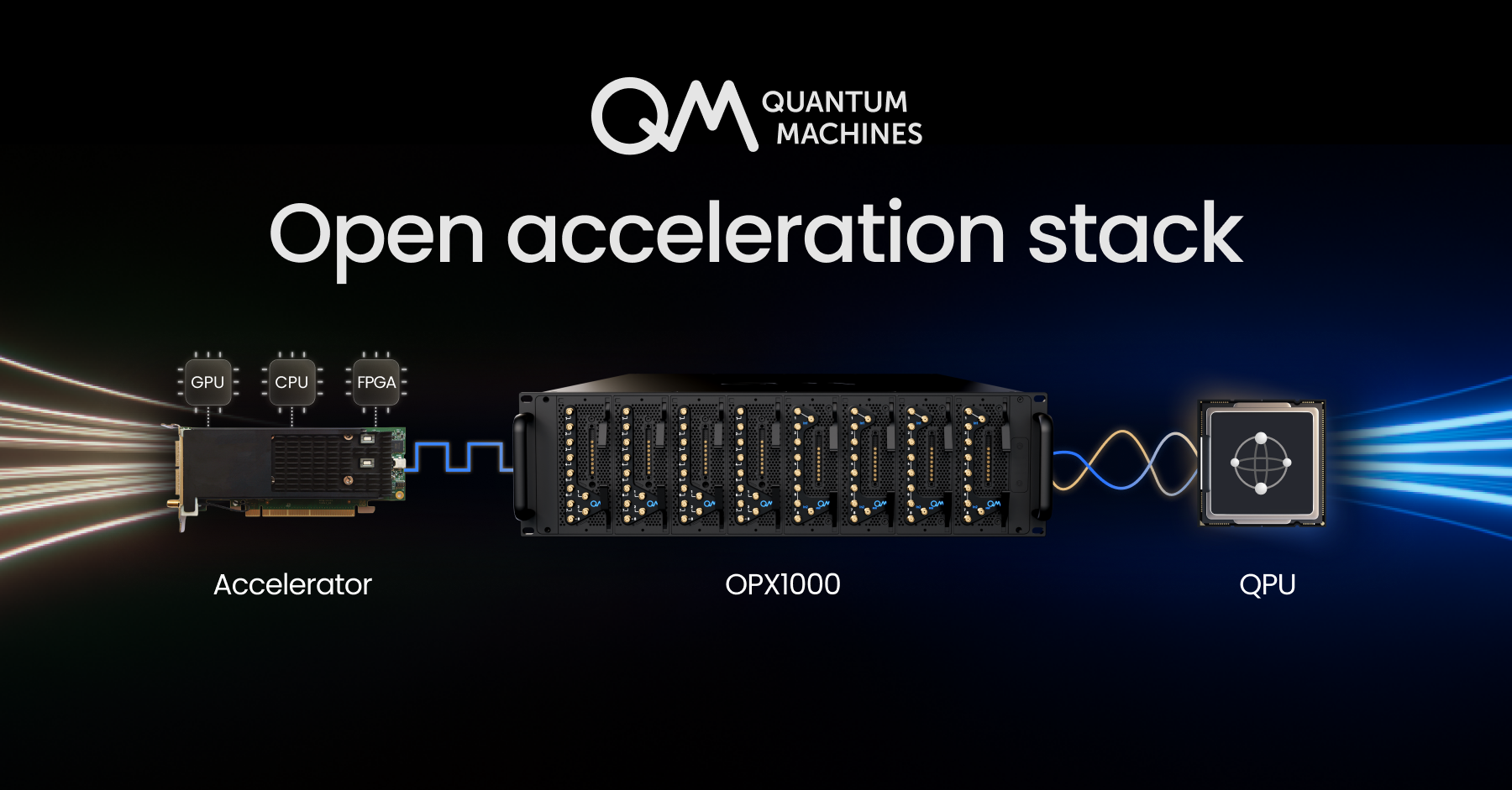
Denver, March 16 2026 – Today Quantum Machines launches The Open Acceleration Stack, a first-of-its-kind framework allowing users to integrate any classical processor (XPU) into their quantum control stack. This novel architecture allows quantum computers not only to be Quantum Error Correction (QEC)-ready and AI-ready, but also QEC- and AI-native.
The Open Acceleration Stack marks a significant expansion of Quantum Machines’ Orchestration Platform, the industry’s leading hardware and software framework for the control and operation of quantum processors. Using Quantum Machines’ OPNIC (OPX Network Interface Card) and NVIDIA NVQLink, the framework enables an ultra-low, microsecond-level latency link between its proprietary Pulse Processing Unit (PPU) and high-performance accelerators, including GPUs, CPUs, FPGAs and ASICs.
Important computational tasks, such as decoding for real-time QEC and advanced AI-native QPU and circuit calibration, require a variety of processors and accelerators to work in harmony and communicate with low latency, high bandwidth and synchronization with the PPU, which runs the quantum program. Quantum Machines’ Open Acceleration Stack enables this hybridization, allowing users to develop and deploy complex hybrid workloads.
Users can deploy CPU-GPU-QPU integration using NVIDIA NVQLink through co-development by Quantum Machines and NVIDIA.
With this solution now evolving into an Acceleration Stack with an open, modular architecture, labs and enterprises will be able to integrate a range of classical processors, from CPUs by companies like AMD, as well as FPGAs, high-performance NVIDIA GPUs, and real-time quantum error correction systems from partners such as Riverlane. This allows users to right-size their setup to meet specific performance and budget requirements and choose the optimal architecture for their applications.
“The Open Acceleration Stack reflects the industry’s shift from quantum computing demonstration to scaling and integration,” said Yonatan Cohen, CTO and Co-Founder, Quantum Machines. “It meets the needs of two critical areas of quantum development: real-time error correction and advanced qubit calibration, and provides the framework to scale both hardware and software with user experience and performance in mind. We are very excited to engage with our customers and the entire quantum community around these tools and their utilization to advance the field and bring useful quantum computation closer.”
Industry partners highlighted the importance of tightly integrating accelerated computing infrastructure with quantum control systems to enable scalable hybrid architectures.
Sam Stanwyck, Director of Quantum Product at NVIDIA, commented: “GPU computing is integrating deeply with quantum processors to scale logical qubits. With NVIDIA NVQLink, Quantum Machines is delivering the low-latency, high-bandwidth performance to power real-time quantum error correction and calibration – bringing practical, large-scale quantum-GPU supercomputing closer to reality.”
“The path to scalable quantum computing depends on heterogeneous architectures that combine quantum processors with high-performance classical compute,” said Madhu Rangarajan, Corporate Vice President, Computing, Enterprise and AI technologies, AMD. “The Open Acceleration Stack enables integration of AMD CPUs and adaptive computing technologies into the quantum control layer, supporting demanding workloads such as real-time error correction and complex hybrid algorithms. By bringing leadership high-performance compute into quantum control systems, AMD is helping enable the next phase of scalable quantum research and deployment.”
As the industry moves toward fault-tolerant quantum computing, fast and reliable quantum error correction will be essential for building large-scale systems. “Fault-tolerant quantum computing depends on fast, reliable quantum error correction running in real time,” said Steve Brierley, Founder & CEO of Riverlane. “Delivering that capability requires specialized classical infrastructure tightly integrated with the quantum control stack to produce reliable logical qubits at scale. Open frameworks such as Quantum Machines’ Open Acceleration Stack help enable this level of integration, representing an important step toward scalable, error-corrected quantum computers.”
Quantum Machines will be hosting live demonstrations of the new Open Acceleration Stack at the APS Global Physics Summit (March 15-20, 2026, Denver, CO) on booth #1607. The first will showcase a fault-tolerant quantum phase estimation using an OPX1000-based system, and the second will remotely connect to live qubits at the IQCC to demonstrate real-time qubit calibration.
About Quantum Machines
Quantum Machines (QM) is a global leading provider of quantum control solutions, driving the advancement of quantum computing with its hybrid control approach. By harmonizing quantum and classical operations, hybrid control eliminates friction and optimizes performance across hardware and software, enabling researchers and builders to iterate at speed, resolve setbacks, and bring visionary ideas to life. Quantum Machines’ Orchestration Platform supports any type of quantum processor, empowering the industry to scale systems, accelerate breakthroughs, and push the boundaries – previously impossible. Learn more at: https://www.quantum-machines.co/