

Scalable Orchestration Solutions
Explore Quantum Machines’ solutions for controlling, automating, and scaling quantum systems. From small research setups to large-scale QPUs, QM’s Orchestration Platform connects quantum hardware with real-time classical processing to accelerate progress.



One Platform. Multiple Quantum Frontiers.
Quantum technologies are evolving in many directions — each with its own architecture, challenges, and performance requirements. Quantum Machines brings them together through a unified platform designed to support experimentation today and scalable quantum systems tomorrow.
Quantum Machines’ Orchestration Platform
Quantum Machines’ Orchestration Platform brings together hybrid controllers, a powerful software ecosystem, and real-time classical compute integration to control quantum systems from research experiments to scaled QPUs. It enables deterministic timing, synchronized control, readout, feedback, automation, and adaptive workflows across qubit modalities. With pulse-level programming, reusable libraries, calibration frameworks, and integrations with external accelerators, the platform helps quantum teams simplify complex experiments, reduce control overhead, and move faster from device bring-up to high-performance quantum operation.
The Hybrid Control Approach
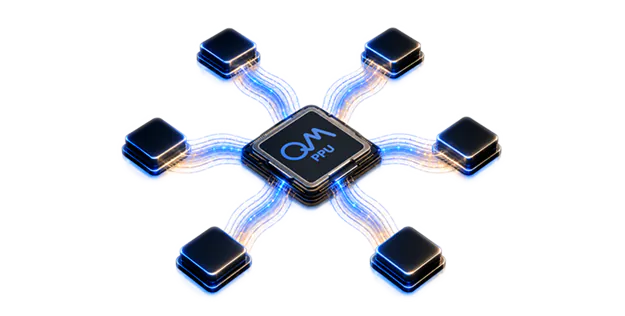
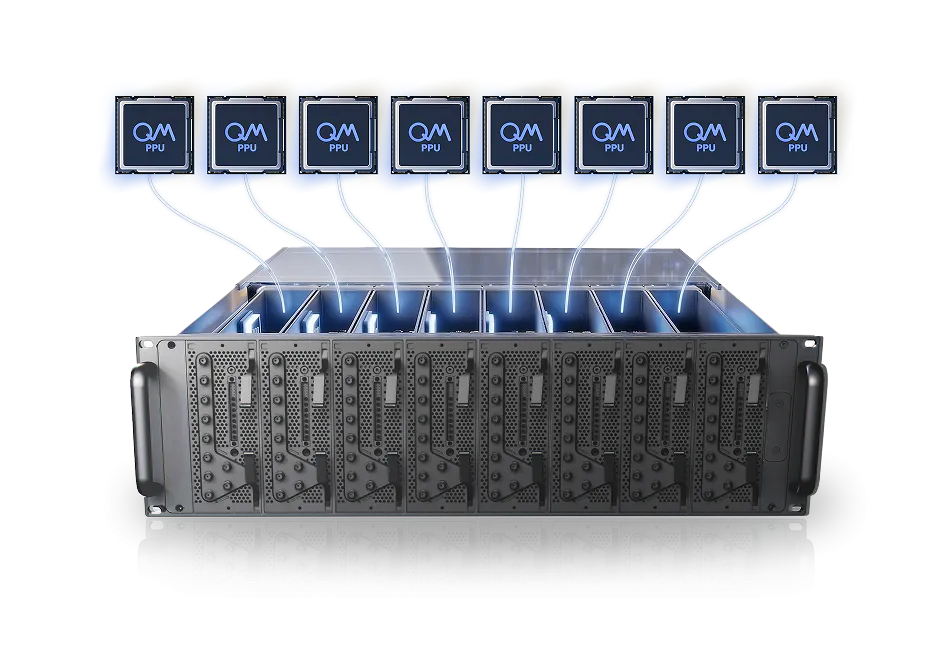
QM’s Hybrid Control approach brings real-time classical decision-making directly into quantum experiments. Instead of running static pulse sequences and analyzing results only afterward, QM’s hybrid controllers let programs measure, compute, branch, update parameters, and respond while the sequence is running. This enables adaptive reset, feed-forward, drift handling, embedded calibrations, and dynamic experimental protocols within one synchronized control flow. By tightly connecting quantum operations with classical logic, Hybrid Control helps teams extract more information from every shot, reduce latency, and operate increasingly complex QPUs with greater efficiency and flexibility. Truth is, there is no Quantum Computing without Classical processing in real-time.
The Open Acceleration Stack
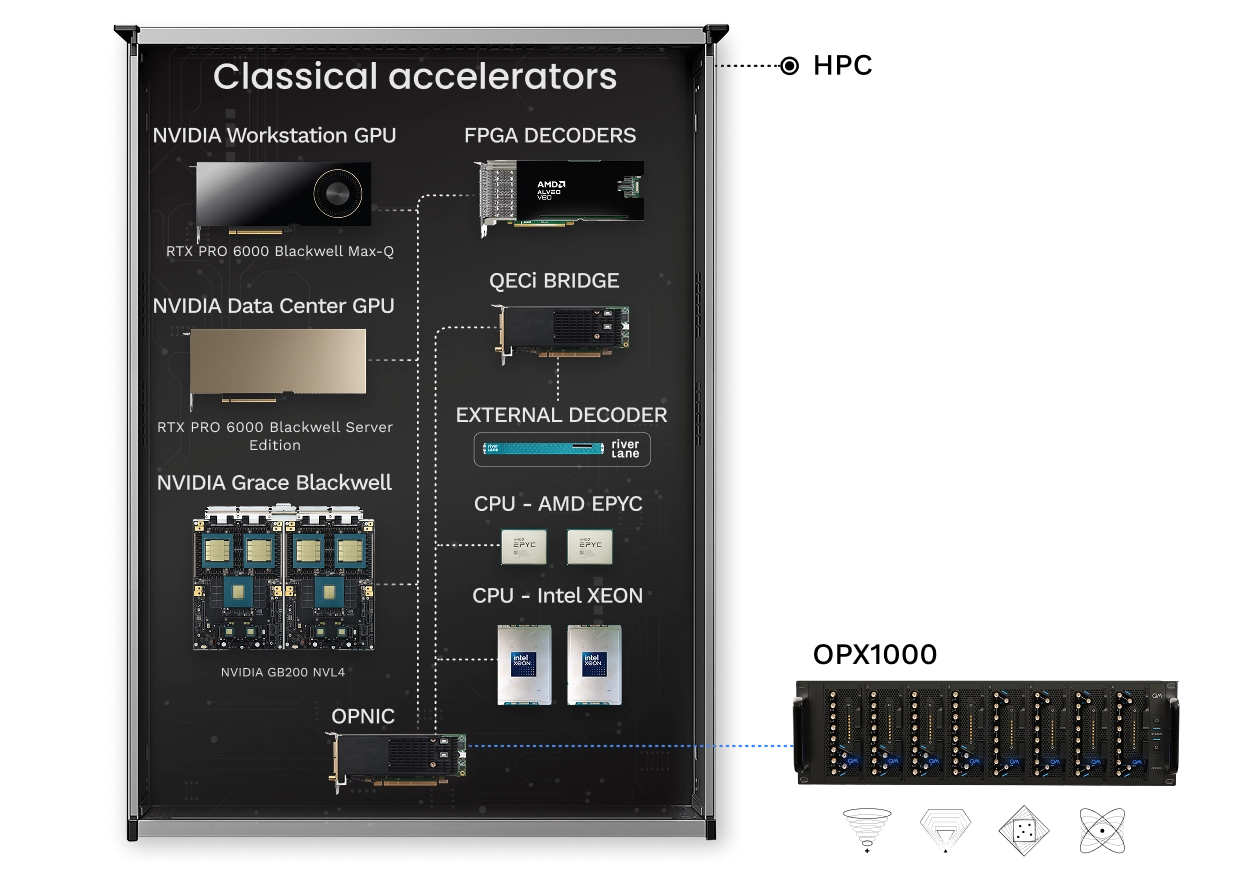
QM’s Open Acceleration Stack connects hybrid quantum controllers with external classical compute resources such as CPUs, GPUs, and FPGAs, with the unprecedented low latency of 2-4 microseconds. It extends real-time control beyond the controller, enabling complex workloads like image processing, optimization, reinforcement-learning calibration, syndrome decoding, and decoder-dependent feed-forward to run in tight coordination with quantum programs. By linking quantum operations with high-performance classical acceleration, OAS helps teams build adaptive workflows, automate demanding routines, and scale toward QPUs that can compute, calibrate, and respond in real time, while paving the way for HPC integration.
Accelerate Your Research, From Day One
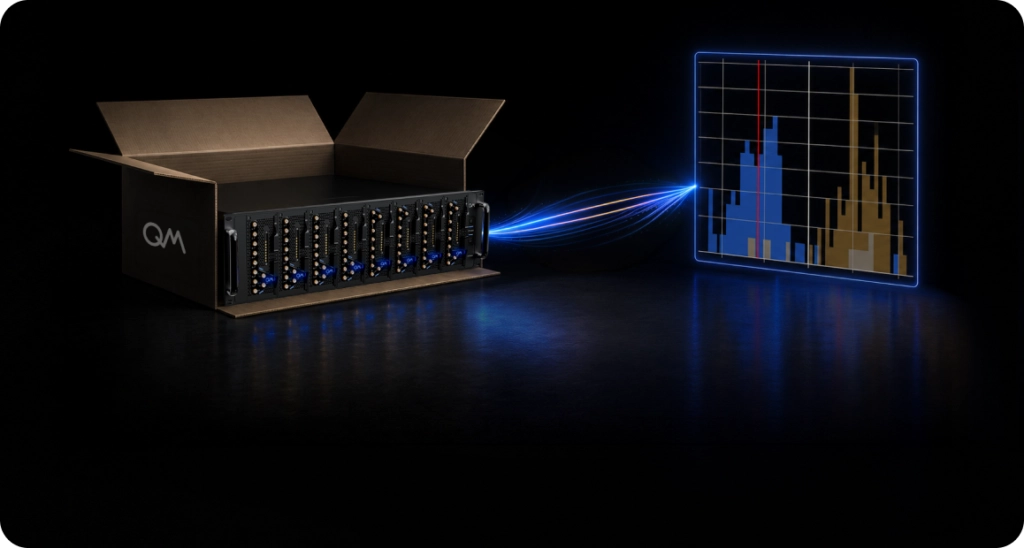
Stop losing weeks to setup and calibration. Our PhD-level Customer Success team ensures your systems run smoothly from unboxing to experiments.

Fast to Physics
From unboxing to operational results in days, not months.
Get your system running immediately with onsite expertise and proven quantum control workflows.

A Long-Term Partnership
Lab-mate level support beyond troubleshooting.
We stay engaged as your research evolves, capturing knowledge and ensuring smooth scaling.

Built to Scale
Seamless growth without costly redesigns.
Implement automation-first calibration and structured control workflows to expand effortlessly.

Local Expertise
Platform-specific know-how at your bench.
Access dedicated PhD-level specialists worldwide to resolve issues faster and reduce iteration cycles.
Accelerate Your Research, From Day One
Stop losing weeks to setup and calibration. Our PhD-level Customer Success team ensures your systems run smoothly from unboxing to experiments.

Fast to Physics
From unboxing to operational results in days, not months.
Get your system running immediately with onsite expertise and proven quantum control workflows.

A Long-Term Partnership
Lab-mate level support beyond troubleshooting.
We stay engaged as your research evolves, capturing knowledge and ensuring smooth scaling.

Built to Scale
Seamless growth without costly redesigns.
Implement automation-first calibration and structured control workflows to expand effortlessly.

Local Expertise
Platform-specific know-how at your bench.
Access dedicated PhD-level specialists worldwide to resolve issues faster and reduce iteration cycles.

Classically Accelerated Readout for Neutral Atoms with CPU/GPU Integration
Read more June 2026 | 9 min readWhy Scaling Quantum Requires a Unified Strategy Across Every Major US Hub
Read more May 2026 | 6 min readActive Reset for Qubits: Building Qubits You Can Count On
Read more March 2026 | 9 min readChoosing the right control stack starts with understanding your platform
Explore supported qubit technologies and solution architectures to find the best path for your quantum computing program.
FAQs
What is Hybrid Control, and why does quantum computing need real-time classical processing?
Hybrid Control is QM’s approach of bringing classical decision-making directly into the quantum experiment — programs measure, compute, branch, and update parameters while the sequence is still running, rather than analyzing results only afterward. This is powered by the Pulse Processing Unit (PPU), an advanced classical processor central to QM’s Hybrid Control approach that positions classical compute as close as possible to the quantum hardware, enabling ultra-fast feedback loops and real-time adaptive control based directly on measurement outcomes. It’s essential because operations must complete faster than qubits decohere — the PPU shapes pulses, enforces deterministic timing, performs mid-circuit measurement, and applies feed-forward within hundreds of nanoseconds, the regime where real quantum control happens.
Can the platform scale from a small research lab to a large-scale QPU?
Yes — this is the core “labs to scalers” design. The same controllers and QUA programs run from a single OPX+ on a benchtop experiment up to large OPX1000 clusters, where any combination of low-frequency and microwave modules and any number of units are programmed together and operate as one. The OPX1000 is built to cost-effectively scale control to 1,000 qubits and beyond, so teams grow their system without redesigning their software.
How do you program and automate experiments on QM’s platform?
Experiments are written in QUA, a Python-embedded, pulse-level language that reads like pseudocode while exposing full real-time capability — it unifies quantum operations at the pulse level with classical resources, including Turing-complete computations and rich control flow such as if/else, for, and while loops using real-time parameters. Routine bring-up and tuning are handled by QUAlibrate, QM’s automated calibration solution, and a library of pre-built programs for most characterization experiments, including contributions from leading research groups, accelerates development. For gate-level work, an OpenQASM3-to-QUA compiler lets algorithms run out of the box.
How is a QM controller different from a standard AWG or RF test instrument?
A QM controller is processor-based, not a static waveform player: instead of defining pulses point by point as an arbitrary waveform generator requires, you describe the experiment in a few lines of QUA and the PPU does the heavy lifting in real time. As QM puts it, the OPX skips the point-by-point waveform definition that makes AWGs so cumbersome — you write a few lines of high-level QUA and the PPU inside handles the rest. That difference is what enables real-time branching, feedback, and adaptive protocols that simply aren’t possible on conventional test-and-measurement gear.