
Parallel Measurement Workflows: Speed Up Quantum Experiments with QSwitch
Parallel measurement workflows in quantum and cryogenic experiments
In cryogenic and quantum experiments, the slowest steps are unavoidable: dilution refrigerator cooldowns, magnetic field sweeps, and long stabilization periods. What is avoidable is repeating them. Yet many workflows still rely on manual rewiring or separate runs for different configurations, turning a single experiment into days of repeated work.
This creates a major bottleneck in quantum experiment throughput, particularly as systems become more complex and require repeated measurements across configurations.
A different approach promises to make things easier and avoid repetitions: parallel measurement workflows enabled by software-defined quantum control and fast switching to increase experimental throughput and reduce repeated runs.
Enabling parallel measurements with QSwitch
That’s exactly where QM’s QSwitch comes in. This tool enables researchers to switch rapidly between configurations and samples without manual intervention, within a single experimental run. Multiple datasets can be collected during a single sweep, converting serial experiments into parallel workflows and reducing total measurement time. This principle applies not only to materials experiments, but also to the operation of quantum devices at scale.
In an exciting new demo, Conductor Quantum recently showed fully automated tuning of 128 double quantum dots across 64 devices on a single chip in a single run, using QDAC-II Compact and QSwitch as part of their control stack. The experiment perfectly illustrates how parallelization and automation can remove bottlenecks in quantum device development. This approach is increasingly important for scaling quantum systems and accelerating device characterization.
Before automation, tuning required days of manual work per device. “A researcher had to sweep voltages by hand, interpret charge stability diagrams, and repeat for every device on the chip,” explains Brandon Severin, Conductor Quantum’s CEO. “The bottleneck was human attention and skill, not measurement speed.”
With automation, the full sequence – from device health checks to double quantum dot formation – runs without a researcher in the loop, turning what was previously a multi-week process into a single experiment. And QSwitch plays a key role in enabling this workflow. “QSwitch lets us programmatically ground and un-ground devices safely without anyone in the lab,” Severin notes. “Many of our measurements were run remotely. That kind of operation is only possible when every instrument can be controlled through software.”
As systems scale, this approach becomes necessary rather than optional. “Manual tuning does not scale to millions of qubits,” he adds. “Automation and parallel measurement remove the human bottleneck, making it possible to characterize more devices in a day than labs have done in their lifetimes.”
Reducing cooldown cycles in cryogenic experiments
A similar shift is taking place in quantum materials research.
At the Technical University of Denmark (DTU), researchers study oxide interfaces based on Strontium Titanate (SrTiO₃) capped with aluminum oxide (Al₂O₃). At cryogenic temperatures, these systems host a two-dimensional electron gas (2DEG) that can exhibit metallic behavior, magnetism and superconductivity. Characterizing these materials requires measurements of sheet resistance, carrier density and mobility, traditionally across multiple configurations and repeated cooldowns.
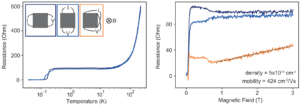
Three measurement configurations of a SrTiO₃/Al₂O₃ sample where a current, I, is applied and a voltage, V, measured; two van der Pauw sheet resistance configurations (dark/light blue) and Hall (orange), performed under magnetic field, B. The left panel shows sheet resistance vs temperature for a single dilution refrigerator cooldown; capturing this data would otherwise require two cooldowns (>24 hours each). The right panel shows a magnetic field sweep, where three configurations are required, and thus a 3x speedup achieved using the QSwitch
Using QSwitch during a dilution refrigerator cooldown in a recent experiment, the team cycled automatically between configurations while acquiring resistance data. “To see that you have a roughly uniform sheet resistance, you normally need multiple cooldowns,” says Damon Carrad, previously a researcher at DTU who took part in the experiments, and currently validation engineer at QM. “Cooling from room temperature takes more than a day.” With automated switching, all measurements were completed in a single cooldown, capturing the full dataset without repeating the experiment.
Magnetic field sweeps present similar constraints, as each measurement point requires stabilization. By introducing a Hall configuration, the DTU team measured carrier density and mobility – parameters that typically require separate sweeps and manual rewiring. “Without QSwitch, it would have required three separate sweeps and swapping the cables around each time,” Carrad explains. Instead, all datasets were collected in parallel during a single continuous sweep.
Across both examples – quantum materials and quantum device tuning – the same pattern emerges: experiments that were once sequential become parallel. At DTU, this enables multiple configurations and samples to be measured in a single cooldown. In Conductor Quantum’s work, it enables full-chip tuning across dozens of devices in one automated run.
“The QSwitches are really saving researchers an insane amount of measurement time,” Carrad notes. “It’s about four times faster, and scales with the number of samples.”
For quantum computing, the implications are broader. Scaling to large systems requires automation and parallelization at every layer of the stack, from device tuning to system control. For quantum materials research, the same approach increases throughput without increasing infrastructure.
Parallel measurement workflows, combined with software-defined control, are becoming a foundation for both quantum research and quantum computing development. By eliminating repeated runs and manual intervention, these approaches improve reproducibility, reduce human error, and maximize the value of each experimental cycle. In fields where cooldowns and sweeps define the pace of progress, parallelization changes how experiments are designed and executed.
From cryogenic materials to quantum chips, the direction is the same: reduce experiment time by replacing serial workflows with parallel measurement approaches because time matters, as we try to get towards quantum advantage faster.