The Ghost in the Machine: Why Quantum Chaos is Haunting the Future of Computing
Superconducting transmon qubits are a leading platform for quantum computing, but scaling them introduces complex many-body effects. One key challenge is the emergence of quantum chaos, which impacts control and fidelity in large-scale systems. David DiVincenzo wrote this blog off the back of a QM seminar he presented, which you can watch here:
https://www.quantum-machines.co/seminars/quantum-chaos-a-challenge-for-transmon-quantum-computers/
In quantum computing, superconducting transmon qubits have long enjoyed the spotlight.
Over the past several years, leading groups have scaled these systems to tens and even hundreds of qubits, and have been able to run small, noise-limited algorithms. Looking ahead, the goal is to move beyond this regime toward fault-tolerant quantum computing, where quantum error correction enables much larger and deeper computations – a key milestone for scalable quantum computing.
At the same time, this shift in scale brings a different kind of challenge. A fault-tolerant quantum computer is expected to be an exquisitely controlled system, executing operations with very high fidelity. And yet, the physical building blocks we rely on can exhibit complex dynamics in many-body quantum systems that are not obviously compatible with that level of control.
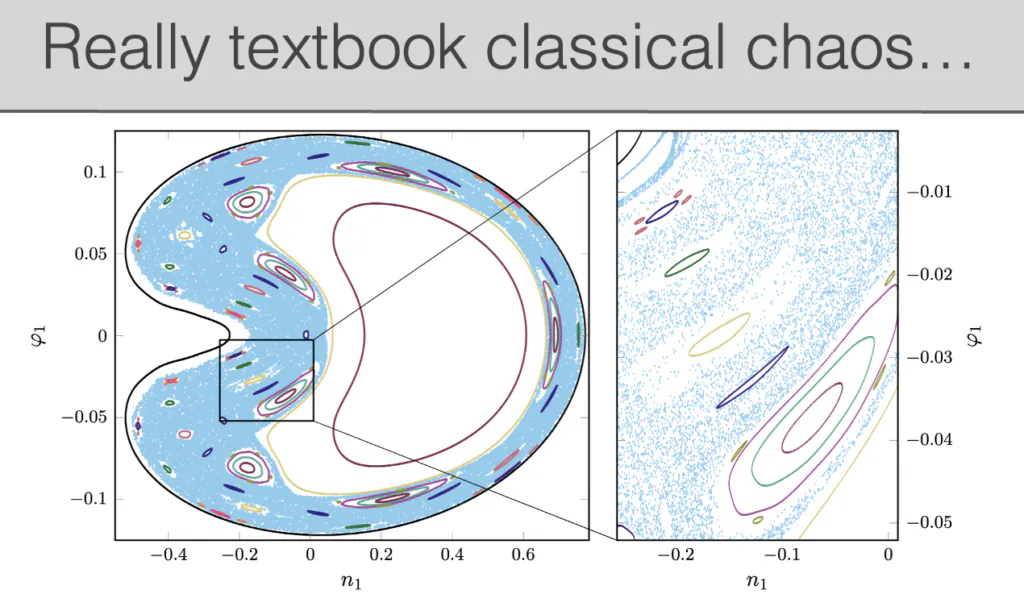
When we assemble arrays of transmons, we are not just building a collection of qubits – rather, we are realizing a many-body system, central to superconducting qubit architectures. In fact, transmon systems provide, in a way, textbook examples of quantum chaos.
From transmon qubits to quantum chaos
A single transmon can be understood as a weakly anharmonic oscillator. Its two lowest energy levels define the qubit, while higher levels are detuned and typically avoided during control operations. This structure has been essential to the success of the platform, allowing long coherence times and relatively simple microwave-based control in superconducting qubits.
There is also a useful classical analogy. The transmon Hamiltonian closely resembles that of a pendulum. For a single system, the dynamics are regular. But when two such systems are coupled, the classical dynamics already become complex, and in fact exhibit chaotic behavior. This is a well-known feature of coupled pendula.
When one moves to the quantum description, the situation changes, but does not become simpler. Quantum chaos is not identical to classical chaos, but it emerges from it and shares important features. Quantum chaos refers to complex dynamics in quantum systems that lack simple integrable structure, often visible in their energy spectra. In particular, signatures of this behavior appear in the structure of the many-body energy spectrum.
An important architectural choice in early superconducting processors was to use fixed couplings between qubits. In these designs, qubits are permanently connected through capacitive interactions, and all operations are implemented using microwave drives. This approach avoids the need for flux tuning or additional control elements, and enabled relatively simple and coherent devices.
However, fixed coupling means that the qubits are never truly isolated. Even when no gate is being applied, the system continues to evolve under a network of always-on interactions. From the perspective of an ideal quantum computer, this is not what one would want: ideally, qubits should remain idle unless actively manipulated.
Energy spectra, state mixing, and loss of qubit structure
To understand the consequences of this, one can look at the energy spectrum of a small array of coupled transmons. Even for a modest system, the spectrum quickly becomes extremely dense and complex.
At low coupling strengths, the structure of the spectrum retains a degree of regularity. Energy levels can cross or pass near one another without strong interaction. In this regime, one can still identify states that correspond closely to simple qubit configurations, bit strings of zeros and ones.
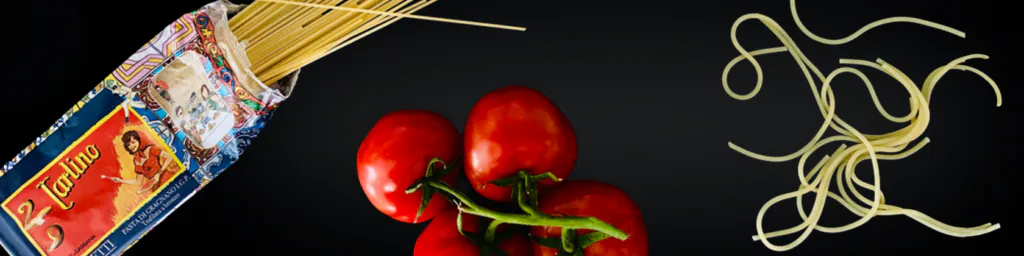
As the coupling increases, this picture changes. Energy levels begin to strongly repel each other, and the spectrum takes on a highly tangled structure. In this regime, the eigenstates are no longer well described in terms of individual qubits. Instead, they become highly mixed many-body states. This transition can be visualized in terms of a “spaghetti” analogy. At weak coupling, the levels resemble uncooked spaghetti – straight and largely independent. At stronger coupling, they resemble cooked spaghetti – entangled, interacting, and difficult to disentangle. This corresponds to the onset of quantum-chaotic behavior in superconducting qubit systems.
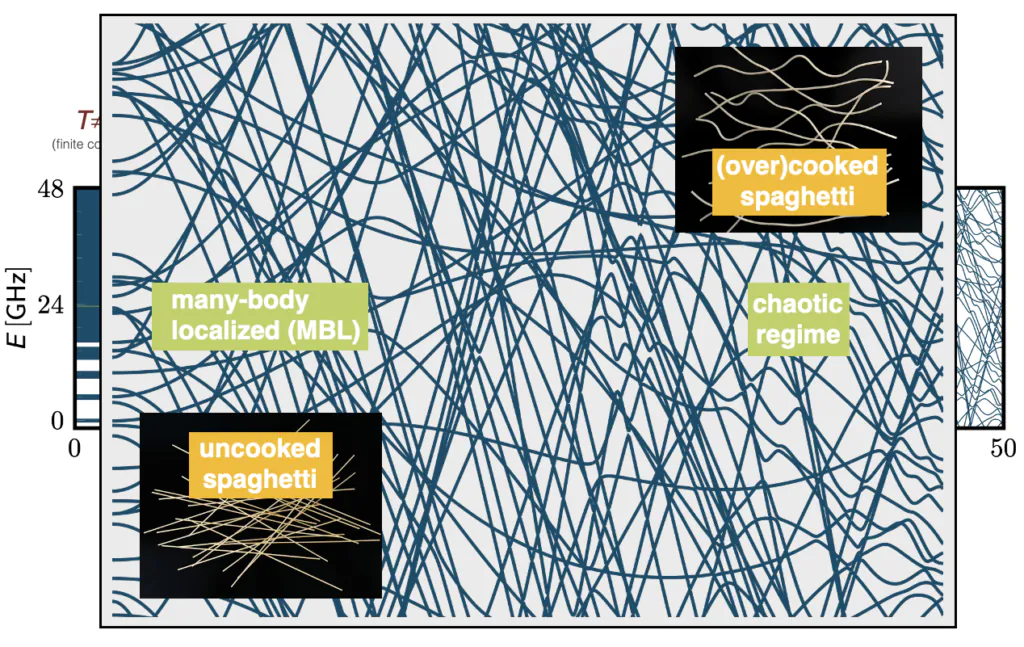
In such a regime, the system loses the structure needed for quantum computation. The notion of individual qubits carrying information becomes blurred, and the ability to implement controlled operations is compromised. Between these two extremes, there is an intermediate regime often described as many-body localization. Here, the system is not fully regular, but it has not yet become fully chaotic. One important ingredient in reaching this regime is disorder: small variations in qubit parameters from site to site.
In transmon systems, such variations arise naturally, for example in the Josephson energies, and are typically on the scale of hundreds of megahertz. This disorder can help suppress the spread of interactions across the system, allowing the qubit structure to remain approximately intact. In this sense, disorder can play a constructive role.
However, even in this regime, interactions do not disappear. In particular, effective “ZZ” couplings, where the energy of one qubit depends on the state of another, remain and grow with the coupling strength. These terms distort the ideal structure of the spectrum and limit the fidelity of quantum gates. Quantitatively, one finds that to keep these effects under control, the coupling between qubits must remain very small—on the order of a few megahertz or less. This places a practical limitation on fixed-coupling architectures, since weaker coupling also implies slower gate operations.
Tunable couplers and decoupling for scalable quantum computing
Given these constraints, a different architectural approach has emerged. Rather than relying on permanently coupled qubits, one can introduce tunable couplers in superconducting qubit architectures that allow interactions to be turned on and off.
In this picture, the system can be effectively decoupled when idle, eliminating the unwanted many-body dynamics, and only coupled during gate operations. From the standpoint of quantum chaos, this avoids operating in regimes where chaotic behavior would otherwise dominate. This approach does come with increased complexity, though. Tunable couplers require additional control hardware and more elaborate calibration, and significantly expand the overall system design. For some time, this added complexity made them less attractive. Nevertheless, the field has increasingly moved in this direction. Both IBM and Google have adopted architectures that incorporate tunable couplers, recognizing that decoupling on demand provides a more reliable path to scaling.
The broader lesson is that building larger quantum systems is not only an engineering problem. It is also a problem in many-body physics. The choice of qubit, the nature of its interactions, and the structure of the resulting Hamiltonian all play a central role in determining what is possible.
The main point is, in the case of transmon-based systems, quantum chaos is not just a theoretical curiosity. It is a practical consideration that shapes architecture, control strategies, and the path toward fault-tolerant and scalable quantum computing.
BONUS: Q&A with David DiVincenzo, as per the questions asked in the recent QM seminar:
Q: The spaghetti-like level anti-crossings resemble Rydberg atoms in a magnetic field, where classical chaos leads to sub-Poissonian level spacing distributions. Is there a connection to your problem?
A: Yes, atomic states in a magnetic field are also well known instances of chaotic dynamics. I would say that the only resemblance comes from the known universality of energy-spacing statistics — all models lead to so-called Wigner-Dyson type statistics. I would say there is no resemblance in any of the detailed physics.
Q: How easy is it to address an individual τ-qubit? Would it require multi-physical-qubit pulses?
A: Maybe by τ-qubit you are referring to the dressed qubit that I discussed in the lecture, which is actually called an l-(qu)bit in the papers. Good question, no because of frequency selectivity it suffices to send a pulse just to the dominant physical qubit. But exciting a nearby physical qubit at the right frequency can also do the job, and this is actually one origin of “classical crosstalk” in pulse coupling, showing that this doesn’t only come from cross-contamination of the classical signals, such crosstalk is intrinsic to the coupled-qubit system.
Q: What happens in a regime where ZZ coupling is the dominant energy scale and SWAP-type interactions are very small (i.e., a blockaded regime)?
A: An exotic regime, I am not sure offhand what happens, but it does not sound like a good regime for qubit control.
Q: In systems with tunable couplers that can null qubit–qubit coupling but retain non-zero coupler–qubit coupling, does chaotic behavior still emerge?
A: Yes, I don’t think that tunable couplers are a complete cure-all, for example they may easily leave the higher states |2> coupled between qubits, affecting certain readout schemes. I think that some aspects of chaos are still present of the energy spectrum of such “tuned-off” couplers, but it will certainly be less chaotic.
Q: If many-body localization does not survive in the thermodynamic limit, does increasing the number of qubits inevitably lead to systems that are not safe from chaotic dynamics?
A: Maybe, but to the extent that I understand the discussion in statistical physics of the “lack of MBL”, it may be that this only comes into play at much larger sizes. We “only” care about a million qubits or so!
Q: Are there similar studies on other hardware platforms (e.g., trapped ions, Rydberg atoms), and do they face the same challenges?
A: No, I am not aware of such studies. Always-on coupling are surely present in other platforms, but are maybe intrinsically less than in the superconducting platforms of 5 years ago.
Q: Could having multiple qubits on a single readout line contribute to chaotic behavior?
A: Perhaps – we have not included the “readout hardware” at all in our model studies, but multiplexed lines is certainly a possible source of additional unintended couplings.