
Why Scaling Quantum Requires a Unified Strategy Across Every Major US Hub
How California, UC San Diego, and industry leaders Quantum Machines, HPE, and Qualcomm are co-architecting the bridge between national research and industrial utility.
As California develops a statewide quantum strategy, leaders from industry, academia, government, and national laboratories gathered this week at the Quantum San Diego Convening (QSDC) to address a growing industry challenge: how to turn quantum computing from scientific progress into scalable systems and industrial infrastructure.
The event was hosted at the Qualcomm Institute at the University of California San Diego and jointly organized by UC San Diego, HPE Quantum, and Quantum Machines, with support from the California Governor’s Office of Business and Economic Development (GO-Biz). The discussions reflected a broader recognition that the future of quantum computing will depend not only on individual companies or research labs, but on coordinated regional and national ecosystems.
As California’s broader statewide quantum strategy evolved, Quantum San Diego quickly expanded into a larger convening bringing together researchers, startups, industry, national labs, and policymakers from across Southern California.
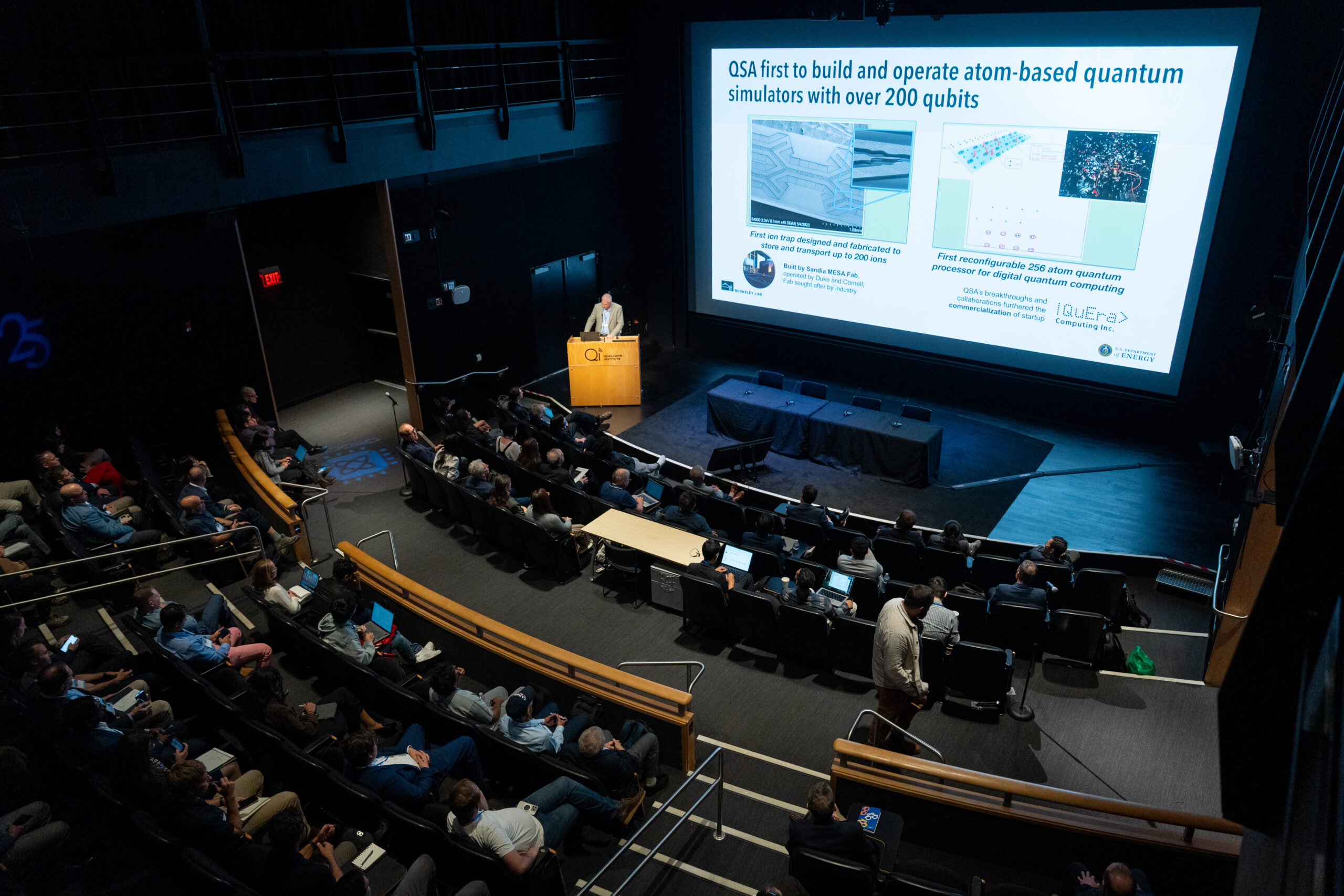
“Quantum San Diego began as a smaller meetup idea, but it quickly became clear that Southern California needed to be part of the broader Quantum California strategy,” said Keith Wright of Quantum Machines, one of the convening organizers. “The state had already convened leaders in Berkeley and Santa Barbara, and with the strength of San Diego, Los Angeles, and Pasadena, it made sense to bring that conversation south. The speed at which UC San Diego, the California Governor’s Office, Hewlett Packard Enterprise, Quantum Machines, national labs, and industry partners came together showed how timely and important this effort was.”
From scientific breakthroughs to industrial infrastructure
For the US as a whole, this matters strategically. Quantum technologies are increasingly viewed as critical infrastructure technologies with implications for economic competitiveness, cybersecurity, AI, advanced manufacturing, defense, and scientific leadership.
The country already possesses extraordinary strengths in quantum science and entrepreneurship. These include major federal initiatives such as the Department of Energy’s National Quantum Information Science Research Centers, NSF-funded programs, national laboratories, and pan-US efforts such as the Genesis initiative. Then there are regional ecosystems emerging across the country, which include Illinois’ Chicago Quantum Exchange, the Illinois Quantum & Microelectronics Park (IQMP) and Bloch initiative. And, of course, one shouldn’t forget Colorado’s Elevate Quantum, New Mexico’s Quantum Frontier Project, Maryland’s Capital of Quantum, Connecticut’s QuantumCT, and California’s Quantum California strategy. The challenge now is connecting these efforts into a more coordinated national strategy capable of supporting industrial-scale quantum deployment.
California is uniquely positioned to help lead that effort. The state combines world-class universities, national laboratories, semiconductor expertise, AI leadership, venture capital, photonics, advanced networking, and one of the world’s most concentrated deep-tech ecosystems. Importantly, these capabilities are distributed across multiple regional hubs, including San Diego, Santa Barbara, Berkeley, Silicon Valley, and the national labs, each contributing different strengths.
“California already has world-class quantum assets, but many efforts are still developing independently rather than as a coordinated system,” said Riley Need, Research Specialist at UC San Diego’s Qualcomm Institute and one of the organizers of the convening. “The next step is building stronger alignment around workforce, infrastructure, manufacturing, investment, and long-term statewide strategy.”
That distributed model may ultimately become one of California’s biggest advantages. “Quantum technologies will scale through ecosystems, not isolated efforts,” said Itamar Sivan, CEO of Quantum Machines. “What makes California particularly important is the density of expertise across academia, infrastructure, semiconductors, software, networking, and advanced engineering. Bringing those communities together is essential if the US wants to lead the next phase of quantum computing.”
The San Diego gathering focused heavily on the increasingly complex engineering problems involved in moving quantum computing from laboratory demonstrations toward deployable systems. Those challenges extend far beyond qubits themselves, as scaling quantum systems requires orchestration, control infrastructure, hybrid quantum-classical computing, advanced packaging, networking, error correction, software automation, and manufacturing readiness. It also requires workforce development and long-term investment strategies capable of supporting technologies developing over decades rather than quarters.
Why states are becoming central to quantum strategy
That’s exactly where regional hubs become critical. “Quantum technologies are too complex for any one institution to scale alone,” Need said. “Regional hubs create the dense networks of research, manufacturing, talent, capital, and public-private collaboration needed to move technologies from the lab into real-world systems.”
Historically, many transformative technologies — from semiconductors to biotechnology to aerospace — accelerated through geographically concentrated ecosystems where universities, startups, investors, suppliers, and government institutions evolved together. Quantum technologies are likely to follow a similar path.
The conversations in San Diego also reflected a broader shift taking place across the quantum industry globally. Over the last decade, much of the field focused on proving that quantum computing was scientifically possible. Increasingly, attention is now turning toward questions of scalability, reliability, interoperability, energy efficiency, and integration with classical computing infrastructure. “A recurring theme throughout the convening was that the conversation is shifting from proving scientific concepts to building manufacturable, deployable technologies at scale,” Need said. “That means solving challenges in supply chains, packaging, networking, workforce development, and integration with classical computing systems.”
Those priorities mirror trends emerging internationally. In Europe, policymakers are preparing the European Quantum Act alongside broader efforts to strengthen quantum supply chains, industrial coordination, and technological sovereignty. Similar national strategies are emerging across Asia and the Middle East. The global race is no longer only about who publishes the best papers or builds the largest experimental systems. It is increasingly about who can build sustainable ecosystems capable of supporting long-term industrial deployment.
For the US, that creates both an important opportunity and growing urgency. Federal initiatives remain essential, particularly through agencies such as the Department of Energy, NSF, NIST, and DARPA. But state-level strategies are becoming increasingly important as well, especially in areas like workforce development, regional infrastructure, startup support, public-private partnerships, and manufacturing ecosystems. “Federal programs are critical for advancing foundational research, but states are often better positioned to coordinate industry development and regional infrastructure,” Need said. “California has the scale and diversity of capabilities to help define what a mature quantum ecosystem can look like in practice.”
California’s effort under AB 940 may therefore become an important model for how states can help accelerate quantum development in coordination with national priorities.
Importantly, participants at the San Diego convening focused on identifying the system-level capabilities needed to enable long-term scaling. That perspective will likely define the next decade of quantum development, as future quantum computers will not operate as isolated scientific instruments. They will function as deeply integrated computing systems connected to classical supercomputers, cloud infrastructure, AI workflows, networking layers, and advanced control architectures. Building that future will require sustained collaboration across disciplines that historically operated separately.
“Quantum computing is becoming an infrastructure challenge as much as a scientific one,” said Sivan. “No single company, university, or lab can build this industry alone. Long-term leadership will depend on how effectively we connect research, engineering, software, manufacturing, and national strategy into a coordinated ecosystem.”