Quantum Machines Demonstrates First External Match of Rigetti Novera QPU Performance Targets
Quantum Machines brought Rigetti’s commercially available Novera™ QPU from cold start to full operation in 7 working days, achieving 99.5% median two-qubit fidelity across all 11 qubit pairs using its OPX1000 orchestration and calibration platform.
In an external collaboration on Rigetti’s Novera platform, Quantum Machines achieved Rigetti’s standard 99.5% median two-qubit fidelity target using its OPX1000 orchestration and calibration stack, demonstrating that high-performance Novera operation can now be reproduced outside Rigetti’s in-house control system.
To our knowledge, this represents the highest full-system Novera performance achieved to date using an external orchestration and calibration platform, reaching the same fidelities that Rigetti achieves internally with its own control.
Why does this matter?
Achieving this level of performance outside the original hardware developer’s environment is a significant technical challenge. A qubit chip’s performance depends as much on how it’s built as on how it’s controlled. While there have been many advances in qubit fabrication, the control infrastructure required to operate these devices reliably at scale is just as demanding. And interactions between many qubits make it even more difficult to achieve simultaneous high-fidelity operations across the chip, far beyond what single-qubit benchmarks suggest.
To address this, we need fast, routine calibration and continuous fidelity estimation, enabled by efficient, automated, and highly parallelized control workflows. That’s exactly what our work with Rigetti demonstrates.
As part of the collaboration, a Quantum Machines team worked onsite at Rigetti to calibrate and bring up the Novera QPU using QM’s OPX1000 orchestration platform and QUAlibrate calibration framework. This resulted in a 99.93% median single qubit gate fidelity across all nine qubits of Rigetti’s Novera 9-qubit chip, alongside 95% readout fidelity across the full QPU. Moving toward scalable operation, we also demonstrated a 99.5% median and a 99.86% peak two qubit CZ gate fidelity across 11 qubit pairs (all those functioning and available) on the Novera device.
Importantly, these results show that Quantum Machines’ orchestration and calibration stack can reproducibly achieve the same operational regime previously reached with Rigetti’s in-house control infrastructure, rather than relying on a one-off optimized “hero” calibration result.
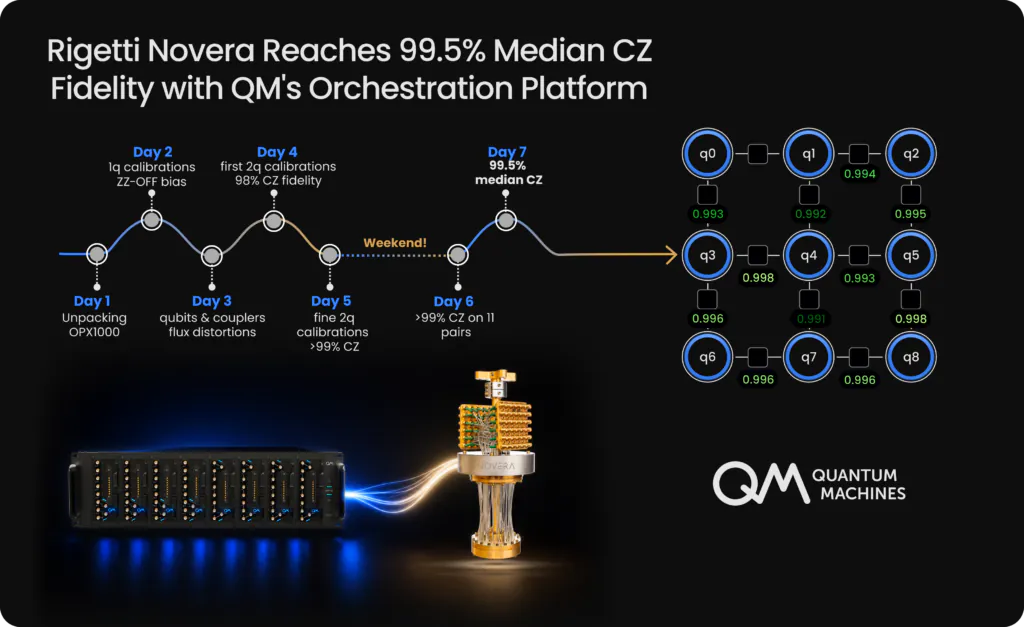
These numbers show that the relevant figure of merit is shifting from individual gate fidelity to the ability to sustain calibrated, bounded error rates across the entire system for extended periods.
How did we do it? From installation to first qubits
A superconducting QPU behaves like a finely tuned orchestra: let even one instrument drift off-pitch, and the magic disappears. The qubits and their interactions rely on bias voltages, and even small drifts cascade into errors across the entire device. A QPU is therefore only reliable when performance is maintained uniformly across the entire device, since meaningful computations span all qubits.
This tight coupling between qubit and its control makes scalable operation a hard control problem. The 9-qubit Rigetti Novera QPU, which sports a square lattice of flux tunable qubits connected by tunable couplers designed for high-fidelity Controlled-Z (CZ) gates, is a prime example of this. The Novera QPU is the unit cell of Rigetti’s modular architecture where several Novera QPU’s can be tiled together with inter-chiplet couplers, making it a direct proxy for larger systems. This makes the Novera a great testbed to evaluate single- and two-qubit gate performance, crosstalk, and calibration robustness across a fully operating device.
Each additional qubit and coupler introduce additional parameters and interactions that must be calibrated. Without a structured approach, bringing up the square lattice of qubits can take weeks of manual tuning and iterative experimentation.
Quantum Machines’ control and calibration stack helped us overcome this roadblock by not only achieving high-fidelity for isolated best-cases of the QPU, but at the level of the full QPU.
We started our calibration routine by identifying the qubits and bringing them into a stable operating regime. Sweeping a drive tone on the qubit, while reading out the resonator response, allowed us to identify the qubit frequency regimes. On the OPX1000, the 9 qubits were controlled via the 9 outputs with 3 additional readout lines and 3 inputs on two of the MW-FEM, and the LF-FEM controlled the qubit and coupler frequencies by sending nanosecond baseband pulses.
From the frequency domain, we moved to the time domain to perform single-qubit calibrations. However, first we had to ensure that the Novera chip was in a regime where the couplers were turned off. This was not a trivial task.
The architecture of the chip with the tunable couplers means that even when no two-qubit gate is applied, residual interactions, particularly ZZ coupling, can degrade single qubit gate performance and complicate calibration routines. However, determining when the couplers are turned off so that the qubits can be treated as isolated, single qubits, is often an iterative process.
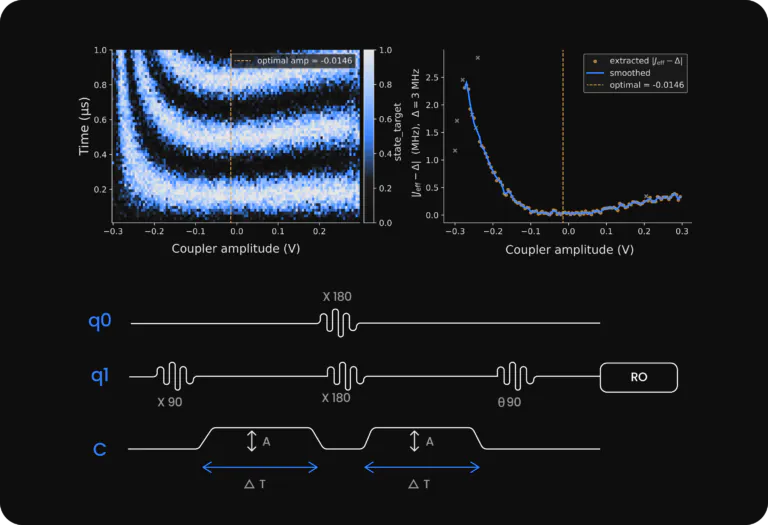
To address this, we identified the ZZ-off operating point using the JAZZ protocol introduced by Nakamura et al [https://journals.aps.org/prx/abstract/10.1103/PhysRevX.14.041050]. This experiment measures the ZZ interaction strength between two qubits against the coupler DC bias voltage using a Ramsey Echo protocol. The Ramsey Echo measures the frequency shift of a qubit when a coupled qubit is excited to it’s |1> state, while suppressing slowly varying noise. By analyzing the Ramsey echo, we could find the coupler bias point where the frequency shift is zero, implying that the ZZ interaction is fully suppressed. This step defines the clean baseline from which controlled interactions can later be introduced.
Close to the minimum coupling point, the Ramsey oscillations slow down (longer than the coherence time) making it hard to precisely fit and locate the minimum interaction point. To fine tune the ZZ off position further, we leverage the real-time phase control enabled by the Pulse Processing Unit (PPU) to introduce an artificial detuning to better resolve the slow oscillations. Within approximately one day after connecting the OPX1000, the system reached stable single-qubit operation with ZZ interactions effectively suppressed.
Ultimately, this allowed us to fine-tune the single-qubit gate calibrations. We then performed the single qubit RB achieving a 99.93% median single-qubit gate fidelity across all nine qubits. With single-qubit control established, we turned to one of the less visible but perhaps most impactful sources of error in two-qubit gates: flux distortions.
Turning on two qubit gates
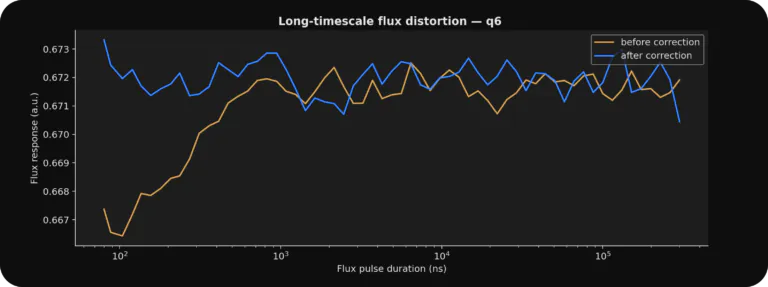
In tunable coupler architectures like the Novera chip, the frequency of the qubits and the couplers are controlled via the flux line. The flux at the device, compared to the source waveform, is distorted due to impedance mismatches, reflections, and bandwidth limitations along the coaxial lines inside the cryostat. These distortions translate directly into gate errors if left uncorrected.
To address this, we characterized the response of both qubit and coupler flux lines and applied compensation using real-time digital filters implemented directly in the OPX1000 control hardware. Because these filters run in real time on the control processor, waveform corrections are applied in real-time without recompilation. This enables a native distortion compensation not reliant on precompiled pulse sequences, a critical ingredient when running non-deterministic sequences such as adaptive circuit algorithms or real-time Quantum Error Correction with feedforward operations.
Once qubits were isolated and control distortions compensated, the next step was to find and characterize two-qubit interactions. On the Novera architecture, this is achieved through tunable couplers, enabling diabatic resonant CZ gates. To apply gates with precise timing, amplitude control, and phase coherence, we first identified the relevant interaction regimes between the qubits and the coupler flux pulses. Within these regimes, we performed interleaved randomized benchmarking (IRB), in which a CZ gate is interleaved within a reference circuit composed of random Clifford gates. By comparing the fidelity decay rates as a function of circuit depth between the reference and interleaved sequences, we extracted the CZ gate fidelity.
At this stage, without any pulse optimization, we already could show CZ gates reached fidelities of approximately 98%.
Refining two-qubit gates to high fidelity
Pushing CZ performance beyond the 99% regime relies on reducing leakage errors, systematic over/under conditional phase rotation, and coherent phase errors that accumulate across gate repetitions. In our workflow, high fidelity came from addressing all three in a tight, measurement-driven loop.
In a diabatic resonant CZ implementation, the interaction drives a controlled excursion between the |11⟩ and |20⟩ states. Ideally, the population returns fully to the computational subspace while acquiring the desired conditional phase. However, imperfect return causes leakage by leaving residual population outside the computational basis, ultimately impacting the gate fidelity.
To circumvent this, we used the recently introduced PALEA (Phase Averaged Leakage Error Amplification) protocol to reach high two-qubit fidelity. The trick was to make small leakage probabilities measurable by coherently amplifying them over many gate repetitions. This improves the signal contrast which in turn enables finer tuning and more precise localization of the leakage minimum.
While clear in theory, executing PALEA places tedious demands on control. The protocol requires alternating pulses at two phase-coherent frequencies on the same qubit to address the |0⟩↔|1⟩ and |1⟩↔|2⟩ transitions while preserving a consistent phase reference throughout the sequence. In QUA, this is handled natively using the real-time update_frequency instruction with keep_phase=True argument, which preserves the phase at both frequencies and removes the need to manually track and re-stitch phases during execution.
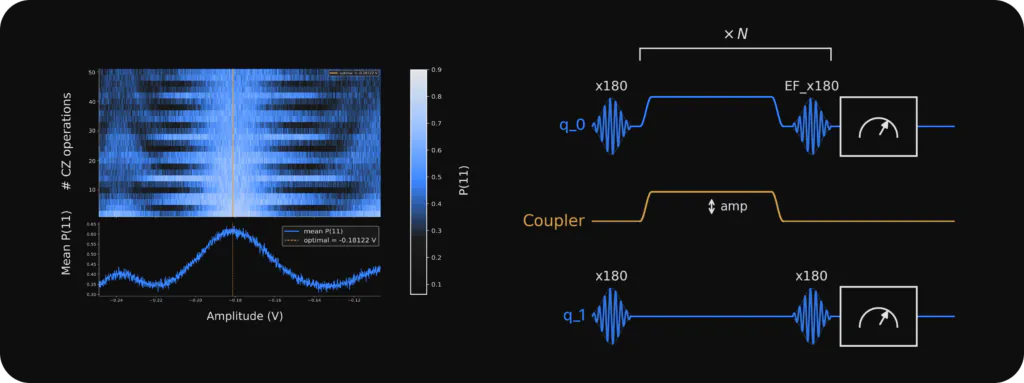
Making the errors visible paid off as these refinements allowed us to reach CZ fidelity distribution across 11 qubit pairs showing above 99% fidelity on all gates with a median of 99.5% CZ fidelity at the device level.

Calibration at scale
These results validate both the performance of the Novera platform and the role of an integrated control and calibration stack in reaching high-fidelity performance quickly and reproducibly across the full device. The same stack is already running in quantum computing environments at Montana State University, Fermilab, and Horizon Quantum, each pushing the platform in different directions, supporting its integration and operation. TreQ also selected the QM OPX1000 for their multi-QPU system, which includes the Rigetti Novera, to develop their first Open Architecture Quantum (OAQ) specification.
The next challenge is sustaining that performance. As QPUs grow and operate continuously over hours or even days, manual calibration becomes the bottleneck. Automated, parallelized recalibration is the only viable path forward. The same is true for quantum error correction, which demands real-time feedforward at nanosecond timescales. Quantum Machines’ Open Acceleration Stack is built precisely for closing the loop between qubit readout and control at the speed the experiment demands.
So, whether you are bringing up a 5-qubit device or scaling toward 50, 500, or beyond, reach out to see what full-device, reproducible operation can look like on your system.
Acknowledgements: We thank Kevin Villegas Rosales and Kyunghoon Jung for the helpful discussions and collaboration throughout this work.
References:
[1] R. Li, K. Kubo, Y. Ho, Z. Yan, Y. Nakamura, and H. Goto, Realization of high–fidelity CZ gate based on a double–transmon coupler, Phys. Rev. X 14, 041050 (2024).
https://doi.org/10.1103/PhysRevX.14.041050
[2] F. Marxer, J. Mrożek, J. Andersson, L. Abdurakhimov, J. Adam, V. Bergholm, et al., Above 99.9% fidelity single–qubit gates, two–qubit gates, and readout in a single superconducting quantum device, PRX Quantum (2026), https://doi.org/10.1103/n86s-2b88.