

Control Tailored For Your Qubits
Explore Quantum Machines’ solutions for diverse qubit modalities, each with distinct control, readout, calibration, and real-time computation needs. Our modular platform adapts to your architecture, enabling faster experimentation today and scalable quantum systems tomorrow.



DIFFERENT QUBIT TECHNOLOGIES
Quantum computing is built on diverse qubit technologies, each with distinct control, readout, calibration and real-time computation needs. Quantum Machines delivers a modular platform that adapts to every qubit modality, enabling faster experimentation today for both research and industrial efforts, at any scale.
Quantum-Classical Integration and Control Highlights
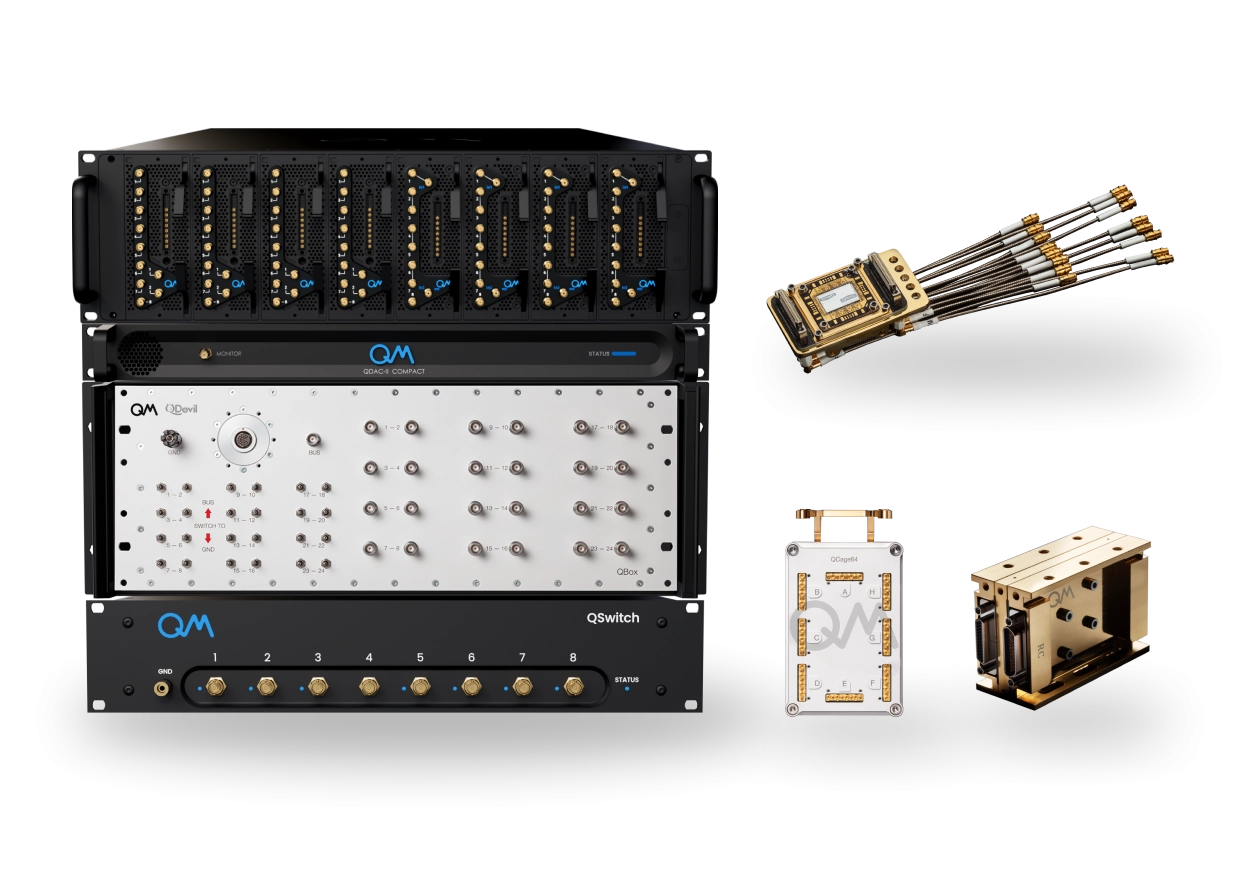
A modular portfolio for all your control, filtering, and sample holder needs
Quantum Machines’ solutions are based on a wide portfolio, which includes room-temperature controllers and cryogenics electronics implementing novel technology.
The OPX1000 offers a unique control paradigm thanks to the combination of its Pulse Processing Unit (PPU), for classical computation during quantum sequences, and its cutting-edge analog frontend, with direct digital synthesis drive and excellent readout capabilities.
The QDAC-II and QDAC-II-compact offer high-density ultra-stable DC and low-frequency controls and, with QSwitch and QBox, allow for flexibility in DC controls at any scale, without trading off on low noise levels.
The cryogenics filters and sample holders from Quantum Machines offer reliable and tested ways to support your samples and signals in cryogenic environments without limiting coherence and sample integrity.
A software suite with pulse-level programming, automated calibrations, and high-level integration
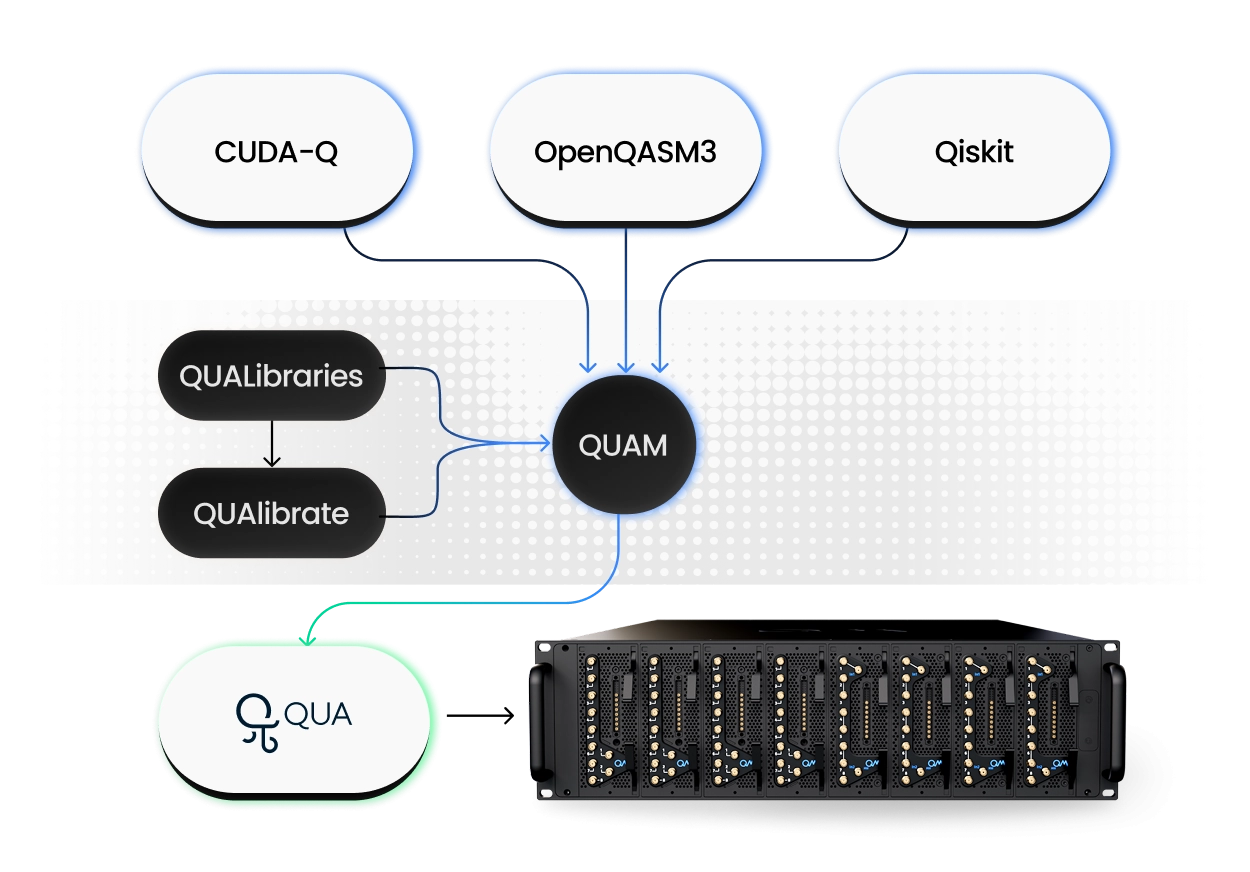
Quantum Machines’ Orchestration Platform allows users to easily program quantum systems of any scale from various levels of the programming stack, by means of multiple layers of abstraction and compilation.
QUA, QM’s open-source pulse-level programming language, enables writing hybrid control sequences, intuitively and from a Python environment. QUA is the core of QM’s software ecosystem, seamlessly combines classical and quantum programming in a comprehensive, expressive, and scalable open-source language. Use the same programming model from one qubit to thousands.
Then QUAM, the qubit abstraction software, and QUAlibrate, the automated calibration framework, enable fully automated calibration workflows which run simultaneously on any number of qubits. Download the QUA Libraries and build on years of accumulated quantum-control expertise to get started faster.
Scalable and Automated Qubit Calibration Framework for High-Fidelity Quantum Systems
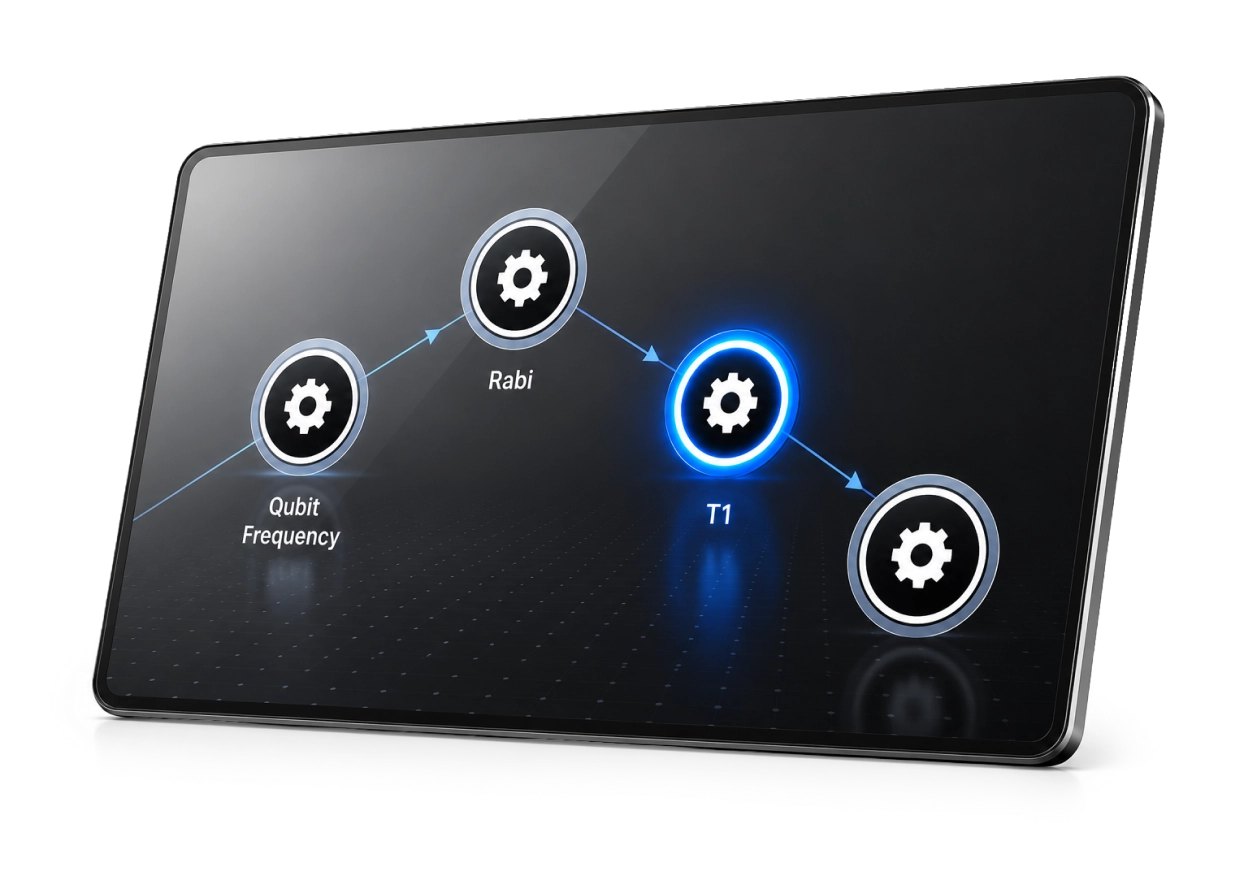
QUAlibrate transforms quantum calibration into a fast, automated, and scalable process. Through a graph-based architecture it enables fast and fully parallelized multi-qubit tune-up increasing fidelity and reducing downtime.
Calibration workflows are defined as customizable graphs of QUA-based nodes, allowing full code-level control over execution and logic. Graphs include Pulse Processing Units (PPU) compute and sequences via QUA, but also classical acceleration via the Open Acceleration Stack. Advanced graph logic optimizes calibration efficiency and allows for complex bring-up and retuning routines to be completely automated.
Powered by QUA and QUAM, QUAlibrate abstracts hardware details, ensuring consistency and scalability across systems while accelerating development and maintaining high-fidelity performance.















QM's control electronics provide the best real-time features along with an intuitive and well-documented programming interface. At TII, we successfully controlled a 25-q chip and conducted multiplexed characterization of all qubits using QM’s OPX and Octave. What we appreciate most, however, is the QM’s unwavering support and commitment to helping us achieve our targets, even going so far as to send some of their best scientists when needed.

Alvaro Orgaz
Lead QC Control
TII, Abu Dhabi
Thanks to the super-fast on-board data processing of the OPX we could resolve the nonlinear phenomena of our superconducting quantum circuits. With conventional AWGs and electronics this would have taken an impractical long time. The OPX is extremely easy to operate and substantially changes the paradigm of data acquisition and analysis procedures in quantum labs.

Dr. Byoung-moo Ann
Researcher
KRISS
The OPX makes developing a brand-new superconducting qubit capability from scratch a breeze. Getting started is straightforward, the coding is easy, and the customer support is fantastic! The OPX reduces the potential barrier to progress and is also well suited for teaching.

Dr. Christian Boutan
Researcher
Pacific Northwest National Laboratory, Richland, WA
I must say I'm very happy with QM's Quantum Orchestration Platform. It's the single most reliable piece of equipment I've got in the lab. I operate it remotely and never had any problems. I strongly recommend the OPX and the QOP to my colleagues. It is by far the simplest way to do qubit physics.

Dr. Emmanuel Flurin
Researcher
CEA Saclay, Quantronics Group
Using high-fidelity rapid readout and real-time state assignment, we were able to do an active reset and generate this noiseless plot (100,000 times averaging) in 20 seconds. Without active reset (assuming 400us between sequences) it would have taken roughly an hour to get a similar quality plot.” Dr. Eunjong Kim Painter Lab, Institute for Quantum Information and Matter (IQIM), Caltech Simultaneous control and reset at scale – 10-qubit device example X180

Dr. Eunjong Kim
Assistant Professor
Seoul National University
With the OPX we were able to reduce the cost of infrastructure development from a few weeks to a few days, without any need to directly program the FPGA.

Dr. Roni Winik
Engineering Quantum System Group
MIT
Quantum Machines' OPX played a key role in our roadmap. It enabled us to get the best control electronics out there [FPGA] without having to learn how to program them. QM provides a very scalable, very easy to use and very powerful hardware, which allows us to focus on the quantum science.

Dr. Théau Peronnin
CEO & Co-Founder
Alice & Bob
Having tried several instruments in the past, I am very impressed by Quantum Machines' OPX. It finally removes the need for us to develop any skills in FPGA programming while still benefiting from advanced FPGA capabilities in our experiments.

Prof. Benjamin Huard
Professor
Ecole Normale Superieure Lyon
The OPX+ has allowed us to tune up complex multi-qubit measurements with multiplexed control and readout signals for studying quasiparticle poisoning and correlated errors in superconducting qubit arrays. The on-board processing has been quite useful for analyzing qubit data streams on the fly.

Prof. Britton Plourde
Professor
University of Wisconsin-Madison, USA
OPX has been a powerful enabler in our lab, helping us quickly characterize the performance of our recently discovered qubits. The hardware removes time wasted in uploading and waiting during pulse programming. QUA has substantially reduced the complexity of writing quantum protocols, allowing us to code dynamical decoupling and RB sequences in just a few lines. It remarkably saves our time in optimizing the processes and visualizing the results, allowing us to focus more on understanding the physics of our new qubits.
Prof. Dafei Jin
Professor
University of Notre Dame
Developing a functional Qubit control electronic system absorbs a PhD-student full time at least for 2 years. QM’S Quantum Orchestration Platform allowed us set up experiments for full Qubit characterization in

Prof. Gerhard Kirchmair
Professor
University of Innsbruck
We are very pleased with the QOP control solution. It’s remarkably easy to use, reliable, and flexible, supporting our advanced quantum research needs. The QOP dramatically expedites our research. Moreover, the Quantum Machines customer team has been instrumental in addressing all our needs to help us to maximize the full potential of the solution. We already use two systems and strongly recommend it.

Prof. Eli Levenson-Falk
Professor
University of Southern California
QCage integrates seamlessly into our workflow of preparing and loading QPUs and supports higher throughput in our lab. Our research directly benefits from QCage's innovative design and engineering.
Prof. Javad Shabani
Professor
New York University
OPX played a crucial role in our advanced quantum experiments. This platform is the most flexible and user-friendly system in our lab. It saved us a significant amount of time, enabling us to concentrate on quantum science and make progress much faster compared to writing our own code. Furthermore, the Quantum Machines customer success team has been extremely helpful in addressing our needs and maximizing the solution's full potential.

Prof. Johannes Fink
Professor
IST Austria
My group is completely satisfied with the multiple OPX systems we’ve purchased. Qubit bring-up is fast and easy, as is optimization of high-fidelity microwave and z-pulse gates. The technical support team at Quantum Machines is outstanding.

Prof. Robert F. McDermott
Professor
University of Wisconsin-Madison, USA
The OPX+ and Octave are a dramatic improvement over the traditional homemade AWG plus DAQ systems. These QM instruments offer ease of use across several levels of abstraction: from implementing and optimizing individual pulses to realizing complex experiments with real time processing and feedback. Coding is user-friendly, which makes transmitting the know-how between group members much more straightforward.
Prof. Sorin Paraoanu
Associate Professor
Aalto University

Accelerate Your Research, From Day One
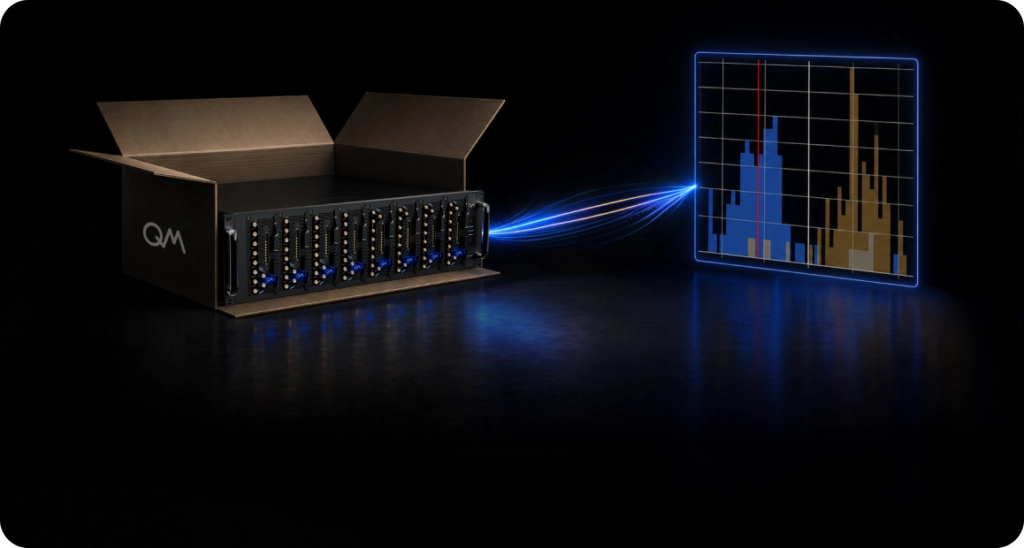
Stop losing weeks to setup and calibration. Our PhD-level Customer Success team ensures your systems run smoothly from unboxing to experiments.

Fast to Physics
From unboxing to operational results in days, not months.
Get your system running immediately with onsite expertise and proven quantum control workflows.

A Long-Term Partnership
Lab-mate level support beyond troubleshooting.
We stay engaged as your research evolves, capturing knowledge and ensuring smooth scaling.

Built to Scale
Seamless growth without costly redesigns.
Implement automation-first calibration and structured control workflows to expand effortlessly.

Local Expertise
Platform-specific know-how at your bench.
Access dedicated PhD-level specialists worldwide to resolve issues faster and reduce iteration cycles.
FAQs
How is qubit readout performed across different qubit modalities?
Readout depends on the modality, and QM’s hardware handles each in real time: superconducting and spin qubits are read out by digitizing the microwave or RF signal from a coupled resonator, while atoms, ions, and defect centers are read out optically using built-in photon counters and time taggers, with camera-based imaging for atom arrays. In every case the OPX captures the raw signal, classifies the qubit state, and can feed that result straight back into the running program. Keeping readout and classification on the controller, rather than shipping data to a separate computer is what makes low-latency, mid-circuit measurement possible.
What is the difference between a physical and a logical qubit, and how does the control system enable logical qubits?
A physical qubit is a single real device, while a logical qubit is an error-corrected qubit built from many physical qubits, so errors can be detected and corrected as a computation runs. Quantum error correction depends on a tight real-time loop: measure many qubits mid-circuit, decode which errors occurred, and apply corrections, all within the qubits’ coherence window. This is exactly where the control system matters: it must perform measurement, classical decoding, and feedback fast enough to keep up, which is why QM’s architecture brings classical processing as close as possible to the qubits to eliminate the latencies that error correction is so sensitive to.
How do you program and calibrate qubits with Quantum Machines?
Qubits are programmed on QM hardware using QUA, a pulse-level language that lets developers implement quantum sequences and classical processing around them in a single program. Routine bring-up is handled by QUAlibrate, QM’s automated calibration framework, so labs spend less time manually tuning and more time running experiments. And because sequences run directly on the controller, deep protocols like randomized benchmarking execute in minutes, with no uploading or compilation time.
What hardware is used to control qubits?
Qubits are controlled by specialized quantum control hardware that generates the microwave, RF, and laser-driving pulses, captures readout signals, and runs real-time classical processing to steer the experiment. Quantum Machines’ OPX controllers, for example, integrate control and real-time processing in a single platform and bring classical resources as close as possible to the qubits, across superconducting, spin, and atom-based modalities. This proximity enables ultra-fast feedback,including active resets as fast as 120 ns, that is essential for adaptive protocols and error correction.
Built for Researchers. Ready for Industry.
Built to support every stage of the quantum journey. Whether you’re advancing fundamental research or scaling quantum systems toward real-world applications, explore the solutions designed for your goals.