

QM’s Technology Hub
From the cleanest microwave generation to the fastest feedback in industry. Have a look at Quantum Machines’ technological backbone.
Built with the most advanced technologies
Quantum Machines’ Customer Success team works as an extension of your lab or engineering group — from
onboarding to advanced experiment design.
Hybrid Control enabled by Quantum Machines’ unique Pulse Processing Unit
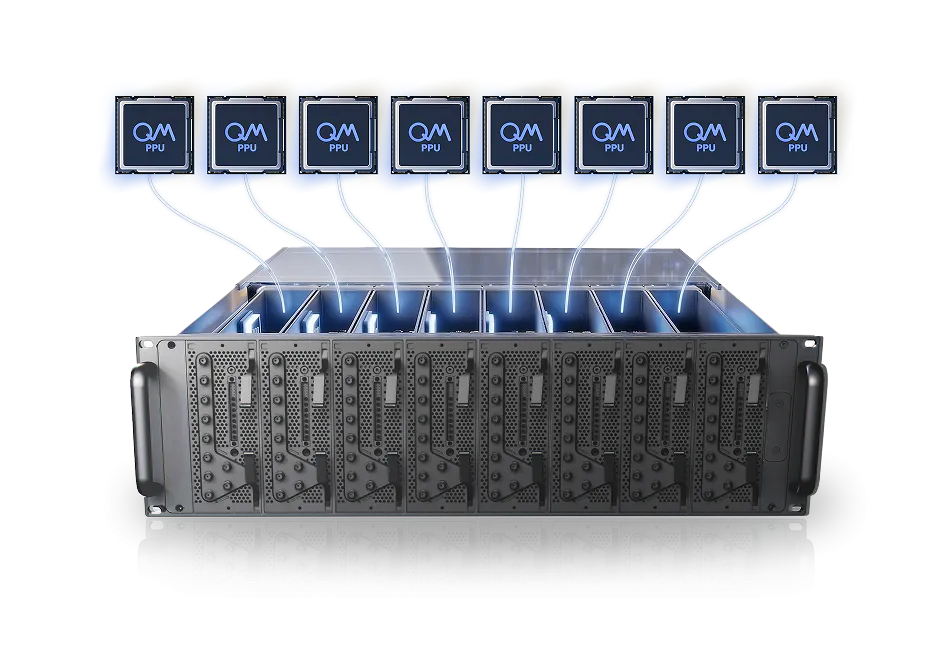
Quantum Machines’ OPX hybrid controllers integrate classical compute into quantum sequences thanks to their unique Pulse Processing Unit (PPU): the most advanced processor dedicated to orchestration of quantum sequences, with processing, generation of signals, and readout.
The PPU enables real-time execution of quantum protocols with minimal overhead and a scalable architecture that allows multiple processors to work as one. It performs calculations in real-time, uniquely allowing for advanced protocols involving parameter change during sequences, or complex calculations such as Bayesian estimations or adaptive control flow protocols.
Thanks to QUA, QM’s open-source pulse-processing language, the PPU is intuitive to instruct via a Python interface while the programs run always at the lowest level of the hardware.
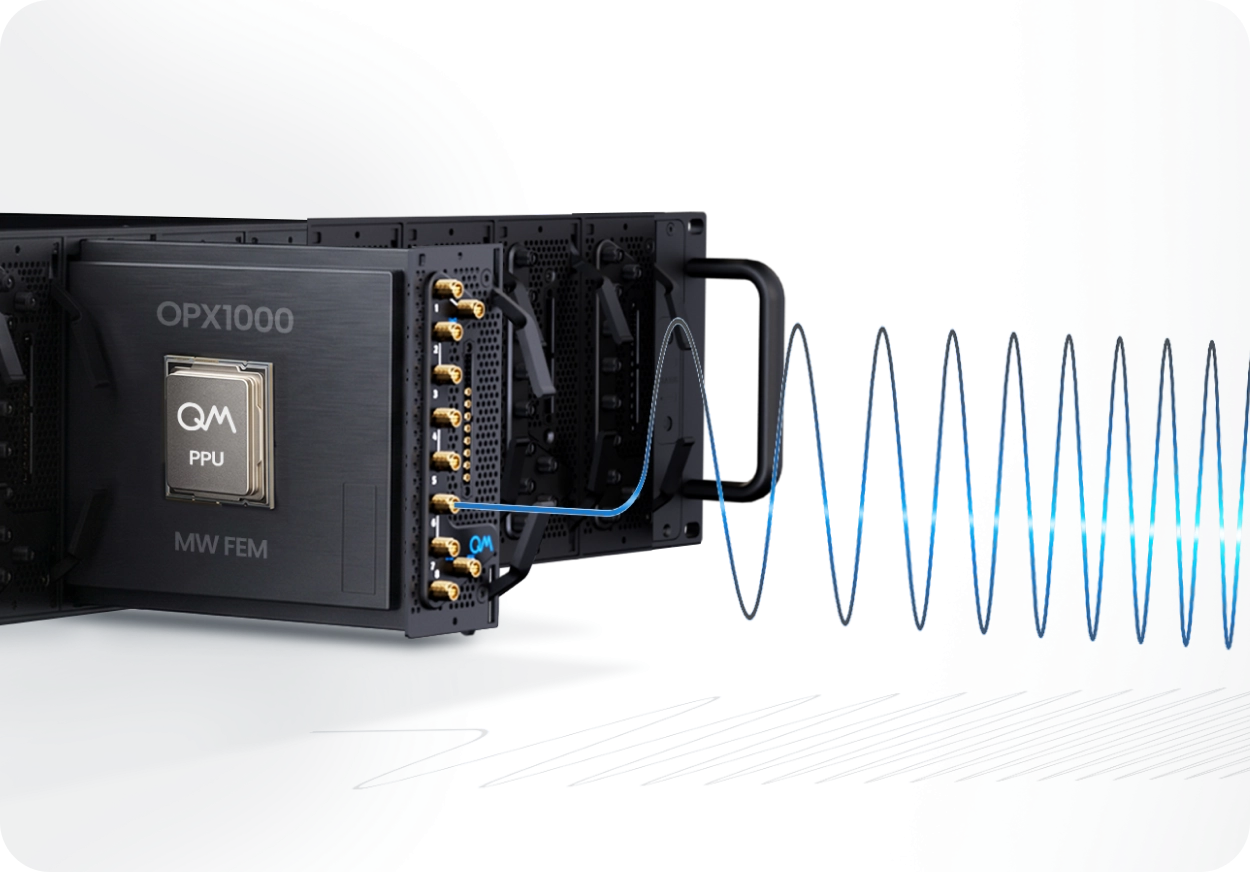
Direct Digital Synthesis for Scalable, High-Fidelity Microwave Control of Quantum Systems
The OPX1000 leverages Direct Digital Synthesis (DDS) to generate microwave signals directly from digital data, fully removing the need for mixers, local oscillators, and complex analog calibration. This streamlined architecture reduces noise, improves reliability, and enables precise, repeatable control of qubits.
DDS delivers the highest spurious-free dynamic range across the full frequency spectrum, along with wide bandwidth and flexible multiplexed operation. A single shared clock ensures ultra-high phase coherence across channels, while digitally controlled oscillators provide deterministic phase control in real time. With fewer components and a highly modular design, DDS enables high channel density and offers a scalable, cost-efficient path to controlling large quantum processors.
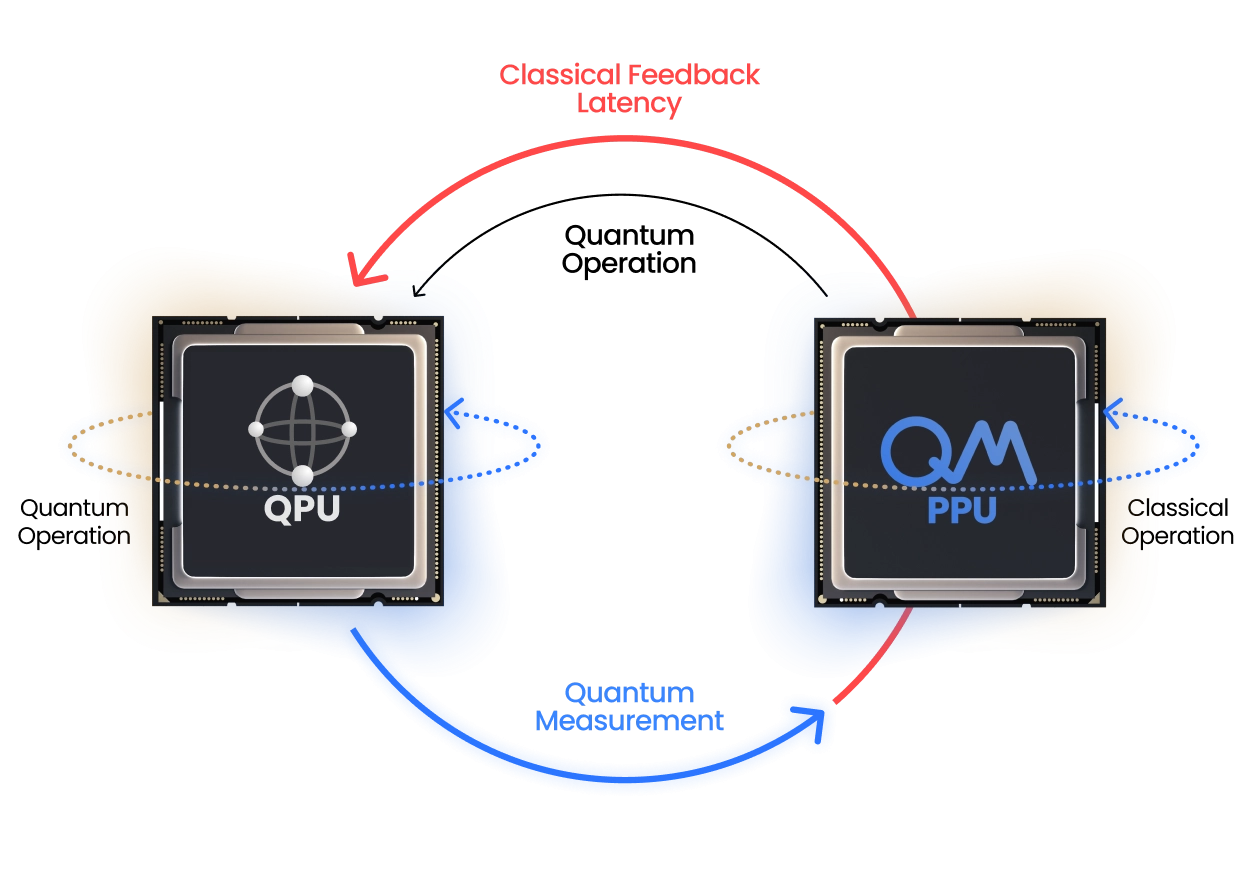
Ultra-Fast Real-Time Feedback for Fully Adaptive Quantum Circuits
Enable fully adaptive quantum circuits through ultra-fast real-time feedback tightly integrating quantum and classical processing. QM’s Orchestration platform executes measurement, computation, and response with Hybrid Controllers, while extending classical acceleration through the Open Acceleration Stack for more complex workloads.
Feedback operations ranging from conditional pulses to dynamic control flow and parametric updates are applied seamlessly at the pulse level, enabling mid circuit measurements and unlimited branching. Performance spans quantum real-time (QRT), system real-time (SRT), and near real-time (NRT), ensuring responses occur within coherence times, adapt to system drift, and scale to fault tolerance. This architecture maximizes fidelity, efficiency, and scalability in advanced quantum protocols.

Accelerate Your Research, From Day One
Stop losing weeks to setup and calibration. Our PhD-level Customer Success team ensures your systems run smoothly from unboxing to experiments.

Fast to Physics
From unboxing to operational results in days, not months.
Get your system running immediately with onsite expertise and proven quantum control workflows.

A Long-Term Partnership
Lab-mate level support beyond troubleshooting.
We stay engaged as your research evolves, capturing knowledge and ensuring smooth scaling.

Built to Scale
Seamless growth without costly redesigns.
Implement automation-first calibration and structured control workflows to expand effortlessly.

Local Expertise
Platform-specific know-how at your bench.
Access dedicated PhD-level specialists worldwide to resolve issues faster and reduce iteration cycles.

FAQs
What is Direct Digital Synthesis (DDS) and why does QM use it?
DDS generates microwave signals directly from digital data, removing analog mixers and local oscillators. It synthesizes signals across 0.1–10.5 GHz directly from digital waveforms, eliminating complex calibration, with low phase noise and high spectral purity. A single shared clock keeps phase coherent across channels, enabling high channel density and a cleaner, more scalable signal chain.
What are quantum real-time, system real-time, and near real-time (QRT/SRT/NRT)?
They’re the three timescales QM benchmarks feedback against. QRT compares controller latency to the qubit’s coherence, SRT to the drift of the setup, and NRT to the duration of the full circuit. This covers active reset, drift-tracking calibration, and algorithm-level loops respectively.
What kinds of real-time feedback can QM controllers perform?
The full pulse-level range including conditional operations, full control flow, and parametric updates, plus mid-circuit measurement and effectively unlimited branching. A running program can apply a conditional pulse, branch, or update a frequency on the fly, and the Open Acceleration Stack extends this to external CPUs, GPUs, and FPGAs for heavier workloads.
How does the technology scale across many channels and chassis?
Multiple PPUs, one per front-end module, across any number of OPX1000 units, are programmed together and operate as one, while DDS channels share a common clock for phase coherence. QM’s synchronization technology holds jitter, phase stability, and skew even across multiple controllers and racks, so the system behaves as one coherent instrument.