

Make your quantum circuits truly dynamic
through mid-circuit measurements, powerful real-time processing, and infinite branching possibilities






Adaptive Quantum Circuites (AQCs)
move beyond static circuits, fixed thresholds, clear circuit parameters and control flow. Dynamically adapt in real
time, based on computation and outcomes of mid-circuit measurements, allowing for infinite branching on fully
adaptive quantum-classical circuits.

Comprehensive
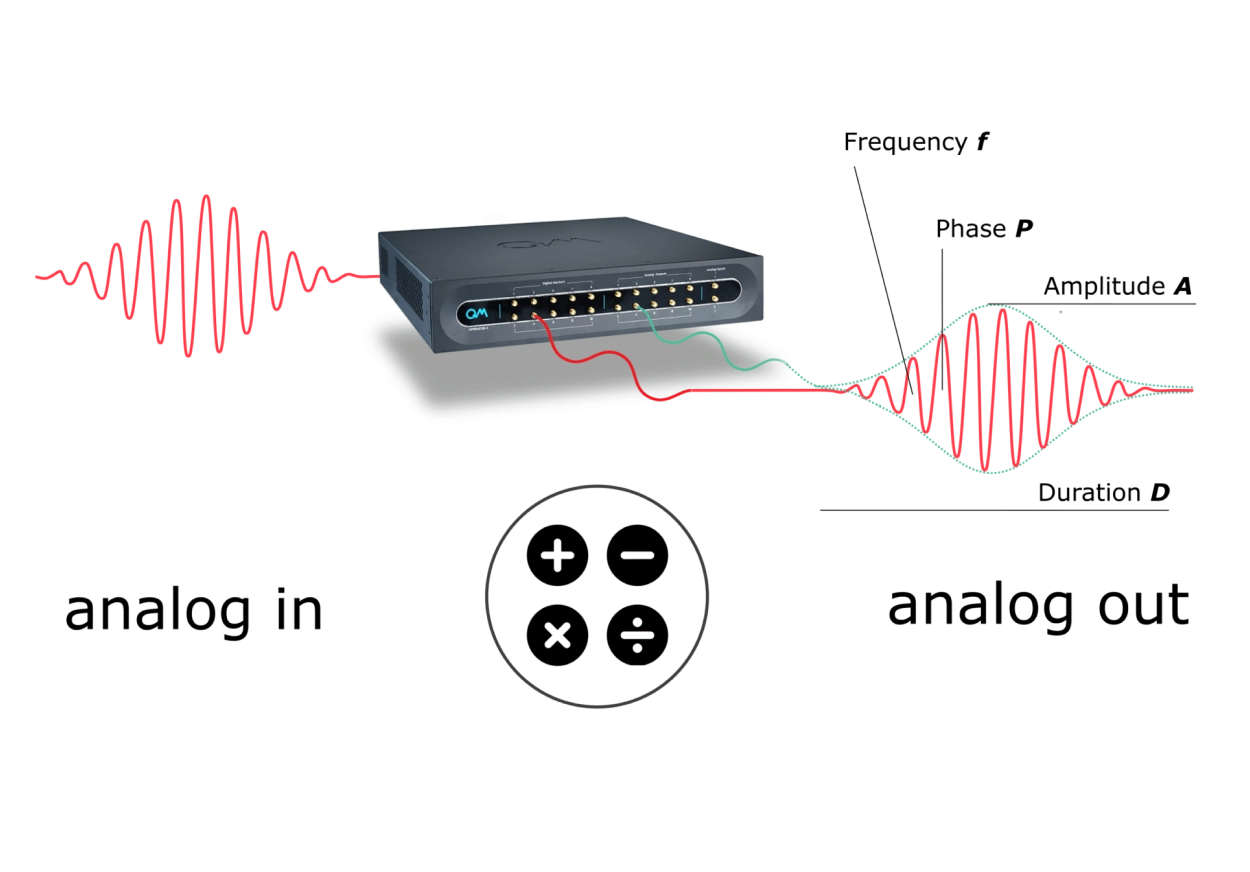
Any manipulation of the quantum circuit done dynamically: conditional pulses, flow control and parametric updates.

Analog & Digital
Calibrate coefficients and parameters in real-time to achieve the highest operation fidelities keeping the up-time high.

Real-Time
Calculations and reactions are happening during the quantum circuit and faster than the qubit’s coherence time.
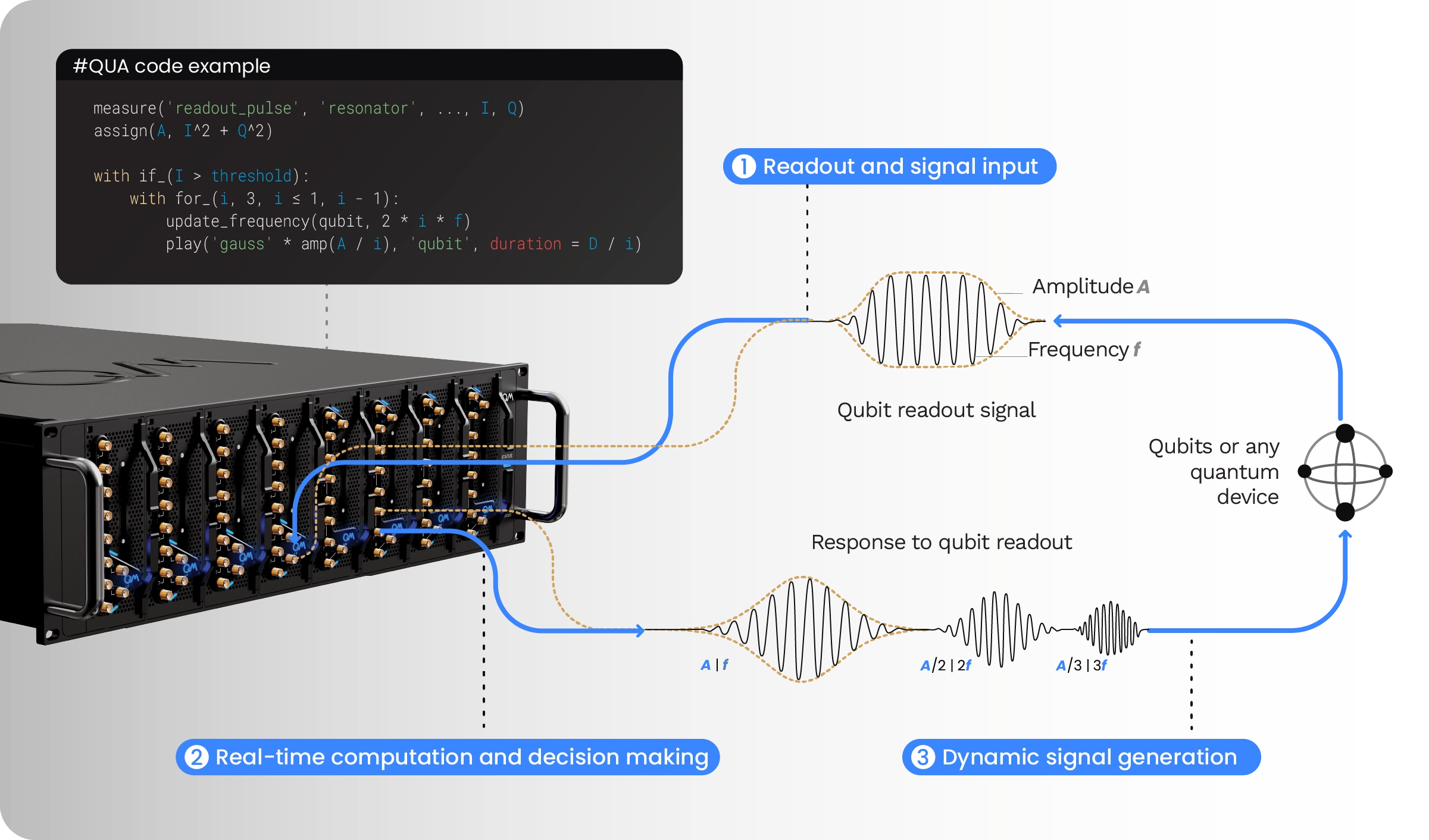
Use real-time feed-forward and feedback composed of the state space of quantum systems. Quantum feedback is enabled by combining FPGA-based deterministic processing, analog processing, and real-time control.
Quantum Feedback in Numbers
Quantum feedback, in its most arbitrary form, allows utilizing and reacting in real-time to information processed from measurements. This requires a high level of integration between classical and quantum resources. Here we focus on quantum real-time (QRT) latency benchmarks, which refer to the delay required for operations that must occur faster than qubit decoherence. We present the numbers for our Quantum Machines’ OPX controllers. To learn more about the control benchmarking system we use click below.
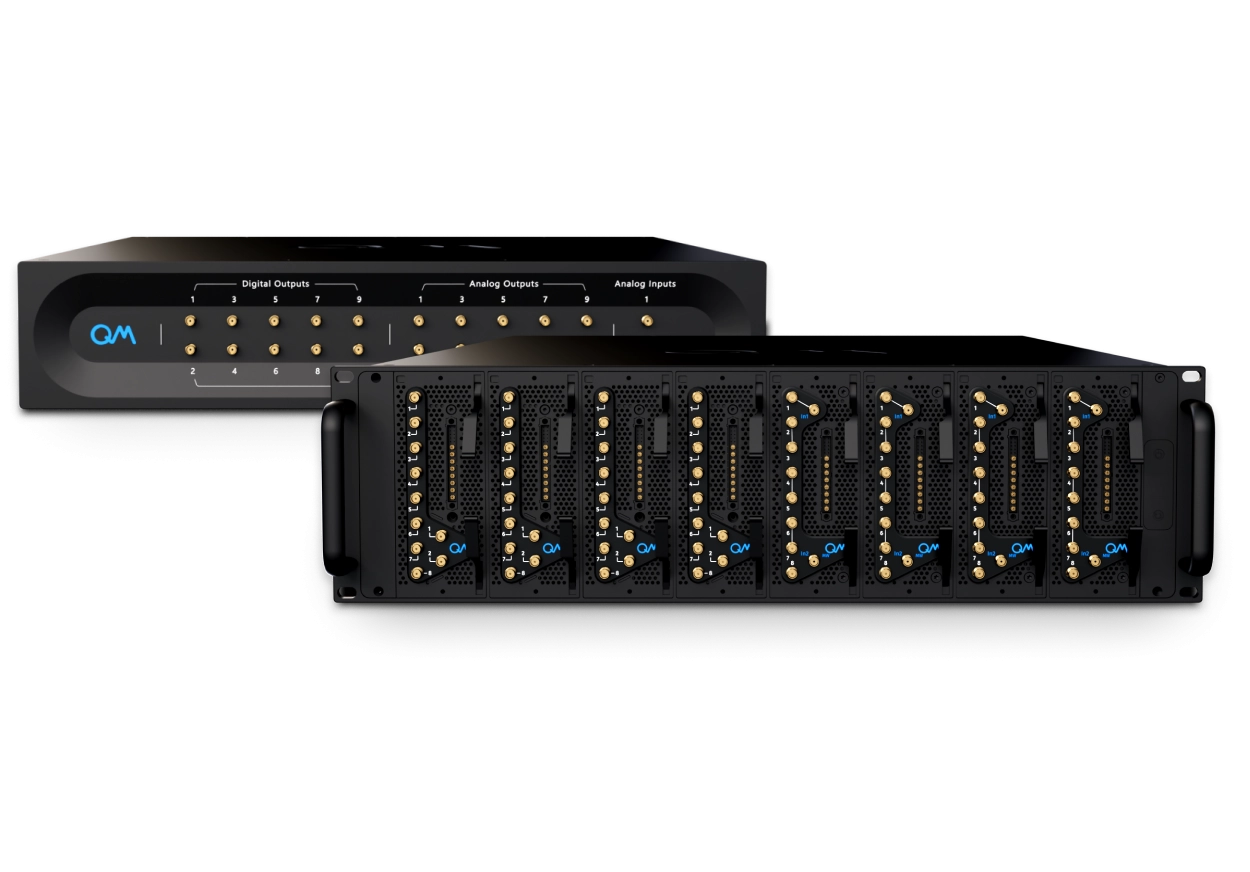
OPX+ Latency Benchmarks
OPX+ controller’s architecture and its QUA programming language, allow for intuitive programming of comprehensive feedback. The PPU responds to measurements, performs calculations and orchestrates the experiment’s control flow and qubit drives based on measurements. As a result, OPX can do much more than the traditional “play/no play” feedback or two-paths-only branching. It easily supports the implementation of advanced dynamic circuits right out of the box. Here we show OPX+ latency for a few QRT feedback benchmarks, such as Active Reset using standard feedback in under 250 ns and π-pulse calibration under 300 ns (numbers for analog-to-analog, while analog-to-digital requires half the latency). Read below for an explanation of the protocols.
Latency numbers explained
Conditional Pulse
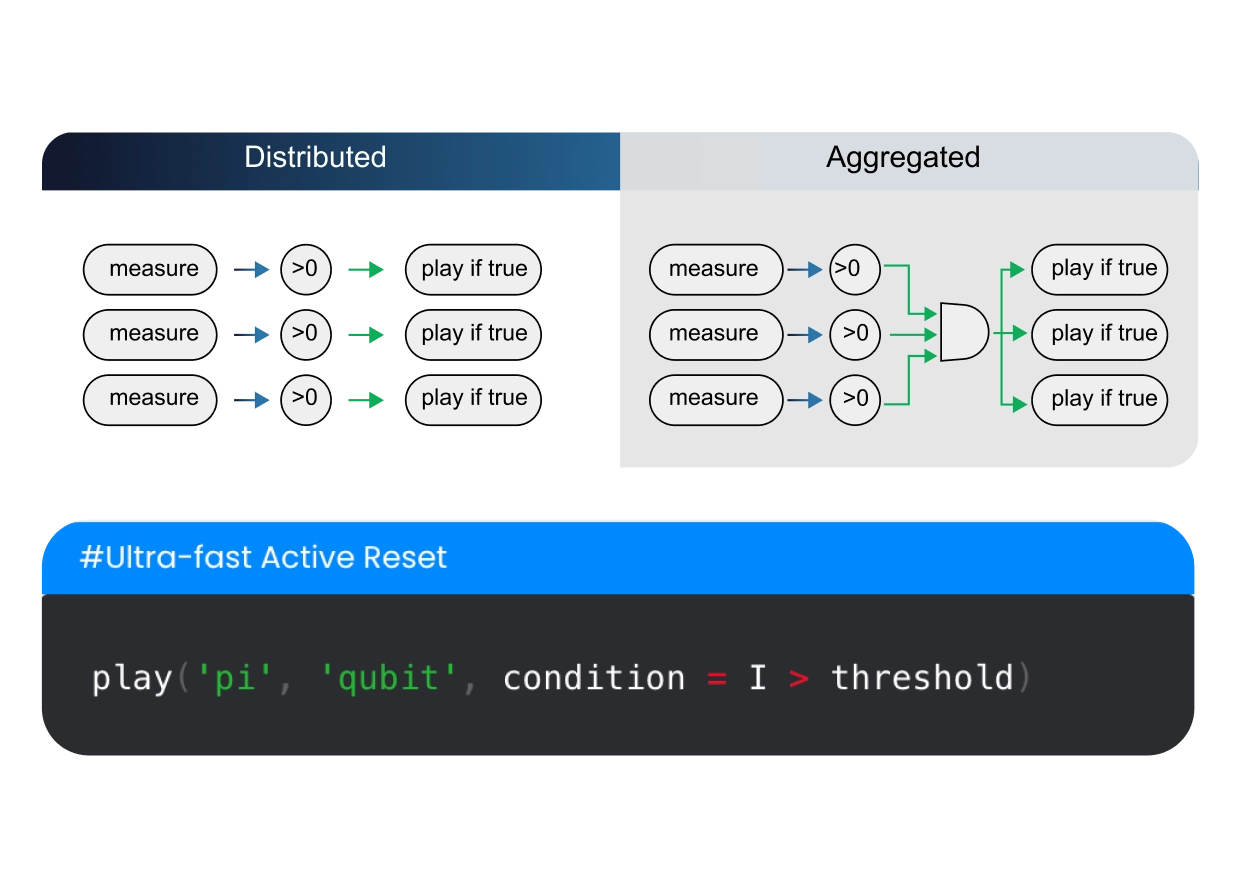
Ultra-fast active reset example
A pulse is either generated or not, according to the Boolean result of classical processing of measurement results. From the moment the last point of a measurement input pulse comes to the controller, OPX processing unit performs state discrimination and decision making, and then produces a reset pulse conditionally on the qubit being in the excited state. This takes 224 ns for one qubit, the fastest arbitrary analog-to-analog feedback in the industry. Easily extendable to any number of qubits simultaneously, and can be performed aggregating or distributing the processing.
Real-time Control Flow
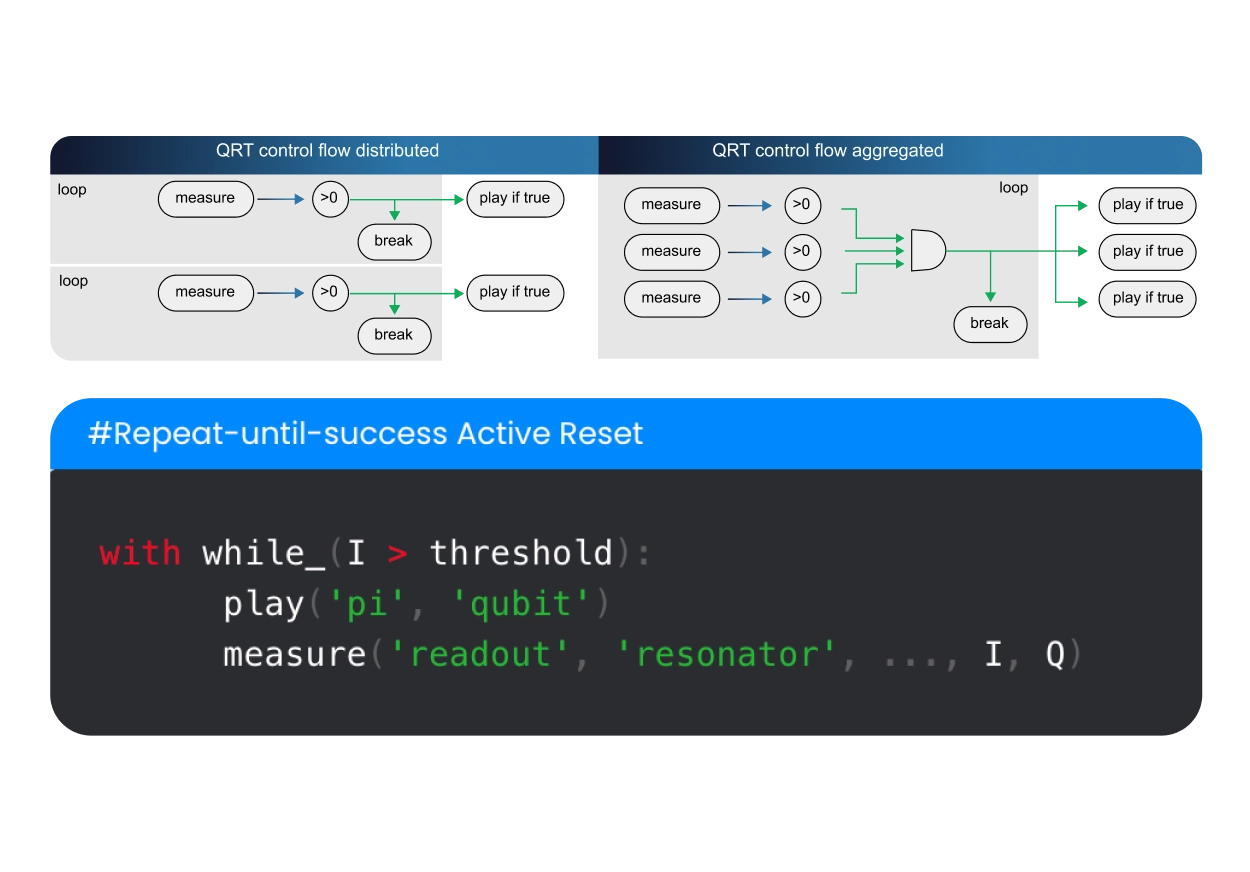
Repeat-until-success active reset example
OPX can change the flow of the program in real-time based on the classical processing of measurement results. The ability to respond to events with real-time decision making based on measurements allows for repeat-until-success (RUS) sequences, where the controller responds dynamically to events as they unfold, in a non-deterministic process. For example, RUS active reset allows to continuously reset until the qubit is in the required state with a given probability, to perform experimental shots always in the required conditions without wasting time.
Parametric Updates
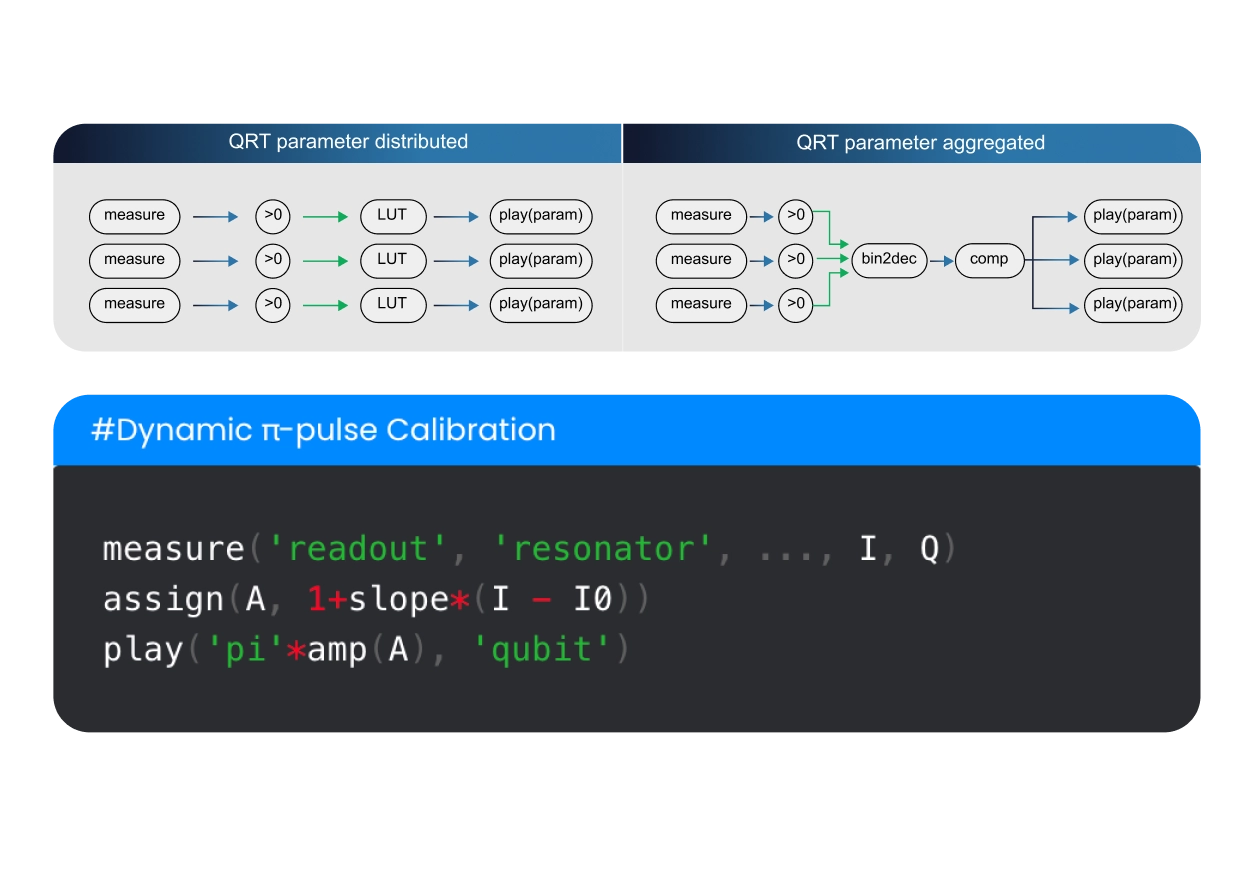
π-pulse calibration example
The OPX can dynamically change parameters (e.g. amplitude, frequency, phase, chirp, threshold, etc.) of a pulse-level operation based on processed measurement results. For example, in a π-pulse calibration, we instruct the pulse processor to change the amplitude of a the pulse dynamically, responding to a measurement, comparing the result to a previous value. Parametric changes are done with ultra-low latency, improving repetition rates of experiments, calibration rates and reducing overhead.




Extreme Speed-Up
Perform operations within coherence times, enabling faster experiments and higher throughput.

Highest Fidelities
Minimize errors with precise, real-time control and feedback.

Mitigating Errors
Detect and correct errors dynamically during circuit execution.

At Any Scale
Scale feedback and adaptive control across complex quantum systems.

Replacing 3 devices with one synchronized, orchestrated machine tremendously simplified lab workflow. Now our pulse sequences run in a fraction of the time of any other device combo. Plus, we can “talk” to the FPGA in human-speak, to run real-time calculations that were too complicated before! Along with the yoga-level.
Diraq is delighted to partner with Quantum Machines, and credits their OPX control system, with its real-time capabilities, as instrumental in achieving the results outlined in our research. The ease of programming sequences in QUA significantly streamlined the experimental process
