

Defect Centers Qubits
Control defect-center qubits with synchronized optical excitation, microwave/RF pulses, photon detection, and real-time logic. Move from emitter discovery to calibrated spin control and multi-spin register operation with QM’s Orchestration Platform.








Research
Research in defect centers is advancing a highly promising qubit modality based on atomic-scale quantum emitters and spin defects hosted in solid-state and emerging quantum materials, including diamond, silicon carbide, silicon, rare-earth-doped crystals, two-dimensional materials, heterostructure and epitaxial nanostructures, and more. These systems offer optical addressability, long coherence times, and operation across a range of temperatures, making them attractive for quantum computing, quantum networking, and quantum sensing applications.
Ongoing research focuses on improving material quality, enhancing spin coherence, optimizing optical and microwave control, integrating defect centers with photonic structures, and scaling from individual defects to larger, interconnected quantum systems. These efforts require close coordination across quantum optics, materials science, microwave engineering, nanofabrication, and advanced experimental control.
Quantum Machines supports defect center research and commercial development by providing high-performance control and orchestration platforms that enable precise synchronization of optical, microwave, and RF signals across complex experimental sequences. With flexible pulse design, real-time feedback, and tight timing control, these platforms help researchers accelerate experimental iteration, improve measurement fidelity, and advance defect-center technologies toward scalable quantum systems, distributed quantum networks, and practical quantum sensing applications.
Set Up Architecture
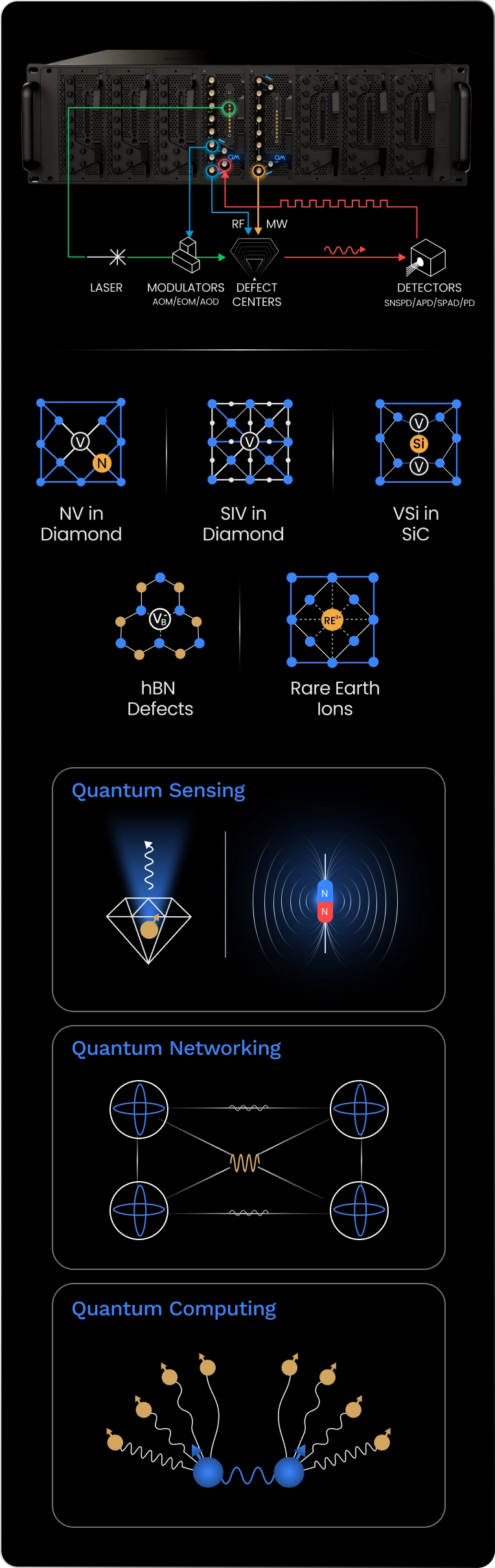
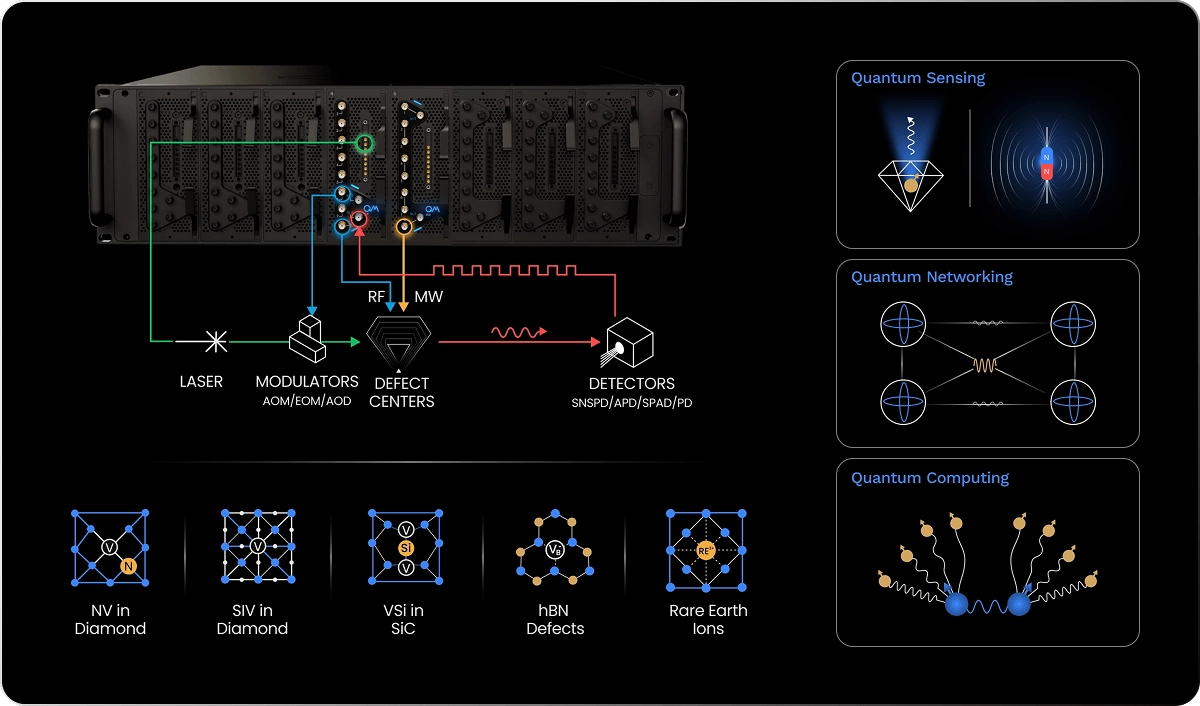
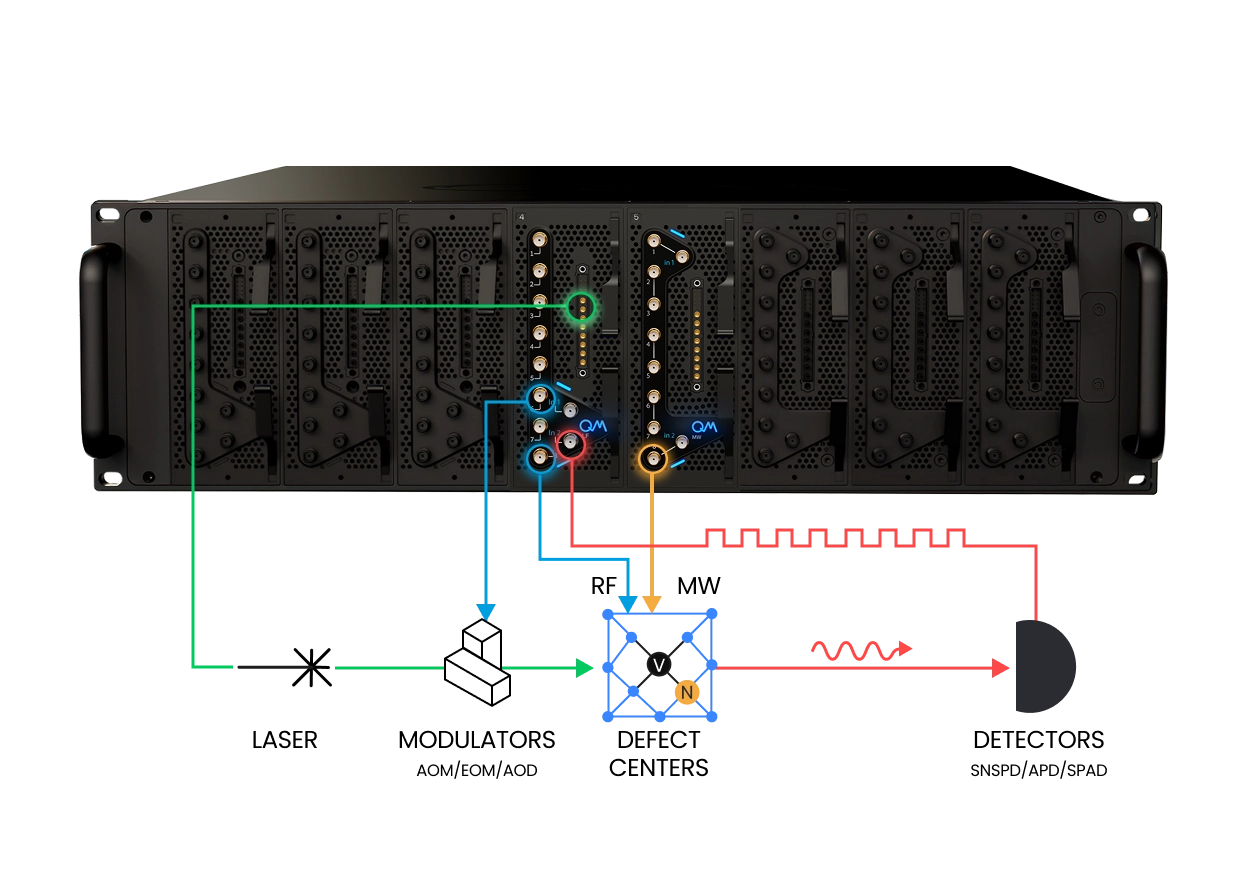
Quantum-Classical Integration and Control Highlights
Programmable Control for Defect-Center Qubits
How long does it take to go from identifying a promising emitter to running calibrated spin-control experiments? Defect-center research often begins with repetitive but essential measurements: ODMR, Rabi, Ramsey, T₁, T₂, echo, lifetime, charge-state dynamics, and correlation experiments. Each of these routines requires precise coordination between optical excitation, photon detection, microwave and RF pulses, external devices, and repeated parameter sweeps.
QM’s Orchestration Platform turns these workflows into programmable, real-time protocols. With OPX, researchers can define experiments at the pulse level in QUA, sweep parameters such as frequency, phase, amplitude, pulse duration, and wait time directly on the pulse processor, and acquire photon counts or time tags within the same synchronized sequence. Instead of uploading long static waveforms or manually coordinating multiple instruments, labs can build flexible calibration routines that are easy to modify, automate, and reuse.
Whether you work with NV centers, SiC defects, rare-earth ions, color centers in diamond, or other optically addressable systems, OPX helps shorten the path from discovery to calibrated control. By combining pulse generation, photon-aware sequencing, real-time logic, and multi-device synchronization in a single programmable platform, QM enables defect-center labs to accelerate daily characterization and focus quickly on the underlying physics, while supporting future workflows in quantum sensing and quantum networks.
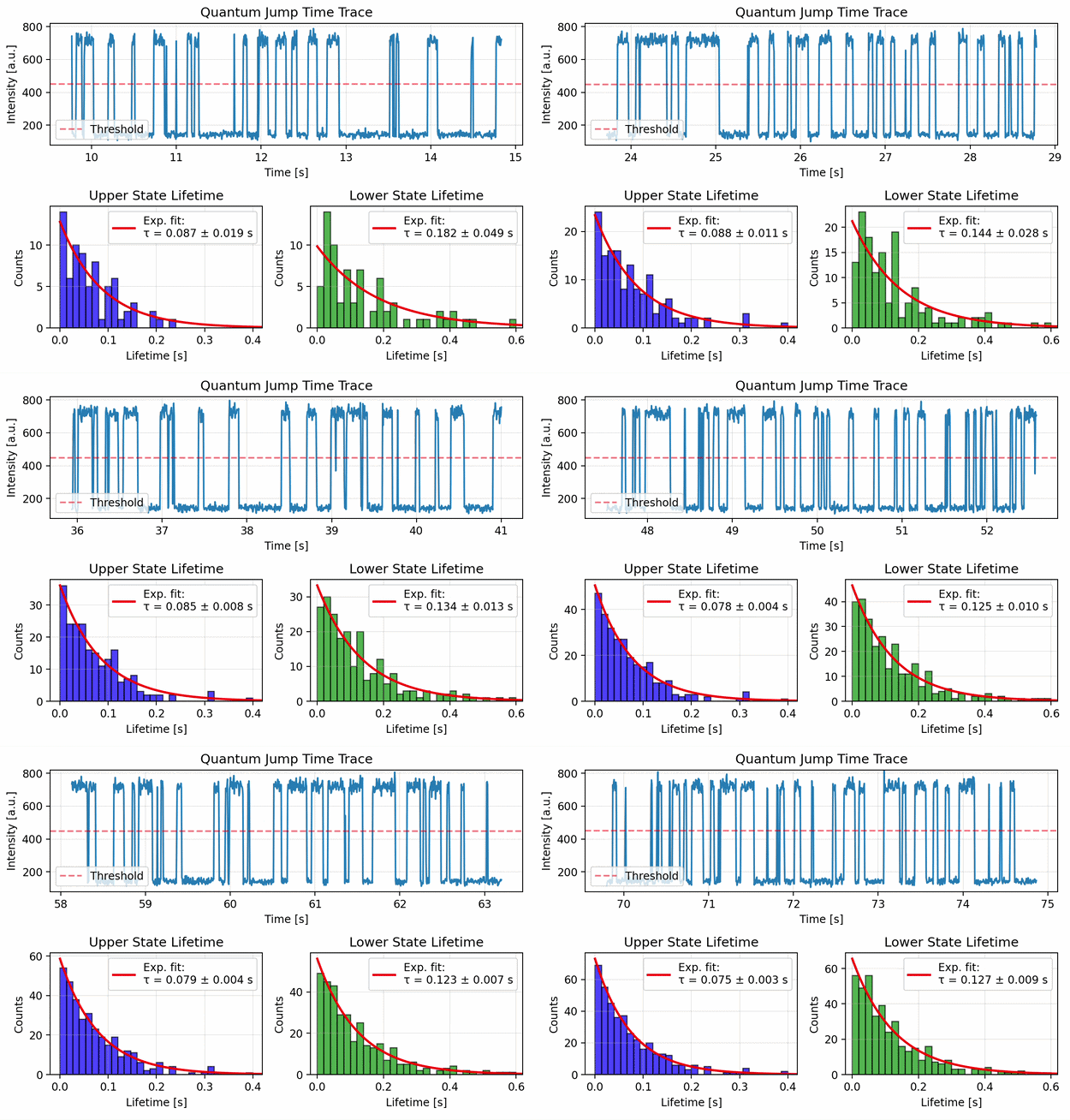
Automated Emission Discovery, Screening, and Characterization
Finding the right defect center is often the first experimental challenge. Before advanced spin control, sensing, or networking protocols can begin, researchers need to locate suitable emitters, verify their optical stability, characterize their brightness and lifetime, identify charge-state behavior, and confirm that they can be addressed reliably. This is especially important when working with implanted samples, nanofabricated photonic devices, integrated cavities, waveguides, or large arrays of candidate emitters.
QM’s Orchestration Platform helps turn this discovery process into an automated and reproducible workflow. OPX can synchronize laser pulses, detectors, microwave and RF channels, digital triggers, and external instruments while collecting photon counts, time tags, and correlation data within the same experimental sequence. Screening routines such as photoluminescence maps, lifetime measurements, g² measurements, spectral checks, ODMR scans, and charge-state tests can be programmed, repeated, and extended without rebuilding the full control stack.
This allows defect-center labs to move faster from material or device fabrication to validated quantum systems. Instead of manually coordinating separate instruments for every screening step, researchers can automate high-throughput characterization, compare emitters under consistent conditions, and identify the most promising defects for calibrated spin control, sensing, or photonic integration.
Multi-Spin Registers, State Preparation, and Real-Time Reset
Many defect-center platforms offer more than a single optically addressable electron spin. Nearby nuclear spins, coupled electronic states, or additional defects can form local quantum registers that act as memory qubits, auxiliary sensors, or resources for multi-qubit protocols. Controlling these systems requires precise microwave and RF pulse sequencing, phase-coherent operations, conditional gates, long dynamical-decoupling sequences, and careful synchronization between optical initialization, spin manipulation, and photon-based readout.
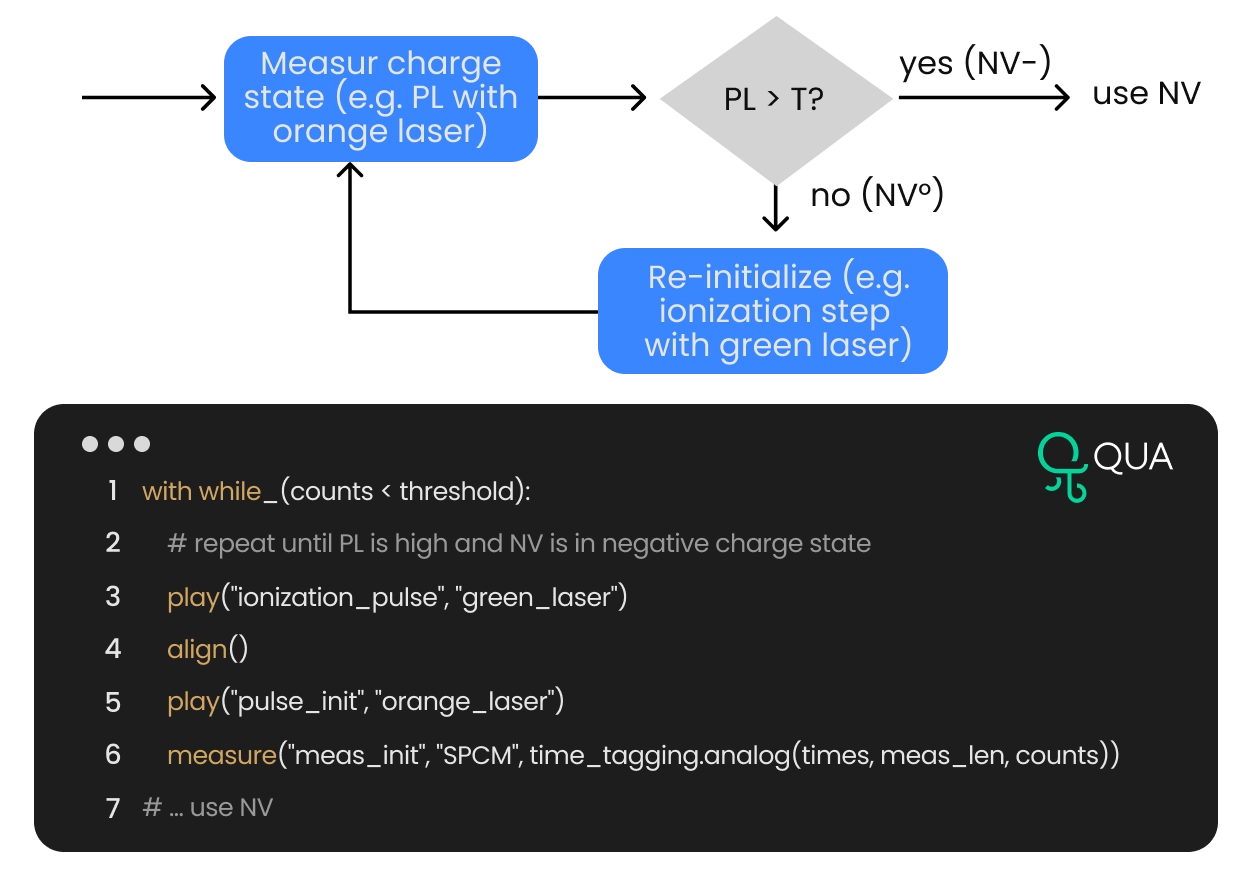
QM’s Orchestration Platform enables researchers to program these workflows at the pulse level. With OPX and QUA, microwave and RF pulses can be played within the same synchronized sequence, while parameters such as phase, frequency, amplitude, pulse duration, and timing can be updated dynamically. Photon counts and time tags can also be processed during the sequence, allowing the controller to decide whether to continue, reset, repeat initialization, or apply the next operation.
This makes OPX especially useful for electron-nuclear spin control, quantum memory experiments, conditional operations, active charge reset, and repeat-until-success preparation routines. Instead of treating initialization and calibration as fixed overhead, defect-center labs can turn them into adaptive real-time workflows that improve reliability, reduce dead time, and support more advanced local quantum systems.



Replacing 3 devices with one synchronized, orchestrated machine tremendously simplified lab workflow. Now our pulse sequences run in a fraction of the time of any other device combo. Plus, we can “talk” to the FPGA in human-speak, to run real-time calculations that were too complicated before! Along with the yoga-level
Prof. Amit Finkler
Professor
Weizmann Institue of Science
We are very impressed to see how simple yet powerful the OPX controller is, as we rebuilt our noise spectrometer for NV centers in a fraction of the time it took us with other instruments. Now, a student with no experimental experience can run the system autonomously, even programming new and advanced dynamical decoupling sequences which include real-time computation. QM's controller is easy to use, and its unique capabilities enable fast and steady progress in our lab.

Prof. Chandrasekhar Ramanathan
Professor
Dartmouth College
I regard Quantum Machines as the quintessential example of how deep-tech companies should operate in harmony. Their OPX+ devices exemplify excellence, and the team's unmatched business ethos sets them apart. From unboxing the OPX+ to the first measurements is a truly exhilarating experience. They consistently go above and beyond for their customers, ensuring mutual success. Transitioning from academia to the startup realm, I have rarely encountered a company as remarkable as Quantum Machines.

Dr. Gopi Balasubramanian
CEO, Co-founder
XeedQ
The Quantum Machines OPX control system has been an enabling technology for our research. It provides unparalleled flexibility and ease of use for experiments requiring real-time quantum feedforward control. With the integrated high-resolution time tagging, this platform is a no-brainer for advanced quantum networking experiments.

Prof. Andrei Faraon
Optical and Quantum Engineer
Oratomic
Using the OPX has been simplifying our work in many respects due to the intuitive implementation of sequences within QUA. In addition, the support by QM helped us debugging possible issues with swift responses and an easy and informal way of getting in touch over Discord.

Prof. Yiwen Chu
Professor
ETH Zurich
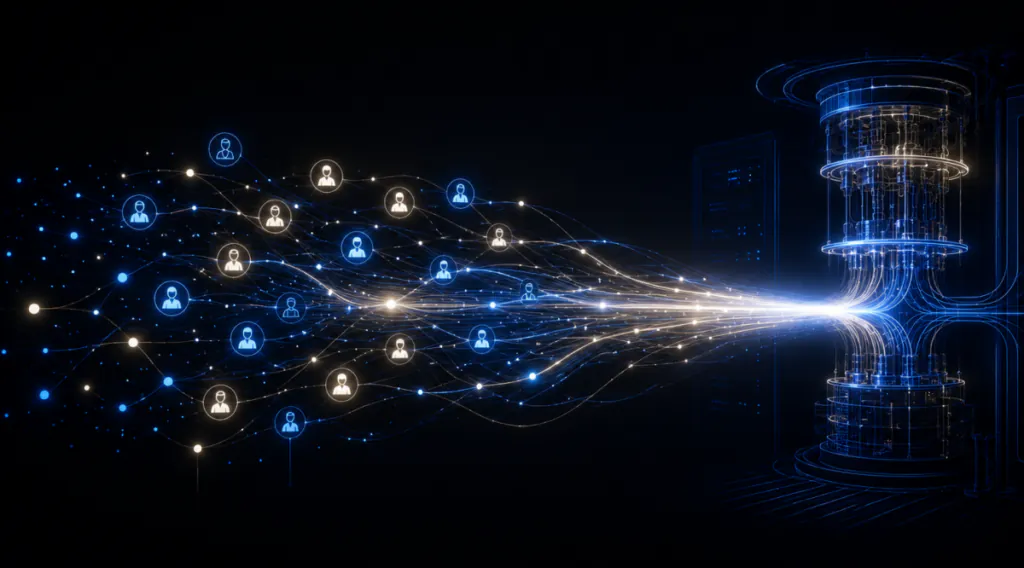
Reinforcement Learning Two Qubit Gate Calibration
Read more August 2026 | 12 min readFrom Classroom to Cryostat: How Hands-On Quantum Control Is Training the Next Generation
Read more August 2026 | 6 min readGate Dispersive Charge Detection in Ge/SiGe Quantum Dots
Read more October 2026Real-Time Adaptive Filtering and the Boxcar Limit in Superconducting Qubit Readout
Read more September 2026FAQs
Which defect-center and color-center systems does the OPX support?
The OPX controls optically active spins across a wide range of host materials — diamond, silicon carbide, silicon, hBN, but also heterostructure and epitaxial quantum dots and oxides — whether the defect is vacancy-type like the NV center or substitutional, such as rare-earth ions. In practice this covers NV centers, SiC defects, rare-earth ions, and color centers in diamond, making it well suited to the optically active spin-defect community from materials-science research through to quantum computing.
How does the OPX handle photon counting and time tagging?
Single-photon counter signals (from SPCMs or similar) connect directly to the OPX inputs, and tagging and counting are performed natively within the Pulse Processing Unit — no separate time-tagging instrument required. Standard mode time-tags events at 500 ps resolution with 1 ns dead time on each analog input, while a high-resolution mode pushes precision below 50 ps with under 100 ns dead time. Because counts and time tags are available in mid-sequence, the controller can act on photon data in real time rather than only after acquisition. Additionally, the tagging here is done via analog inputs, meaning the PPU can compute on the raw signal and can do much more than just thresholding it. For example, multi-photon events can be evidenced via thresholding the derivative, or multiple detector signals can be combined with custom multiplexing logic.
Can the OPX synchronize lasers, AOMs, and other lab instruments?
Yes, orchestration of the full setup is a core function. Alongside its own microwave/RF outputs and digital triggers, the OPX drives external devices such as AOMs, EOMs, AODs, and more, all within one synchronized sequence via analog or digital outputs. This replaces the manual coordination of separate boxes with a single programmable timeline, which is especially valuable for nanofabricated devices, integrated cavities, and waveguide setups. In addition, the controller can handle stabilization (e.g. PID) loops, simplifying and unifying the control electronics substantially.
How does the OPX speed up routine characterization like Rabi, and T₁/T₂?
The OPX turns repetitive characterization into programmable real-time protocols: you define experiments at the pulse level in QUA and sweep frequency, phase, amplitude, duration, and wait time directly on the pulse processor while acquiring photon counts in the same sequence. This collapses the upload-and-coordinate overhead of routines like ODMR scans, Rabi, Ramsey, echo, and lifetime measurements. The approach has been validated externally, for example, an OPX+ control framework demonstrated Rabi oscillations and ODMR at the University of Leipzig with significantly reduced setup time while maintaining precision.
Can the OPX control electron–nuclear spin registers and run real-time reset protocols?
Yes. With OPX and QUA, microwave and RF pulses addressing electron and nuclear spins run in one phase-coherent sequence, and photon counts processed mid-sequence let the controller decide whether to continue, reset, or repeat initialization. This enables single-shot readout, active initialization of the nuclear spin, and conditional electron-spin gates such as CNOTs, supporting quantum-memory experiments, conditional operations, active charge reset, and repeat-until-success preparation.
Can the same platform be used for quantum sensing and quantum networking?
Yes, the same OPX control stack spans defect-center quantum computing, sensing, and networking. Its photon-aware, real-time sequencing is well suited to time-synchronized non-deterministic sequences such as the heralding schemes used in quantum networks, transduction, and quantum sensing. That means a lab can move between characterization, sensing protocols, and network-style experiments on one platform rather than rebuilding the control stack for each.