Microseconds matter: the classical clock behind quantum progress
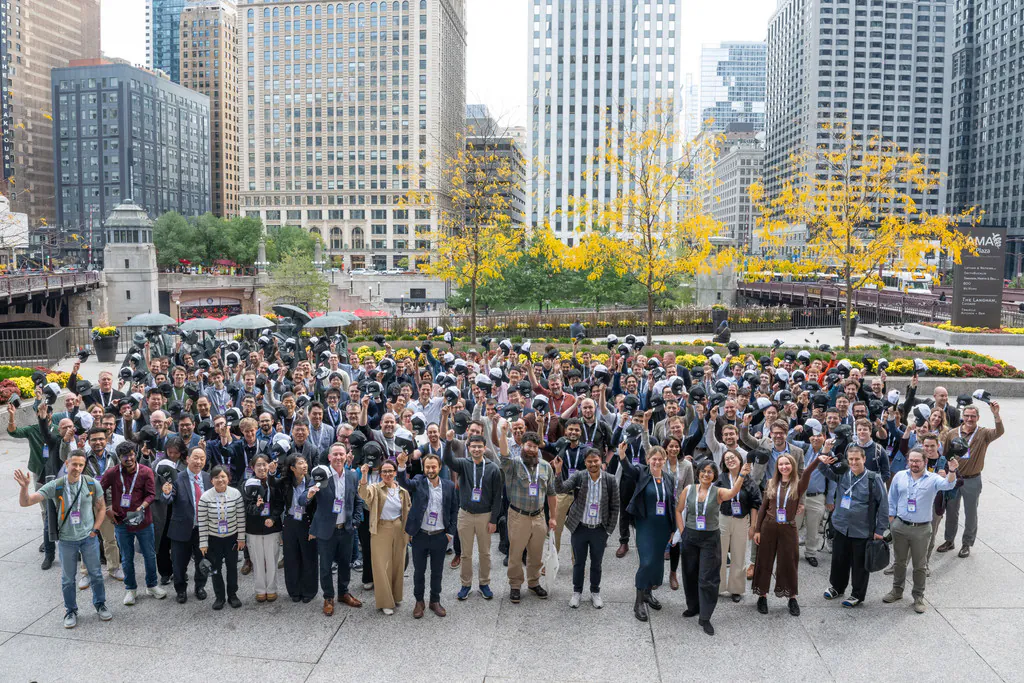
At AQC26 in Chicago, speaker after speaker, whatever kind of qubit they worked with, found the field’s hardest problem in the classical systems that control the qubits.
Prof. John Martinis wasn’t in Chicago. The 2025 Nobel laureate and CTO of Qolab was in South Africa for a Nobel symposium, dialling in to the third day of AQC26 from the other side of the world. He used his slot to tackle an assumption that’s common outside the field, even if the people building these machines know better: that it doesn’t really matter too much how quickly a quantum computer carries out its operations, because its exponential power will make up for it.
Take quantum chemistry, one of the most promising uses for a quantum computer. A $30 million machine carrying out around a million error-corrected operations a second could work through a useful molecule in hours to days, and charge about $1,000 an hour for the work, said Prof. Martinis, drawing on an analysis by Microsoft’s Dr. Matthias Troyer. Slow that machine down a hundredfold and the business evaporates. “I don’t think you can really make a business at $30 an hour,” he said. “The speed of a quantum computer is not something you don’t have to worry about, but it really does matter.”
It was a fitting observation at our event, where speakers kept coming back to the same idea. Over three days in late October, some 30 talks covered every major way of building a qubit, from superconducting circuits to trapped ions, neutral atoms, silicon spins and photons. And again and again, the problem on the slides wasn’t the qubits. It was everything around them: the classical electronics and computers that have to measure a quantum processor, decide what to do and respond, often within a few millionths of a second.
Whack-a-mole, in microseconds
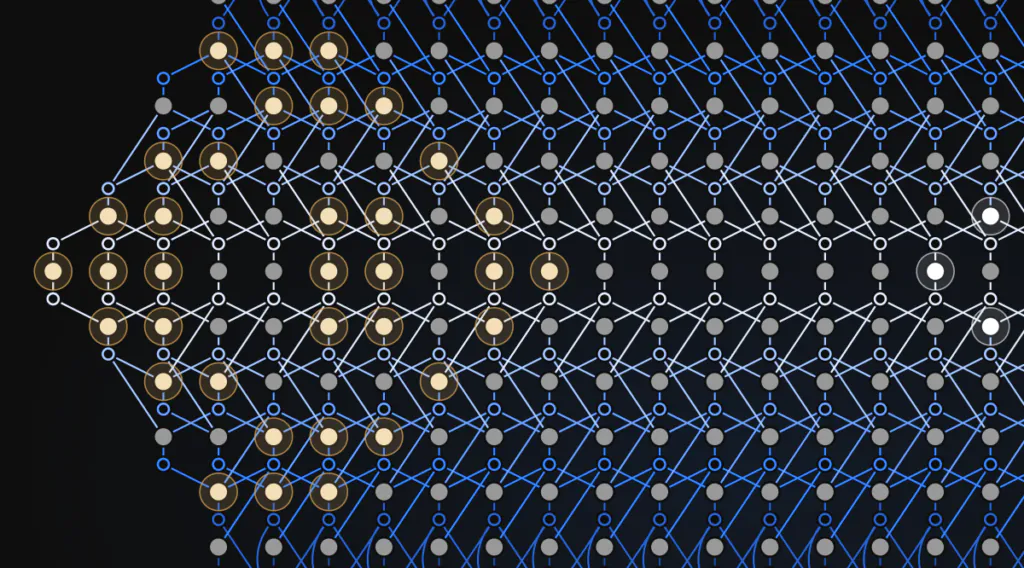
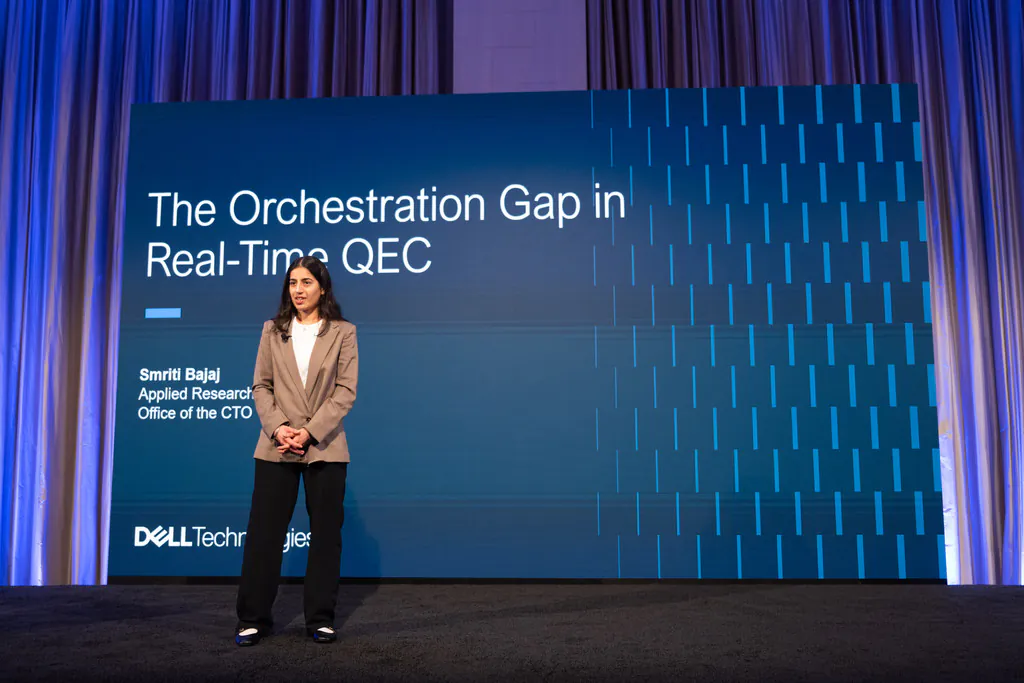
Smriti Bajaj of Dell found the best image for it. Error correction, she said, is like whack-a-mole. In her example, an error signal pops up every 1.1 microseconds. The decoder, the classical software that works out how to fix each error, takes about 63 microseconds to respond. If it can’t keep up, errors build up faster than they can be corrected.
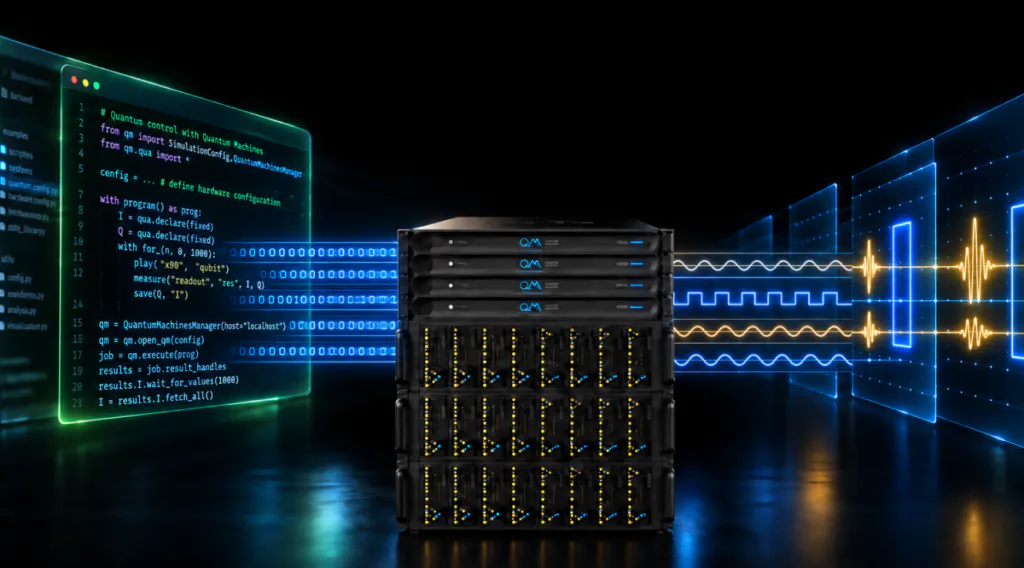
That gap is exactly what we’ve been working on. This week, we published first results from running NVIDIA’s CUDA-Q QEC decoders on our OPX1000 controller over NVQLink. In a test using pre-sampled error data, the trip from controller to decoder and back took a steady 2.4 microseconds, and decoding took under a microsecond per round for the two smaller codes we tested. It’s an early implementation, but it’s a step towards a classical side that can keep pace.
Some labs are already pushing that classical side as fast as physics allows. At the Niels Bohr Institute in Copenhagen, Prof. Morten Kjaergaard’s team runs learning algorithms directly on the control hardware, tracking a qubit’s properties so quickly that they can watch it fluctuate in real time. “We actually hit a fundamental speed limit already now using an OPX,” he said. In other words, at least for this job, the electronics are no longer what’s holding things back.
“I personally see calibration and error correction as equally important pieces of this puzzle,” Dr. Volodymyr Sivak, Google Quantum AI
And speed is one half of the problem. The other is that quantum processors have become too complicated to tune by hand.
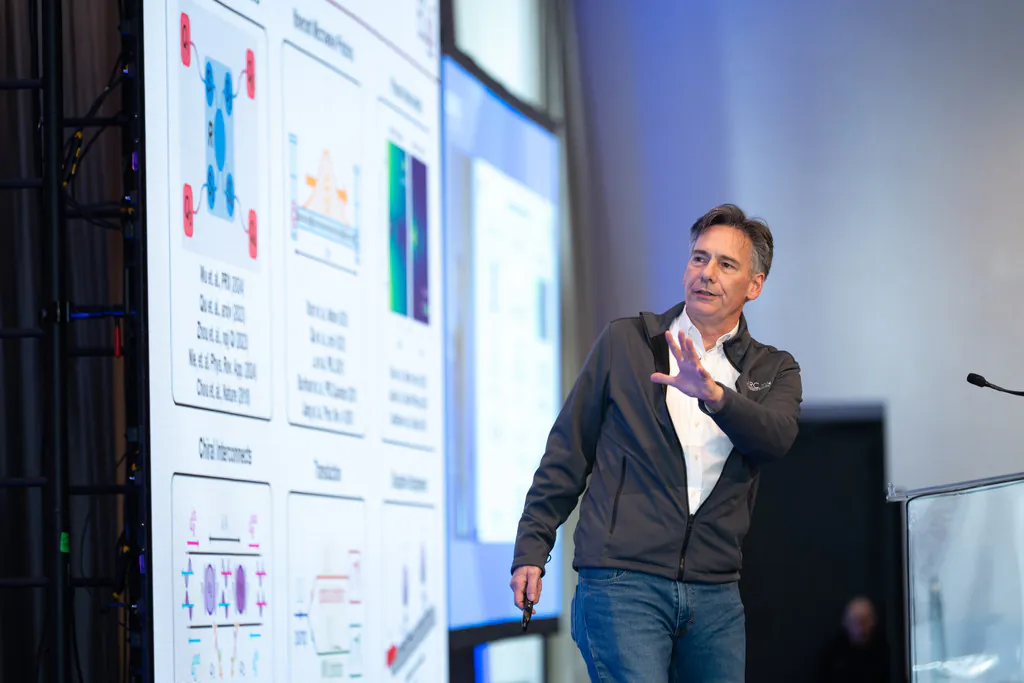
Prof. Will Oliver’s group at MIT wanted to send a single microwave photon from one chip to another, a step towards linking quantum processors together. The protocol had 73 parameters. Two researchers started tuning them manually, then quickly realized it was too much work and handed the job to a reinforcement-learning algorithm.
In his talk, Dr. Volodymyr Sivak of Google Quantum AI outlined how he wants to take that idea all the way. He described using reinforcement learning to keep a processor calibrated while it runs error correction, so that the machine ends up “self-steering” through its own errors. His reminder for anyone who thinks error correction will paper over sloppy hardware: it only works if the analog control underneath is extremely precise. “I personally see calibration and error correction as equally important pieces of this puzzle,” he said.
The same instinct showed up across the programme. Prof. Wolfgang Pfaff at the University of Illinois runs gradient descent with the cost function measured right on the controller’s FPGA, leaving the desktop computer to simply point it in the right direction. Dr. Andre Saraiva of Diraq and Dr. Jonas Schuff of Intel both talked about autotuning large arrays of silicon spin qubits, which Dr. Saraiva expects to be his team’s most crucial task over the coming year as qubit counts grow. In each case, the intelligence is moving closer to the qubits.
Quantum meets the supercomputer
There was a neat bit of symbolism in the venue. AQC26 took place at the Langham hotel, which occupies part of 330 North Wabash, the former IBM Building. Dr. Thaddeus Ladd, who grew up on Chicago’s North Side, pointed out that he still thinks of it by that name. As a teenager in the 1980s, he said, his dream job would have been to work there, on the most advanced computers in the world. Decades later, the same building hosted three days of talks on how quantum processors and classical computers will work together.
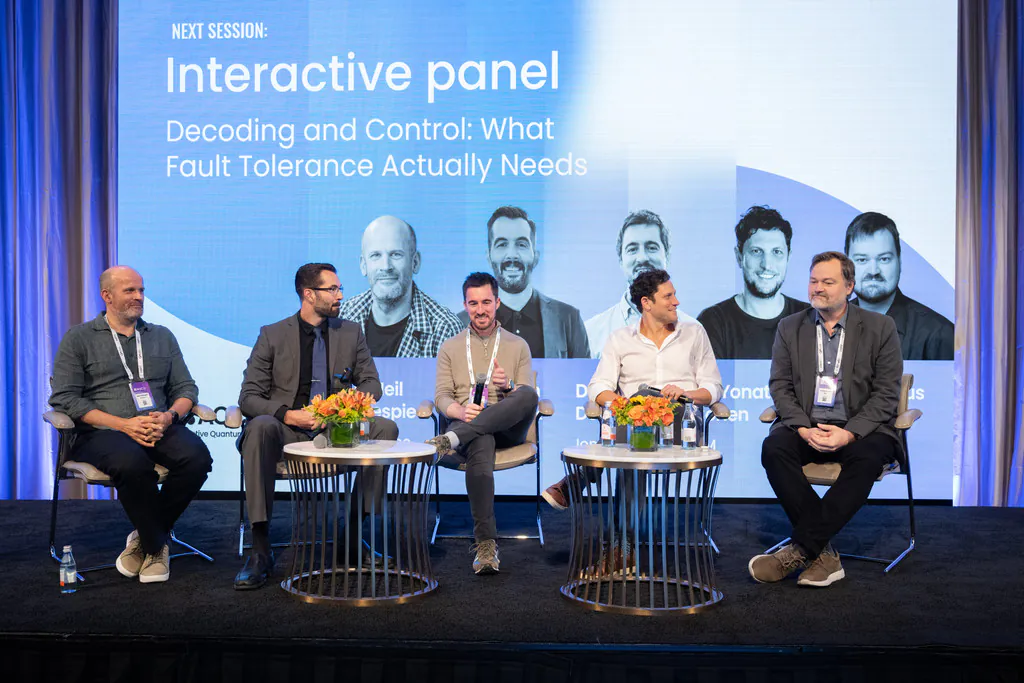
That merger was the conference’s third thread. “We think that all valuable quantum computing is going to be heterogeneous,” said Dr. Shane Caldwell of NVIDIA: quantum processors working alongside CPUs, GPUs and other accelerators as parts of one machine. NVIDIA’s NVQLink, on which QM researchers also worked, is designed to make that connection. Dr. Caldwell noted its integration with our OPX1000, saying that QM “has been a key partner in helping us actually get this to market.”
Dr. Josh Izaac of Xanadu came at it from software, describing how his team compiles fault-tolerant workloads across CPUs, GPUs and FPGAs to hit the tight timing its photonic hardware demands.
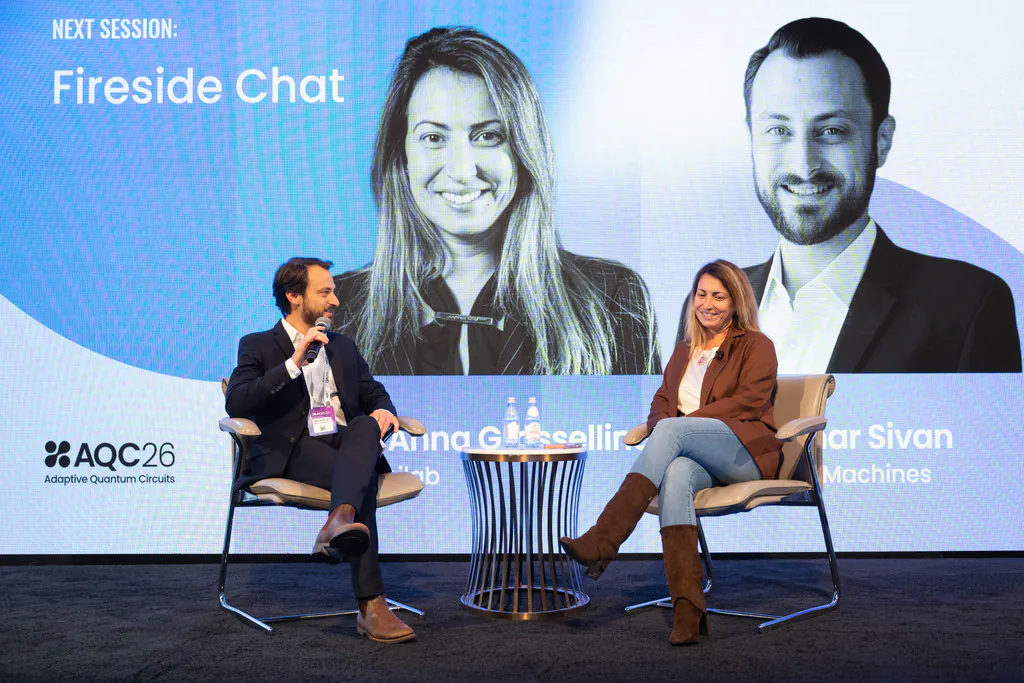
None of this is slowing the hardware down. Prof. Mark Saffman of UW-Madison sees a path to neutral-atom arrays of more than 10,000 qubits. Prof. Martinis described superconducting processors built at wafer scale, with around 20,000 qubits on a wafer and around 100,000 in a single dilution refrigerator. At Fermilab, Dr. Anna Grassellino’s team has built a cavity with 57 high-quality modes, each a potential qudit. But every one of those machines will need a classical partner that can keep up. That’s the part of the stack we build, and it was striking how many speakers see it the same way. “Quantum Machines is actually our partner for the entire control stack,” Dr. Grassellino said during her fireside chat with our CEO, Dr. Itamar Sivan.
When we launched the Adaptive Quantum Circuits conference, adaptive circuits, which measure qubits mid-run and change course based on the results, looked like a niche. In his closing talk, our CTO Dr. Yonatan Cohen suggested the field may now be realizing that all circuits, at least at the lowest layers of the stack, will be adaptive. If he’s right, the classical side of quantum computing is about to get a lot more attention.
“I think we’re really building a strong community around the adaptive quantum circuits,” he said. Judging by Chicago, that community already knows where the hard part is.
All AQC26 talks are available to watch here.