Building blocks for scale: NVision Demonstrates Molecular Spin Qubits on Photonic Chips Using the OPX1000
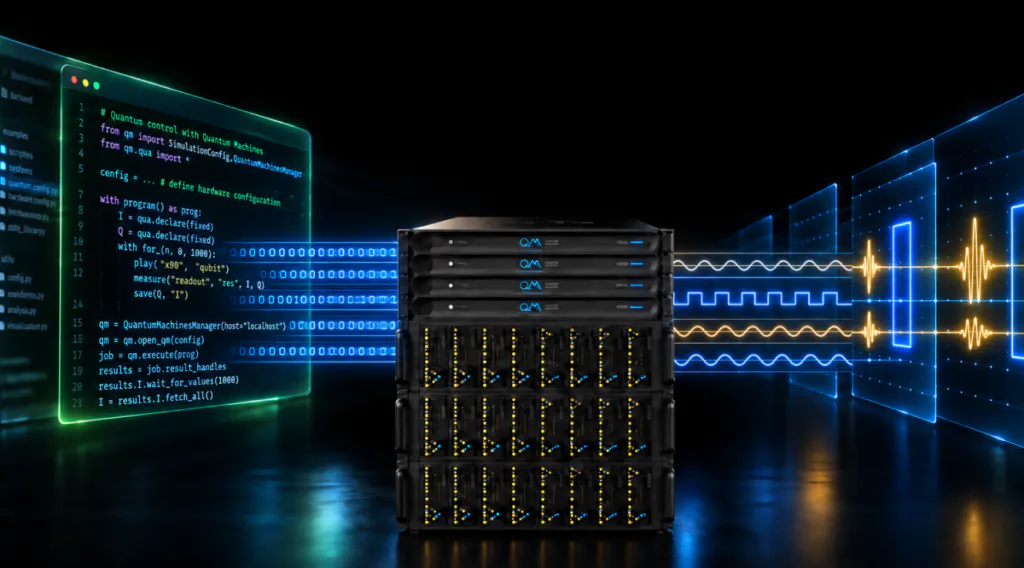
In a paper published recently in Nature,[1] NVision demonstrates the first individually addressable organic molecular qubit with a native photonic interface: a synthetically designed molecule that holds its spin coherence for milliseconds and emits bright, spectrally stable, spin-selective photons. The work is a building block toward quantum computers that scale by linking qubits with light. What enables this is a tightly timed sequence of laser, microwave and photon-counting operations, orchestrated by Quantum Machines’ OPX1000. The result demonstrates a new approach to scalable quantum computing based on molecular spin qubits integrated with photonic chips and controlled using the OPX1000 quantum controller. For the wider community, the result brings chemical design to optically addressable spin qubits, opening a path toward scaling them on photonic chips.
Molecular spin qubits connected by light: A new approach to scalability
NVision’s view is that scalable quantum computing needs a distributed approach, with qubits connected by light. Photons keep their coherence over macroscopic distances, so they can entangle qubits that sit far apart. Photonic links also promise all-to-all connectivity and can draw on the mature manufacturing behind photonic integrated circuits, the same technology already used to connect data centers.
The links are heralded: each qubit emits a photon, and a detection event announces that the two qubits are entangled. If a photon is lost, the system simply resets and tries again. This only works if each qubit has a good photonic interface, which must meet four requirements:
- Spin-selective optical transitions, so each emitted photon maps one-to-one to a spin state.
- Long spin coherence, so the interface can run high-fidelity gates on its qubit.
- A high rate of useful photons, so operations run much faster than the coherence time.
- Indistinguishable photons, so the detector cannot tell which qubit emitted.
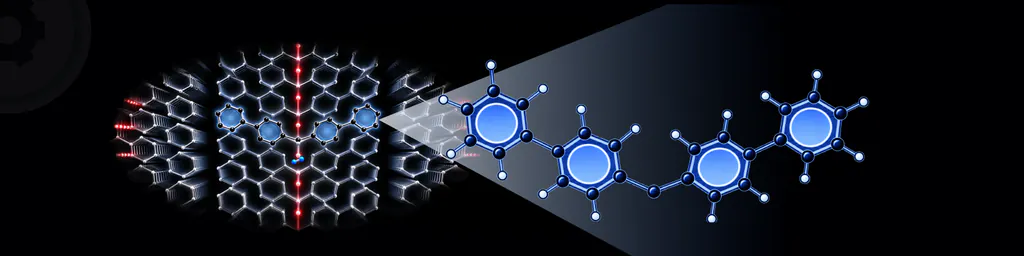
Meeting all four requirements at once is a demanding target. NVision’s idea was to build the interface to meet these requirements, atom by atom. Adding or changing functional groups within molecules can tune their emission wavelength, push fluorescence quantum yield toward unity and shift the spin’s zero-field splitting. Until now, this work was limited to ensembles. A quantum node needs single, individually addressable moleculecular qubits, and that is what NVision set out to build.
Designing the right molecule took systematic iteration. The team ran quantum chemistry simulations on roughly 200 candidate molecules and synthesized more than 40 to determine which functional groups produce which quantum properties. The real enabler was putting quantum optics and spin physicists in the same loop as organic chemists, so each round of characterization fed straight into the next synthesis.
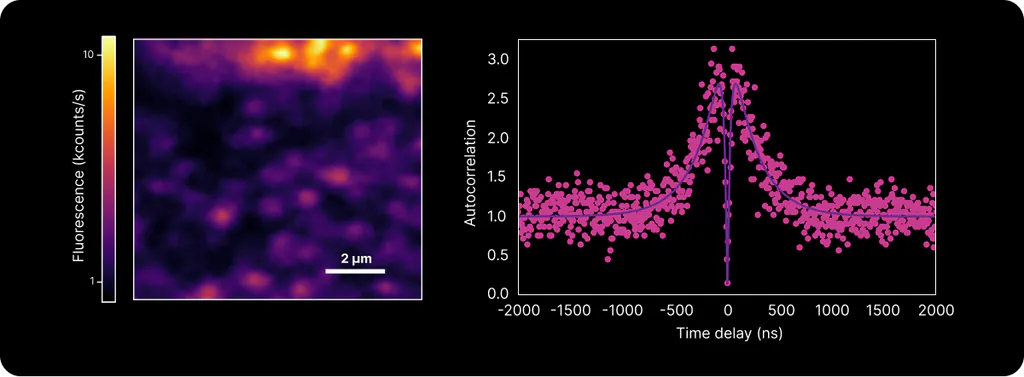
The pivotal result came last December. In a confocal scan, the team saw thousands of bright, isolated single emitters, a moment they nicknamed the Sky Full of Stars. Photon autocorrelation measurements confirmed each spot was a single molecule, with g⁽²⁾(0) = 0.14, well below the 0.5 threshold.
The winning qubit is a diarylcarbene, embedded in a structurally matched ketone host crystal. Two unpaired electrons give it a spin-1 triplet ground state, with an optical transition near 595 nm. Because it is synthesized, the team can place an isotopically labelled nuclear spin, such as ¹³C, at exactly the same position in every molecule. That nuclear spin serves as the long-lived qubit, and the electron spin acts as its interface to light.
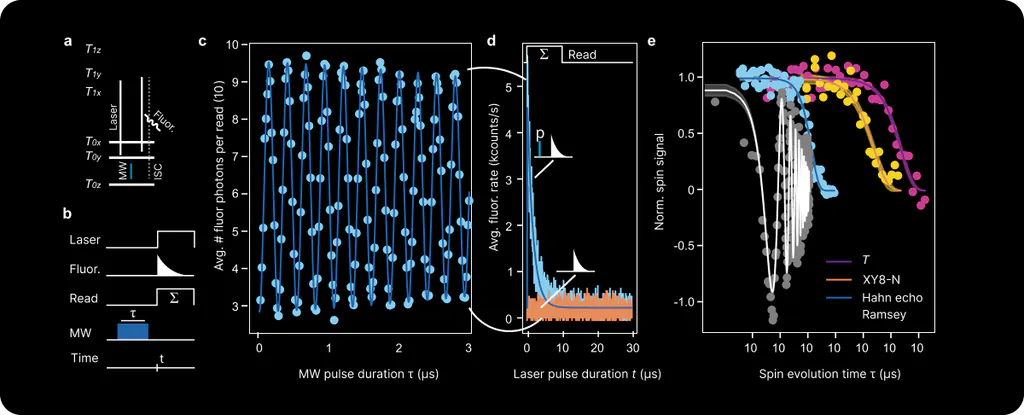
At 4.5 K, a single molecule meets all four requirements set out above. Its spin-selective transitions sit more than 1.5 GHz apart, so a laser tuned to one excites only one spin state, and whether a photon comes out reveals the spin. With dynamical decoupling, its electron spin stays coherent for 2.2 ms, above the roughly 1 ms needed for high-fidelity nuclear-spin gates. Its excited state lasts just 24 ns, so photons come out quickly. And its optical line is spectrally stable, drifting only about 2.5 MHz over more than an hour, with around 95% of the molecules measured behaving this way.
The molecules are also activated in place by a laser pulse, so qubits can be written only where they are needed, for example directly above an optical cavity on a photonic chip.
How the OPX1000 Enables Real-Time Control of Molecular Qubits
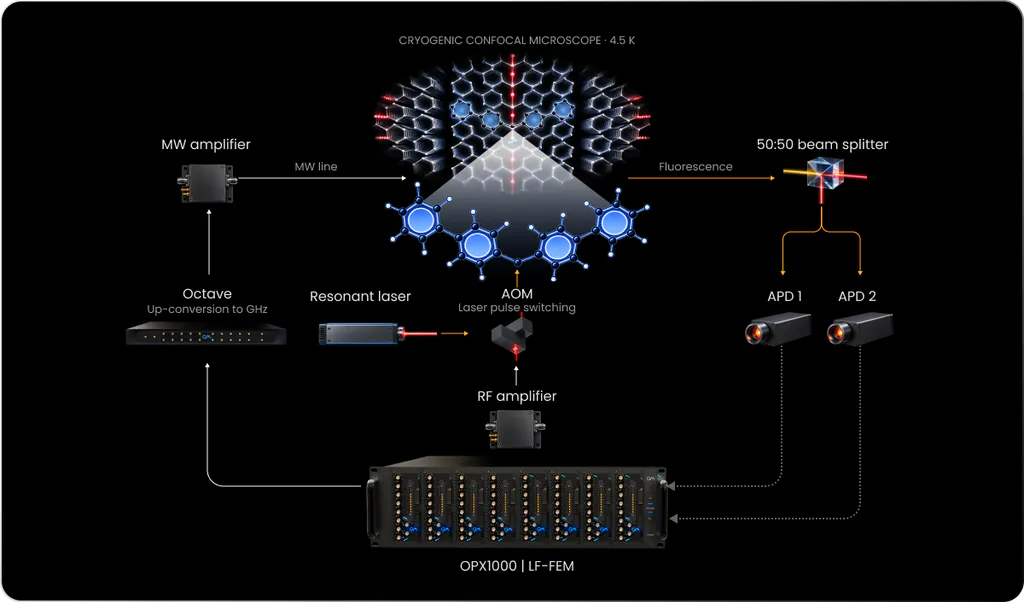
Every measurement on a single molecule is a tightly timed choreography of laser and microwave pulses, and photon counting. A resonant laser pulse produces fluorescence only if the electron spin is in one of its two bright states, the spin states that glow under the laser. Continued illumination then pumps the spin into the third, dark state, which initializes it. Between laser pulses, microwave sequences control the spin, and the next laser pulse reads out the result.
NVision runs this choreography on Quantum Machines’ OPX1000. It handles the orchestration and control of microwave and laser equipment across each step, from Rabi oscillations and Hahn echo to XY8 dynamical-decoupling sequences with up to 2,000 repeated pulse blocks. The low-frequency front-end module (LF-FEM) handles every signal. Paired with QM’s Octave, which upconverts its output to the GHz range, it generates the microwave pulses that drive the electron spin. The same LF-FEM drives an acousto-optic modulator directly, switching and shaping the laser pulses, and its analog input counts the photons arriving from the detector. Microwave control, laser control and readout all run from one OPX1000 controller on a shared clock, so every pulse lands at exactly the right moment relative to the others.
The same control setup is the foundation for the next step: linking two molecules. NVision’s entanglement protocol repeats four steps:
- Optically excite two molecules so each emits a spin-selective, indistinguishable photon.
- Detect both photons at a shared detector, heralding entanglement between the two electron spins.
- Apply a microwave electron-nuclear gate locally to move that entanglement onto the nuclear-spin qubits.
- Read out the electron spins optically, enabling arbitrary gates on the nuclear-spin qubits.
This loop is demanding on control. The pulses must be phase-coherent and precisely timed, and the protocol is repeat-until-success: a missed photon triggers a reset and a new attempt. Initialization can follow the same logic. Instead of slower optical pumping, the protocol can initialize the spin by detecting or not detecting photons depending on the spin state, which yields high-fidelity initialization in about 100 ns. Deciding what to do next based on whether a photon was detected, within microseconds and mid-experiment, is exactly what a pulse processor like the OPX1000 is built for.
What’s next: from single molecules to photonic chips
These results were measured at 4.5 K, and there is room to improve them. Extrapolations suggest near lifetime-limited photons at around 2.6 K, spin lifetimes above 100 ms and, with optimized decoupling, coherence times of tens of milliseconds. Deuterating the molecules should also quiet the surrounding nuclear spins, the main source of decoherence. But the bigger next step is scale.
NVision’s PIQC (Photonic Integrated Quantum Circuits) architecture deposits thin molecular crystals directly on top of photonic components, borrowing techniques from the OLED industry. The team has already grown roughly 100 nm layers inside openings etched to expose silicon nitride waveguides. A photonic switching layer will then route photons from any two molecules to a shared detector, giving near all-to-all connectivity between qubit cells, the kind of long-range linking that efficient error-correcting codes rely on. Because photons only herald entanglement and never carry the qubit, the scheme is forgiving: to entangle 99% of qubit pairs within 10 µs, the architecture can tolerate up to 70% photon loss, far more than photonic qubits allow.
The vision is thousands of molecular qubits on a chip, working together as a fault-tolerant quantum computer. As the system grows, so does the control problem: more channels, tighter timing and more real-time decisions per second. NVision designs the qubits and the photonic architecture that connects them; Quantum Machines’ OPX1000 provides the real-time control that orchestrates them. Scaling up will take both.