
Advancing Quantum Research
Empowering quantum researchers around the globe to control,
explore, and advance the frontiers of quantum research.














RESEARCH WITH QM
Quantum research moves faster when precise control, flexible software, and expert support work as one. QM’s Orchestration Platform helps teams bring up devices, run characterization, automate calibrations, and build adaptive experiments across qubit modalities. With OPX hybrid controllers, real-time classical processing, and QM’s software ecosystem, researchers can move from installation to advanced experiments with less overhead and more focus on the physics.
From Installation to Breakthroughs, Every Step Supported
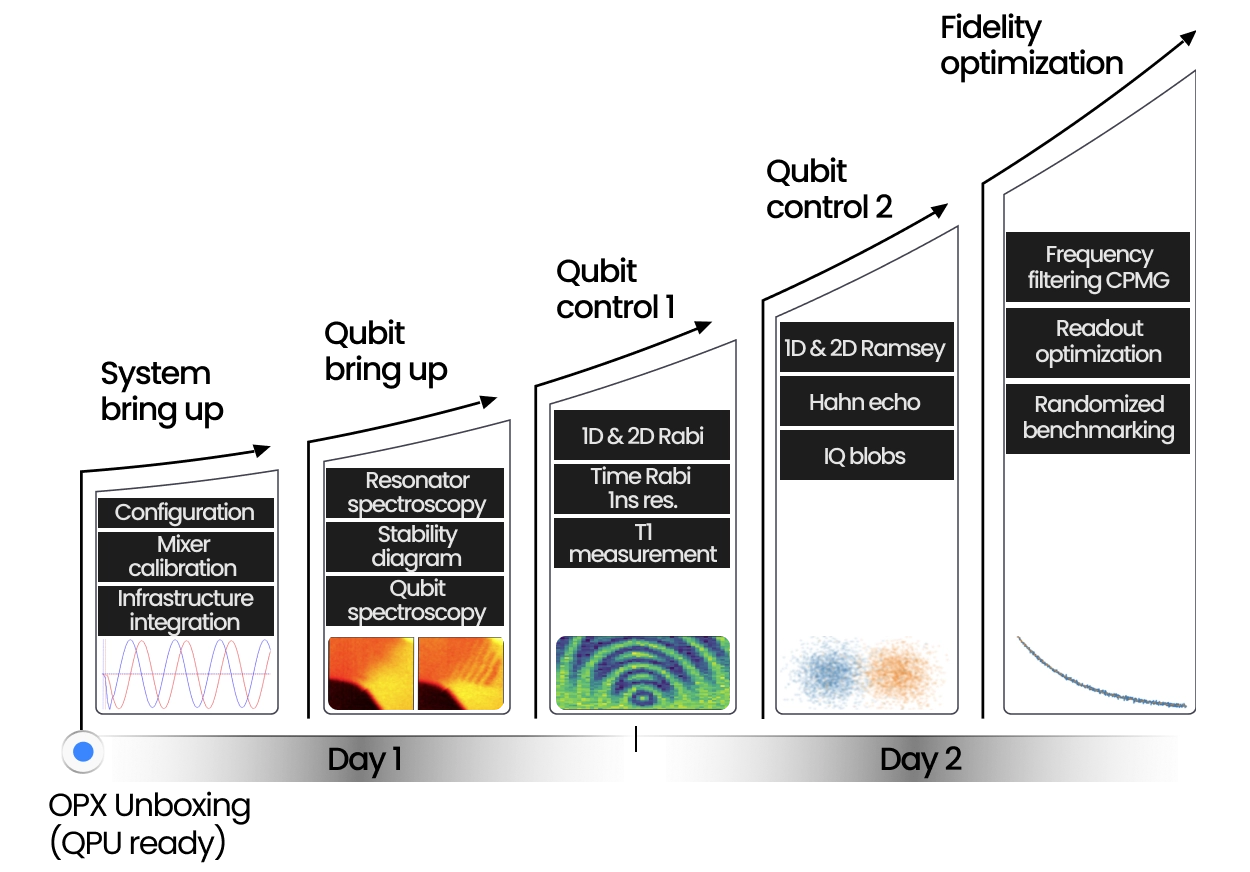
Starting with a new controller should not slow research down. Quantum Machines supports your team from system design and installation to tune-up, characterization, and advanced experiments. In many quantum labs, customers reach two-qubit gates within two days of installation, but our support does not end there. With more than100 experimental physicists in our ranks, we help develop code, solve experimental challenges, share ready-to-use repositories or create custom ones, and support new research directions for years to come. Serving hundreds of labs worldwide, QM’s industry-leading customer success team brings deep hands-on experience across superconducting qubits, spin qubits, photonics, atoms, and more.
Integrated Quantum and Classical Control for Adaptive Experiments
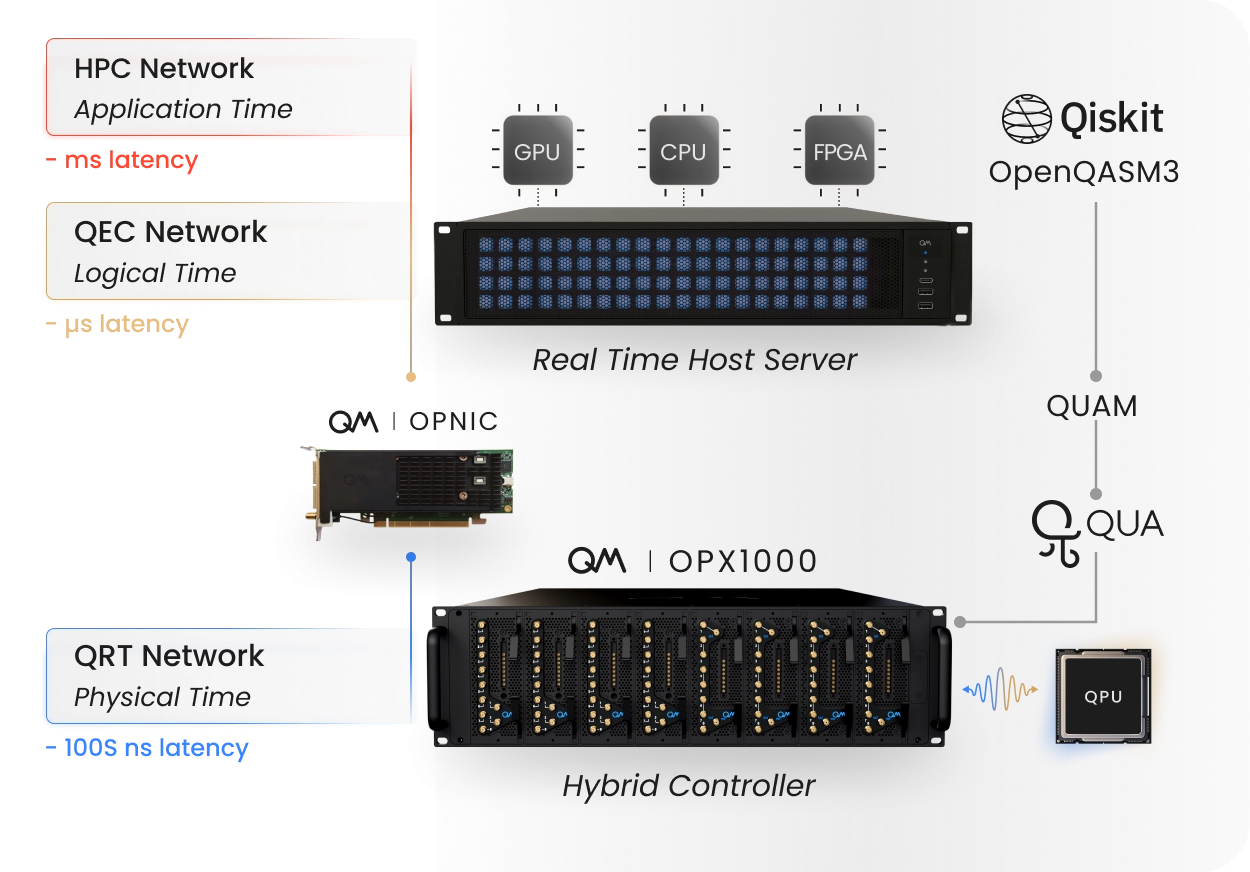
The most advanced quantum experiments are no longer static. The sequence itself must react to the QPU as the physicsunfolds. QM’s Quantum Orchestration bridges classical and quantum computing, making control truly hybrid and adaptive.
OPX hybrid controllers bring quantum control and real-time classical processing into a single workflow through the Pulse Processing Unit, enabling sequences to branch, calculate, update parameters, and respond to measurements with the lowest feedback latency in the industry.
With QM’s Open Acceleration Stack, the adaptive loop extends to external CPUs, GPUs, and FPGAs for heavier computation, hyperparameter updates, embedded reinforcement-learning-based calibrations, quantum error correction, and hybrid decisions between shots. Together, they enable experiments that adapt to the system in real time.
A Software Ecosystem Built for Quantum Research
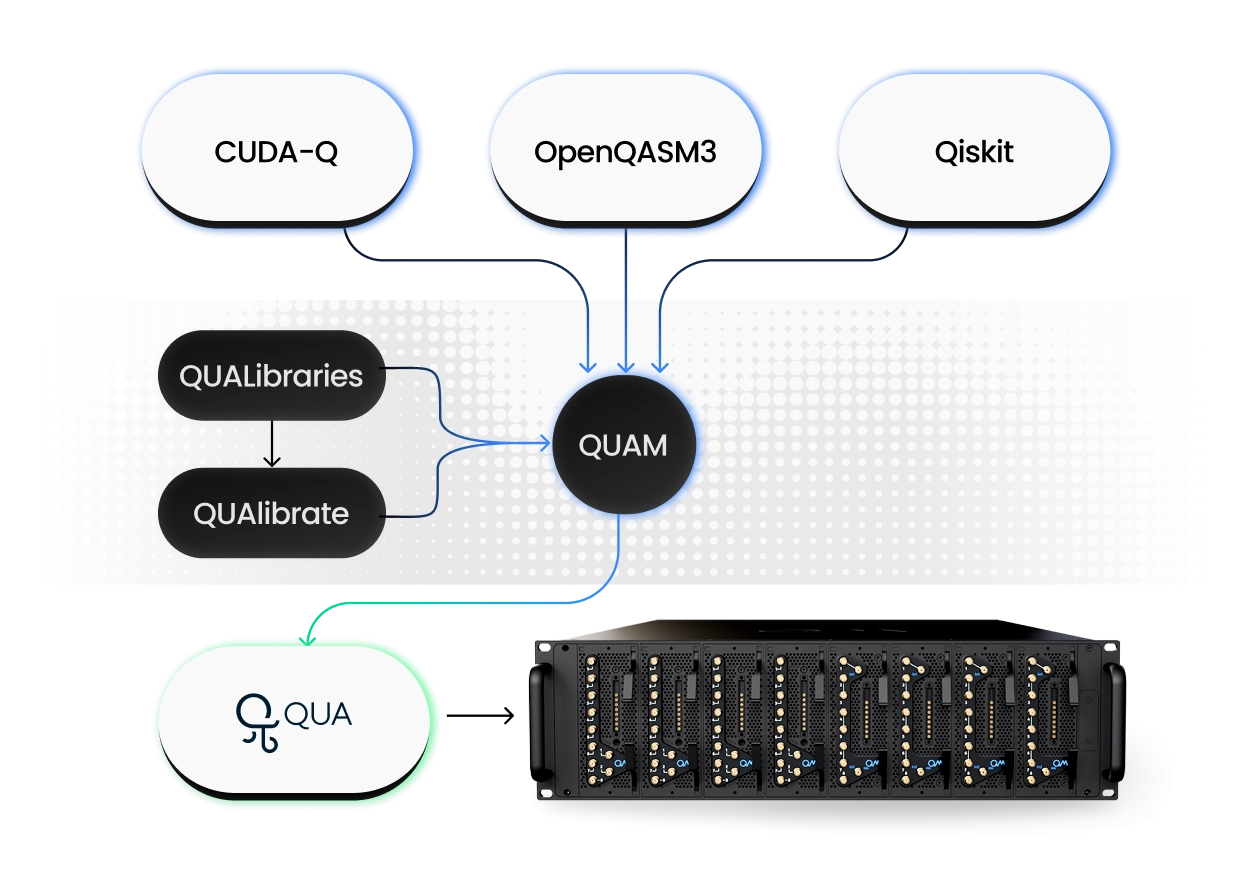
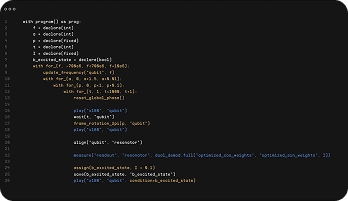
Quantum software should make powerful control accessible. QUA lets researchers program at both pulse and gate level, combining precise waveform control with loops, branching, streaming, feedback, and real-time logic. Gate-level workflows connect to familiar tools such as Qiskit and OpenQASM, while QUA provides direct access to the pulse layer when experiments demand it. QUAlibraries provide ready-to-use protocols and examples across modalities. QuAM adds a structured abstraction layer for devices, parameters, and configurations. QUAlibrate turns tuning routines into automated calibration graphs with dependencies, retries, logic, and parallel execution. For hybrid workflows, QM supports accelerator QPU programs through integrations such as CUDA-Q, C++, Python, and more.









We’ve moved beyond theory into engineering reality. We’re no longer just observing quantum mechanics – we’re orchestrating it to solve the unsolvable.

Alvaro Orgaz
Lead QC Control
The OPX makes developing a brand-new superconducting qubit capability from scratch a breeze. Getting started is straightforward, the coding is easy, and the customer support is fantastic! The OPX reduces the potential barrier to progress and is also well suited for teaching.

Dr. Christian Boutan
Researcher
I must say I'm very happy with QM's Quantum Orchestration Platform. It's the single most reliable piece of equipment I've got in the lab. I operate it remotely and never had any problems. I strongly recommend the OPX and the QOP to my colleagues. It is by far the simplest way to do qubit physics.

Dr. Emmanuel Flurin
Researcher
Dedicated hardware for controlling and operating quantum bits is something we have all been dreaming of. Quantum Machines has answered this call by allowing us and others in the field to scale up with ease and with far greater functionality than was ever possible before.

Prof. Amir Yacoby
Professor
The first time I was introduced to Quantum Machines, It surprised me how people were getting so excited about it. Only later did I realize, it was like explaining the value of a Laser before it existed, and all you knew are light bulbs. Today I truly believe that these systems will revolutionize our space.

Prof. Barak Dayan
Professor
OPX has been a powerful enabler in our lab, helping us quickly characterize the performance of our recently discovered qubits. The hardware removes time wasted in uploading and waiting during pulse programming. QUA has substantially reduced the complexity of writing quantum protocols, allowing us to code dynamical decoupling and RB sequences in just a few lines. It remarkably saves our time in optimizing the processes and visualizing the results, allowing us to focus more on understanding the physics of our new qubits.

Prof. Dafei Jin
Professor
Developing a functional Qubit control electronic system absorbs a PhD-student full time at least for 2 years. QM’S Quantum Orchestration Platform allowed us set up experiments for full Qubit characterization in

Prof. Gerhard Kirchmair
Professor
We are very pleased with the QOP control solution. It’s remarkably easy to use, reliable, and flexible, supporting our advanced quantum research needs. The QOP dramatically expedites our research. Moreover, the Quantum Machines customer team has been instrumental in addressing all our needs to help us to maximize the full potential of the solution. We already use two systems and strongly recommend it.

Prof. Eli Levenson-Falk
Professor
The OPX’s fast feedback and unique real-time processing capabilities were critical for our experiment. Combining these with the OPX’s intuitive programming and QM’s state-of-the-art cryogenic electronics allowed us to do something that we have dreamt of doing for years.

Prof. Ferdinand Kuemmeth
Professor
Quantum Lab Stories: Real-time T1 tracking at the SQuID Lab
FAQs
Can I connect the OPX1000 to a CPU/GPU server?
Yes — OPNIC couples the OPX1000 to essentially any CPU/GPU server, and the productized reference design for this is the Open Acceleration Stack, previously known as the NVIDIA DGX Quantum, co-developed by QM and NVIDIA. It tightly couples GPU-CPU superchips to the QPU with bounded-latency integration so classical acceleration becomes part of the quantum runtime, programmable through python. In practice, the controller streams readout to the accelerator, the server runs decoders, optimizers, or RL policies, and corrections return before the next shot, with a roundtrip latency under 4 microseconds.
How does the OPX1000 scale beyond a single chassis to thousands of qubits?
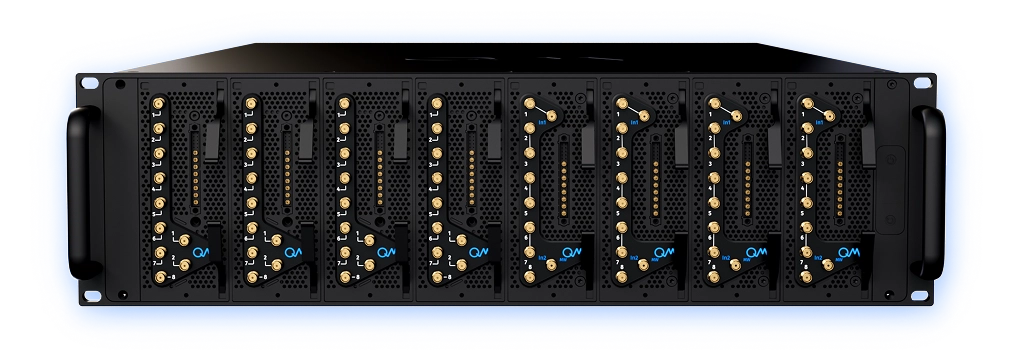
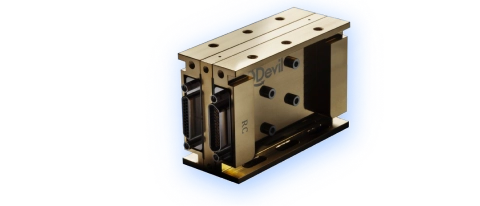
The OPX1000 scales by combining multiple chassis that operate as a single system through QM’s QSync synchronization technology. One chassis with 4 LF-FEMs and 4 MW-FEMs controls a 25-qubit superconducting chip; QSync lets multiple OPX1000s work as one. Crucially, ultra-fast arbitrary feedback works between all modules even across different OPX1000 chassis, so connectivity isn’t confined to a single box.
What are FEMs, and how do modules stay synchronized on a common clock?
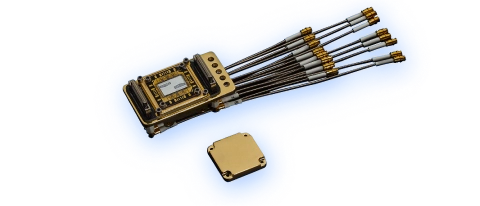
FEMs (front-end modules) are the swappable signal cards in the OPX1000 — up to 8 per chassis, in two types: LF-FEMs for low-frequency/baseband control and MW-FEMs that generate microwave signals across 0.1–10.5 GHz directly from digital waveforms via direct digital synthesis (DDS). Synchronization is handled by sharing a common clock(secondary chassis take their clock from the main OPX1000 over SMA), paired with the QSync link, which maintains ultra-low jitter, phase stability, and skew even when scaling to multiple controllers and racks.
What feedback and decoding latency can the system achieve, and why does it matter for research?
The OPX1000’s per-FEM Pulse Processing Units (PPUs) deliver feedback on quantum timescales, for example, active reset on the order of ~100–200 ns — ,while the OPNIC link to a classical server adds a roundtrip latency below 4 µs with bandwidth above 64 Gb/s. This matters because real-time QEC and online calibration only work if decoding keeps pace with the error rate: keeping the loop below the 10–20 µs budget for useful decoding is what makes intra-shot correction, adaptive protocols, and accelerated calibration possible.


