Reinforcement learning for atom cooling: real-time quantum feedback on the OPX+
Reinforcement learning (RL) is emerging as a powerful tool for quantum control. Researchers in Prof. Vladan Vuletić’s group at MIT have demonstrated the first real-time, RL-based feedback cooling of a single neutral atom, with the neural network running on the Quantum Machines OPX+. We asked co-author Dr. Matthew L. Peters, now a quantum engineer at Atom Computing, to explain how it works.
Reliable, long-running quantum computers must adapt as operating conditions change. This requires a robust, real-time feedback loop that can measure the system as it evolves, decide in situ what should happen next, and keep the experiment running even when the dynamics are noisy, nonlinear, or only partially observed.
But deciding what to do with limited information is hard, especially when experimental conditions change in ways that predetermined analytical models cannot capture.
In a recent demonstration, we reported the first feedback cooling of a single neutral atom in a high-finesse optical cavity using deep RL. The group showed that a neural-network policy trained on experimental measurements could cool the atom through real-time feedback on the OPX+. The result points towards a new mode of real-time quantum control, in which models are refined online during the experiment, neural inference runs inside the feedback loop, and control decisions are made quickly enough to act before the system changes.
How light leaking from a cavity helps cool an atom
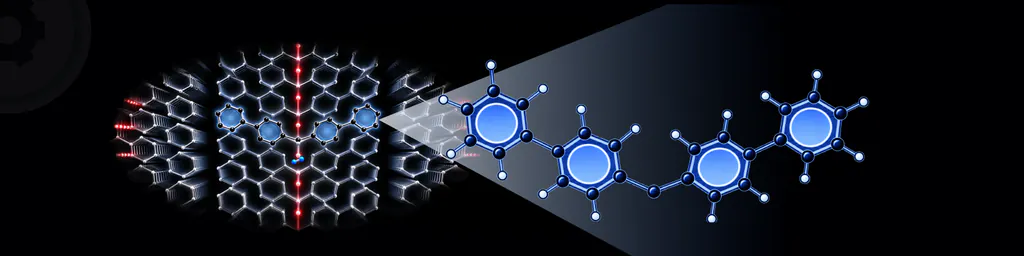
In neutral-atom quantum processors, individual atoms are held in traps made of light called optical tweezers. When an atom is placed inside a high-finesse optical cavity, its motion dispersively shifts the cavity resonance frequency, imprinting information about its state onto the light leaking from the cavity.
Our group has used this to observe individual inelastic collisions between pairs of atoms in an optical tweezer with a timing resolution of just 100 μs. But observation alone does not solve a practical problem in neutral-atom experiments: atoms can be randomly lost, or several can load into the same trap.
Ball and Bowl: what does changing trap depth actually do?
An optical tweezer is a bowl-shaped potential well that can be deep and narrow, or shallow and wide. Cooling the atom or stopping the ball’s oscillation comes down to asking: how deep that bowl is right now and when do you change it?
Now you try
Try holding the button or press space. This will loosens the trap and releasing it tightens the trap back up. Watch both panels as you do it.
Hint: Loosen right as the ball reaches the outer edge of its swing (where it is momentarily slow), then let go of the loosen button as it swings back through the centre (where it is moving fastest). This will take energy out of the ball and slow it down. If you do it backwards — tighten at the edges, loosen through the middle — and energy pours in instead of out.
In earlier work, we combined cavity-based measurements with adaptive feedback running on the pulse processing unit (PPU) inside the OPX+. This let us load a single atom quasi-deterministically, with 92(2)% fidelity. Rather than executing a fixed sequence, the controller responded to the measured state in real time, increasing the probability of ending with exactly one atom in the trap.
This ability to measure, infer, and act forms the foundation of the group’s latest work, which uses reinforcement learning to find feedback actions that cool a single atom’s motion.
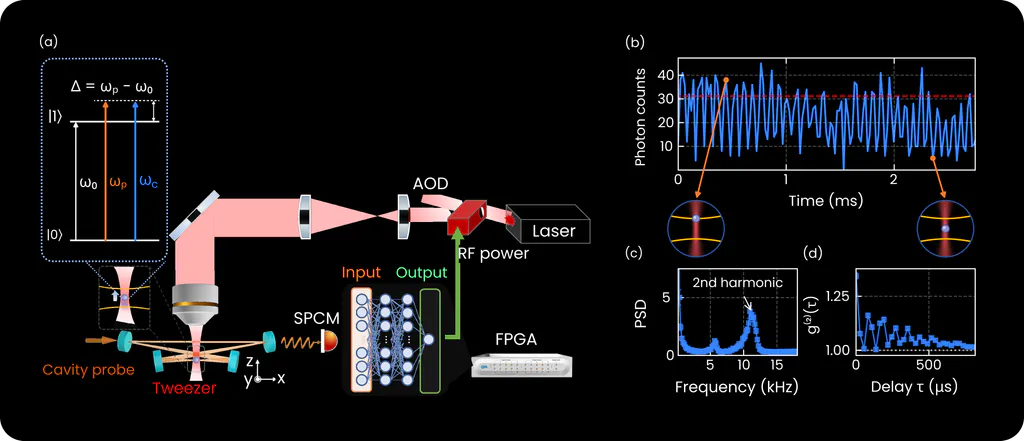
By monitoring the light leaking from the cavity, the agent learns to infer the atom’s state and adjust the tweezer depth to remove energy from its motion.
How reinforcement learning helps cool atoms
Traditional feedback cooling often relies on a model: infer the atom’s velocity, compute a damping force, and apply it. That requires an accurate model, and cold-atom experiments are full of things models may miss, such as experimental drift, nonlinearities, and measurement noise.
Reinforcement learning can circumvent the need to model complex system dynamics. The RL agent can instead learn from experimental data, including effects that are difficult to capture accurately in simulation.
What drew us to reinforcement learning was the gap between models and reality. Many quantum platforms can be challenging to model accurately. What interests me most about reinforcement learning is that the controller can learn from the experiment itself and adapt to differences between the simulation and the real system. That is particularly useful when nonlinear dynamics make an effective feedback strategy difficult or impossible to design by hand.
Because real cold-atom shots are slow (roughly a second each), training an agent from scratch on hardware isn’t practical. Instead, we first trained a small neural network in simulation using stochastic models of the coupled atom-cavity system. This allowed the agent to learn an initial control strategy from a large volume of simulated data before it was transferred to the real apparatus.
Feedback cooling
With feedback running
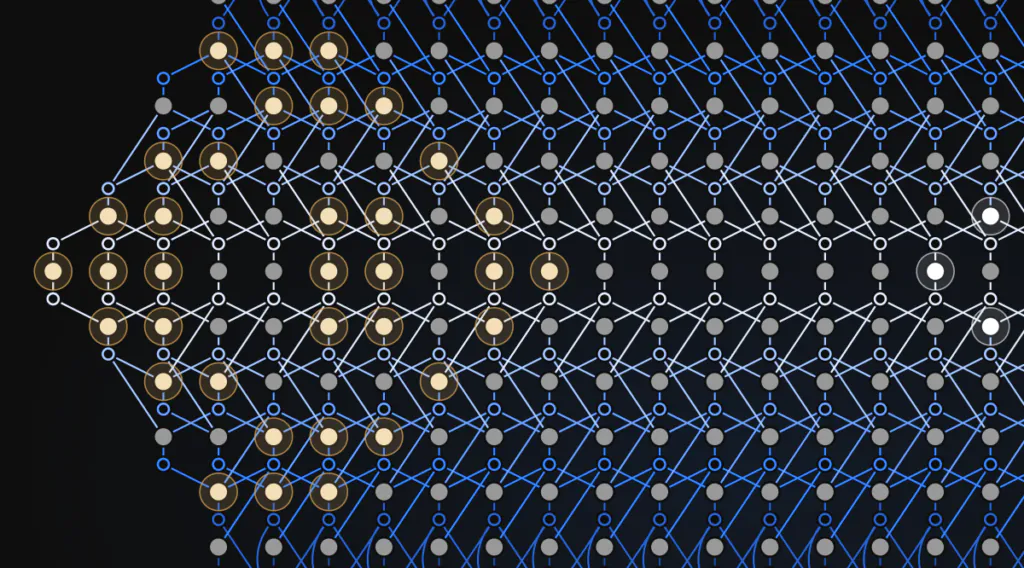
This is the sequence of decisions the experimentally-trained network has to make on one real atom, recorded 27.3 µs apart.
Without feedback
Without feedback the trap depth never changes, so the tweezer beam stays full width throughout.
Real-time quantum feedback with the OPX+
Once deployed on the experiment, the agent adapted to the experimental apparatus. The experiment ran for several trajectories until it reached a predefined number of steps. The computer interfacing with the OPX+ then used this experience to calculate weight updates, and the updated weights were uploaded to the OPX+ for the next round of trajectories. The team used the soft actor–critic architecture, which relies on a “critic” to refine the “actor” that runs on the OPX+ to infer the next control action from the cavity-transmission signal.
So how does the agent know where the atom is? It doesn’t. We never give the agent the atom’s actual position or velocity, which we can’t measure directly. It must instead learn useful control actions from the noisy light signal that we can measure.
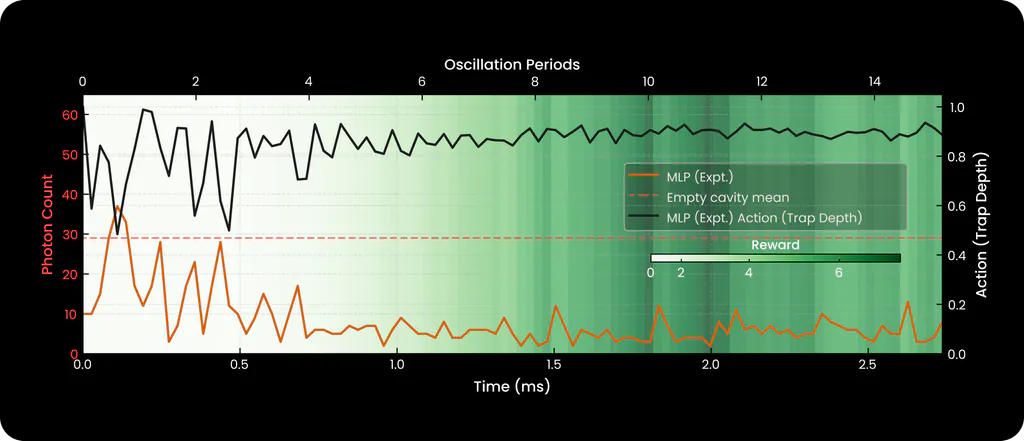
During each trajectory, the real-time feedback loop runs entirely on the OPX+. Every 27.3 μs, the OPX+ receives a new cavity-transmission measurement, updates its internal input state for the actor, and computes the next trap-depth adjustment by running the actor network. The resulting command is applied through an acousto-optic deflector, allowing the trap depth to be modified before the atom completes a significant fraction of its oscillation.
The time-critical loop from measurement to action runs entirely on the Quantum Machines OPX+, avoiding the latency of sending each measurement to an external computer for inference. Weight updates occur separately on the connected computer between batches of trajectories.
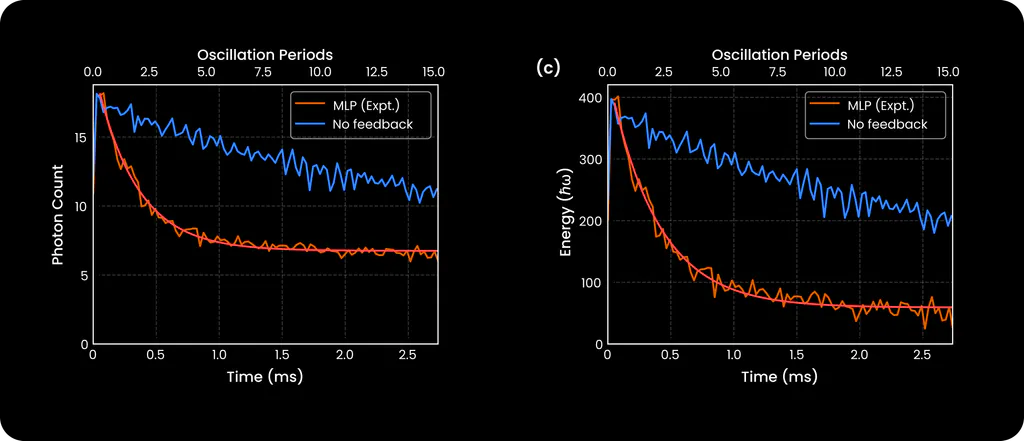
To meet these timing requirements, we implemented the neural-network inference in QUA, QM’s pulse-level programming language, running on FPGA hardware.
The closed loop achieved a total computational latency of just 7.3 μs, fast enough to cool the atom on the timescale of only two motional periods. The system reached a cooling time constant of 388 μs using only the noisy cavity-transmission signal. This shows that a learned policy can carry out feedback cooling in a shot-noise-limited experiment on fast timescales.
Now Try Cooling the Atom
Same as before: hold to loosen the trap, release to tighten it back up. If you loosen at the edges of the oscillation and tighten at the centre, the swinging shrinks. You can also try the version where you only see the photons leaking out of the cavity — more photons mean a bigger swing, fewer photons a smaller one. Try cooling the atom without seeing it now!
Why reinforcement learning matters
Our work demonstrates that a controller can learn online from real experimental data, all while running in real time on FPGA hardware. More broadly, it signals a shift in how complex quantum systems may be controlled. Rather than relying on increasingly detailed analytical models, researchers can combine continuous measurement, real-time inference, and adaptive feedback to discover control strategies directly from data.
As experiments scale to more qubits, more atoms, more sensors, and more control channels, learned controllers offer a way to navigate complexity that would be increasingly difficult to capture with traditional models alone.
Learned feedback, and the compute needed to run it, is becoming increasingly valuable the closer it sits to the QPU. Tight classical–quantum integration lets inference run inside the feedback loop itself, so decisions are made on the timescales of the physics rather than at the pace of a round trip to an external computer.
My hope is that this work will provide a starting point for scientists interested in bringing learned feedback into larger neutral-atom systems and other quantum platforms.
For Quantum Machines, this work highlights the value of bringing measurement, inference, decision-making, and actuation into a single deterministic control stack. Curious what real-time RL feedback looks like running on the Quantum Machines control stack? Talk to us about bringing learned control into your experiment.