From Cold System to Calibrated Fock State: Automating Superconducting Cavity Calibration using Qualibrate
Quantum computing has become synonymous with qubits, yet one of the most promising paths to fault tolerance starts by moving beyond two-level systems altogether. At the Superconducting Quantum Materials and Systems (SQMS) Center at Fermilab, teams are building bosonic quantum error-correction devices that encode information in the many quantum states of a harmonic oscillator, turning a single physical device into a high-dimensional computational resource.
These 3D SRF-based bosonic architectures, read out through an ancillary transmon, belong to the same hardware-efficient family that first reached the break-even point for bosonic QEC. This when an encoded logical qubit outliving its best physical qubit. SRF cavities push the coherence available to that approach by orders of magnitude, and the current frontier is extending error-resilient control to match it.
The physics is compelling. The engineering to get there is not.
Bringing up a single qubit-cavity pair can require on the order of twenty distinct measurements — cavity spectroscopy, dispersive-shift mapping, sideband transitions, displacement and Wigner calibrations, coherence and reset characterization — each with its own parameters, and each depending on the one before it.
Done by hand, that is a day or more expert time, repeated for every mode, every cooldown, every drift. Leonardo Bove, at SQMS, thought there had to be a way to automate cavity calibration.
Over the past several months, he extended and adapted Quantum Machines’ Qualibrate framework to cavity-qubit bring-up. The result was an automated path from a cold system to a calibrated Fock state, with no manually pre-tuned starting values.
Automating this does more than just save a day. “Such flexibility in calibration routines”, as Bove puts it, “is a precondition for scaling to SQMS’s next multi-mode, multi-cavity devices and long-term is what closes the loop from raw hardware to an application-ready quantum resource.”
Cavity-Qubit Bring-Up in Superconducting Bosonic Devices
Bosonic qubits are an attractive way to store and protect quantum information. A single harmonic oscillator mode has an infinite ladder of photon-number (Fock) states, giving room to encode against loss and dephasing without adding more physical qubits.
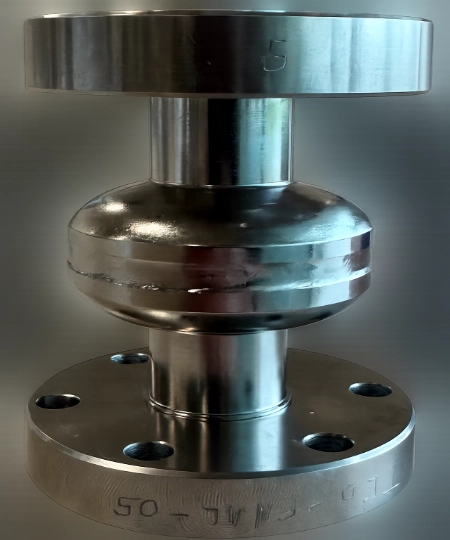
Superconducting radio-frequency (SRF) cavities with niobium structures can hold a single photon for milliseconds, far outlasting an ordinary transmon qubit. At Fermilab, using these cavities for encoding information was a particularly good choice given their decades long expertise in developing cavities with outstanding quality factors.
The ancillary transmon does not store the encoded information itself, but provides indirect measurement and control access to the cavity through dispersive coupling. Each additional cavity photon shifts the transmon frequency by a distinct amount, allowing the cavity’s Fock-state population to be read out. That same coupling also enables sideband transitions, which swap an excitation between the transmon and the cavity and let the cavity climb the Fock ladder one photon at a time.
SNAP operations then use the dispersive coupling to imprint photon-number-dependent phases on individual Fock states. And, displacement provides the complementary control. It drives the cavity directly and coherently shifts the cavity state in phase space.
These operations, along with Wigner tomography, that verify the non-classicality in states, form the building blocks of bosonic quantum control. However, each parameter behind this can drift.
Since nearly every cavity measurement and control operation happens through the transmon, the qubit must be correctly calibrated before any cavity can run. The frequency and pulse parameters of the transmon drift and demand continuous recalibration. The cavity’s own parameters are comparatively stable once characterized.
Why Bosonic Quantum Systems Need Automated Calibration
In principle, you could explore, find, and park a cavity-qubit pair’s parameters in a working regime by hand. Then do it all again every time the system cools down or drifts with the environment. After each result, deciding whether to move on to the next calibration step or go back and adjust something earlier, and repeating until the system is ready to advance.
At today’s pace, manual tuning is too slow to keep up with, if a person is still the one running the loop instead of a machine.
Qualibrate gives the essential things you need to build a from-scratch automation effort: a common definition for a calibration “node” (parameters in, a pulse sequence, analysis, plotting, and a state update out); an orchestrator that chains nodes into graphs; and QuAM, an abstract, hardware-agnostic representation of the quantum system that every node reads from and writes back to.
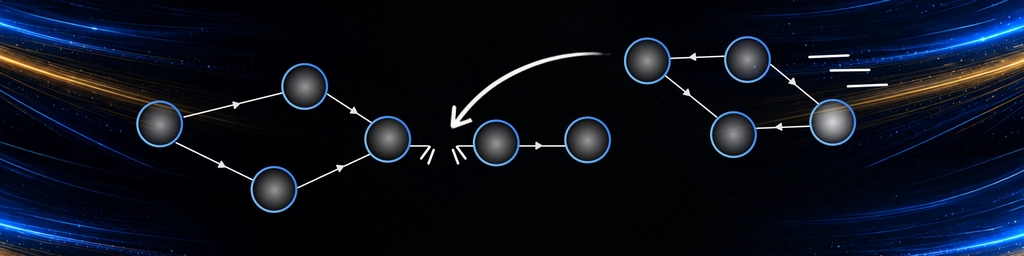
The adaptiveness shifts from the experimentalist in lab to the Qualibrate where a node’s analysis doesn’t just report a result, it decides what the next node should try.
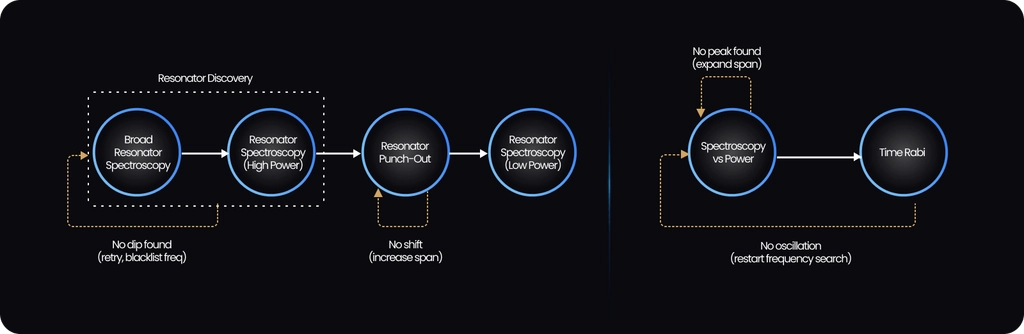
Quantum Machines’ library already includes qubit calibration nodes that have been stress-tested across the field. Bove took those and added the adaptive retry logic and error-code handling.
How Qualibrate Automates the Calibration Workflow
This involved writing a new QuAM component called the CavityMode class exposing displacement() and SNAP-gate operations, a CavityTransmonPair class describing the dispersive coupling and sideband drive between ancilla and cavity, and drive components that track the AC-Stark shift per Fock level live from QuAM state references. “The cavity bring-up and retuning graphs, which I built, simply chain these nodes in a fixed, known sequence and feed results forward.”, Bove said.
What an expert runs in their head— look at the data, think, choose new parameters, try again — turned into orchestration logic.
The Qualibrate graphs launch from a GUI or a shared notebook covering both manual and automatic paths. Since any graph can be stopped mid-sequence, nodes can still be run and accepted or rejected by hand, and the QuAM state is always directly inspectable and editable.
Automated Fock-State Preparation and Wigner Tomography
Tested on a single-cell 3D SRF cavity of TESLA geometry, the automated graphs ran the full bring-up unattended: locating the bare cavity resonance and fitting it with automatic success/fail detection, mapping the dispersive shift χ between the ancilla qubit and the cavity mode, calibrating vacuum and photon-number-resolved displacement, and characterizing coherence and reset fidelity.
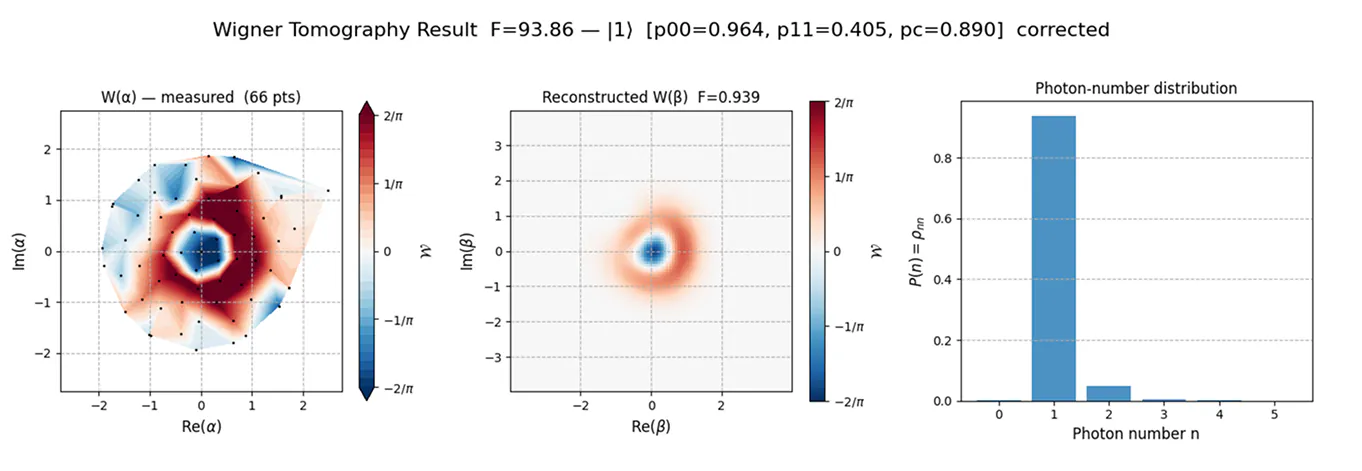
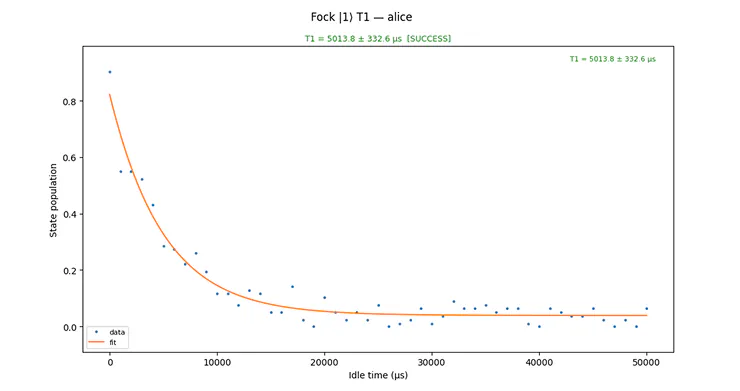
With the calibration in place, the cavity showed a coherent-state T1 of 6.3 ms at a mean photon number of ≈9.7, and an automatically calibrated f0g1 π-pulse prepared the |1⟩ Fock state with a T1 of ≈5 ms. Full 2D Wigner tomography of that state — reconstructed from displaced parity measurements, the standard technique for extracting a cavity’s density matrix — closed the loop end-to-end at 93.9% parity-corrected fidelity, currently limited by the ancilla qubit’s coherence time rather than the cavity’s.
At QM, we built Qualibrate to be more than about nodes and graphs that run autonomously on a specific device. We built it to be something that can speed up development, adapt to new nodes and features and be device agnostic. The routines that Bove wrote calibrate generic properties of a qubit-coupled 3D SRF cavity that matter whether the cavity senses bosonic QEC, dark matter haloscope search or quantum sensing.
At Quantum Machines we are thrilled to see what the community builds with our products, in this case, Qualibrate. Want to try it yourself? Reach out and start using QUAlibrate or get hands-on with multiple superconducting qubit architecture at IQCC.
The work presented here directly on Quantum Machines’ open-source qua-libs and quam-builder frameworks, and on close collaboration with the Qualibrate team. Co-authors on the underlying work: T. Kim, J. Yaker, P. Heidler, D. Van Zanten, and S. Zorzetti (Fermilab).