What can 1-bit do? Bistable Qubit Feedback Cuts Gate Errors by Half
Think of a qubit’s energy levels as a staircase, where the control pulses that drive gates are tuned to the height of one step, the qubit’s transition frequency. In some superconducting qubits, a defect in the chip makes that step jump at random between two heights. Each jump leaves the pulses mismatched, and gates once calibrated stop working as intended.
In a new Applied Physics Reviews paper, an international collaboration of researchers from MIT, the University of Regensburg, Leiden University and NTNU, together with colleagues from Qolab and Quantum Machines, shows that a single measured bit is enough to tell the controller which height is active, so it can retune the next gates in real time. Performing the experiment remotely on a pre-calibrated chip at the Israeli Quantum Computing Center (IQCC), the team showed that feeding that bit forward cut average gate error by more than half.
I sat down with Fabrizio Berritta and Ferdinand Kuemmeth, who led this work, to talk about feedback, control, and what an open-access testbed changes for remote research and for how quickly ideas become results.
What causes qubit frequency to jump or drift?
The qubit here is a transmon. Its transition frequency, about 5.10 GHz, is the step height that sets the carrier of every control pulse. Two-level-system (TLS) defects in the chip’s dielectrics couple to the qubit through their electric dipole and can move that frequency.
An ensemble of TLSs produces slow, 1/f-like drift, which Fabrizio and Ferdinand’s earlier binary-search protocol tracks with a handful of measurements. A single strongly coupled TLS can instead flip the frequency between two discrete values. Such a qubit becomes bistable.
Why a bistable qubit shows beating in Ramsey fringes
A nearby defect (TLS) switches the qubit between two frequencies. Pick a mode, then play or drag the Ramsey delay τ.
I asked which is worse for someone operating the qubit. “Usually 1/f noise causes sub-Hz to kHz fluctuations, and they require many measurements to be tracked,” Fabrizio said. “374 kHz is worse, and standard continuous tracking works for it too. But we show that if the switching is known beforehand, one optimal measurement is sufficient.”
The jumps also carry memory. Once the TLS settles, it stays, here for tens of seconds. “Any kind of memory is detrimental to quantum error correction,” Fabrizio noted.
Bistable qubits and where to find them
From a control perspective, a qubit whose frequency switches randomly between two values, known as telegraphic noise, is bad news. Interestingly, the research question came from a seminar. After a talk on the binary-search work in Copenhagen, Ferdinand asked: what if the frequency can take only two values? Then the controller doesn’t need to estimate a frequency at all, only to choose between two hypotheses.
While the idea was clear theoretically, a bistable qubit was needed to demonstrate it experimentally.
The qubit turned up by chance. “It was found randomly while measuring, but we had the experiment in mind for some time before,” Fabrizio told me. In his experience, about one qubit in five to ten behaves this way. This one sat on a Qolab chip at the IQCC, the open testbed Quantum Machines set up in Tel Aviv. Calibrating it with Ramsey measurements, he saw beating, “a fingerprint of TLSs,” from two frequencies 374 kHz apart.
How does one bit carry the answer?
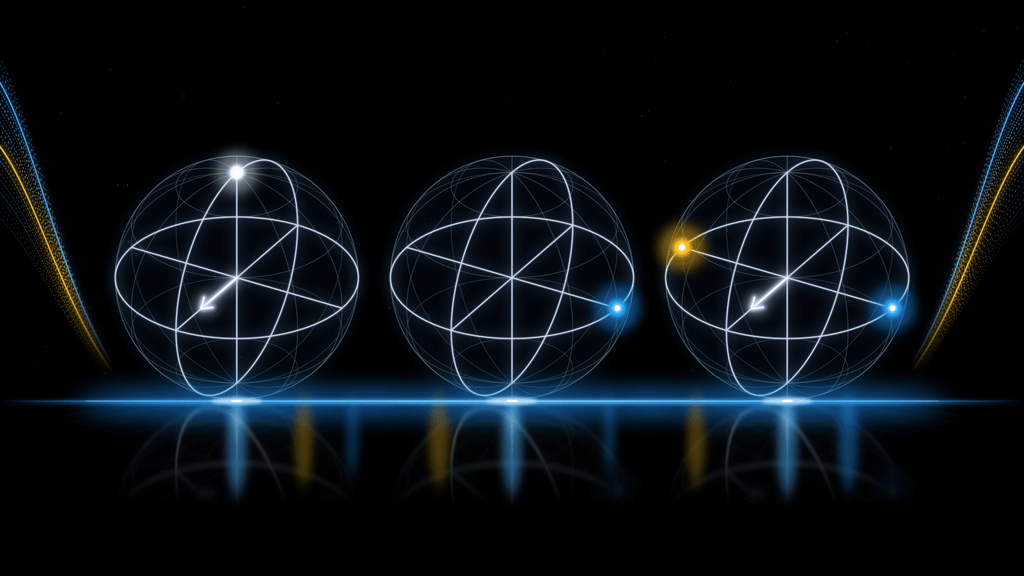
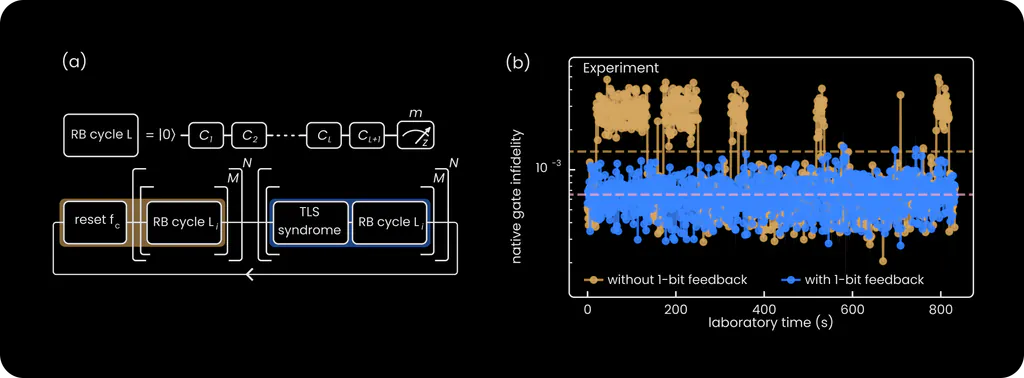
Fabrizio explained that it comes down to the frame. Set the controller’s reference frequency to the high mode and put the qubit on the equator of the Bloch sphere with a π/2 pulse. A high-mode qubit stands still in that frame; a low-mode qubit drifts against it at 374 kHz. After about 1.33 µs it has drifted half a turn, and a second π/2 pulse sends the two cases to opposite poles. The readout gives 1 for the high mode and 0 for the low mode. The OPX1000 acts on that bit at once, keeping the frame or shifting it down by 374 kHz before the next gates.
The 1-bit feedback protocol
One short Ramsey shot reveals the qubit’s mode, and the controller retunes before the next gate. Step through one cycle.
Was that obvious from the start? “It was,” Fabrizio said. “The syndrome extraction itself is not new. What is new is to use the information for feedback to improve qubit control.” Single-shot Ramsey had already been used to detect charge-parity switching in transmons. Here, though, the learned bit retunes the gates that follow.
Does it make the gates better?
First, in the Ramsey experiment, interleaving the syndrome suppressed the beating from the two modes.
Then, in randomized benchmarking, the team alternated runs with and without feedback for about 14 minutes; in the feedback runs, a syndrome preceded each sequence. Without feedback, the infidelity jumped between two levels as the TLS flipped. With it, the average fell from 1.4 × 10⁻³ to 0.65 × 10⁻³, 77% below the worst periods (2.8 × 10⁻³).
When I asked what this teaches us beyond the experiment, Ferdinand pointed to Albert Einstein’s famous objection in 1926 to the probabilistic and random nature of quantum measurements, invoking God. “Generally, quantum theory cannot predict the outcome of a quantum measurement, only a probability distribution, and a single measurement performed on an unknown state has virtually no practical utility. However, if the dynamics of a quantum system is well understood – a key requirement for quantum computing – then a single measurement can carry a lot of meaning. Up to a full bit of information, as shown in the paper! What this means is that, 100 years later, we are well advised to accept the commandments of quantum theory and turn them into useful algorithms.”
What did the IQCC testbed change?
“Access to low-level programming was fundamental to perform feedback,” Fabrizio said. The protocol is a Ramsey sequence with a fixed wait and a conditional frame update: a few lines of QUA. He ran it from Boston, pulling data into Python from VS Code as if the setup were next door. Within two to three days he had all the data needed for the paper. “It’s so nice to work with an already calibrated system and just have fun with it.”
Ferdinand adds that this has been a stunning first in his career as an experimentalist. “Taking data for only 3 days and writing a beautiful paper about that? That’s crazy! I typically tell my group that there is no such thing as a quick experiment. But with the advent of IQCC and low-level access to the world’s best quantum controllers, I think that my community will be transformed.”
What can the 1-bit feedback be used for?
Will this stay a fix for a few bad qubits? Better materials will make such qubits rarer, but every qubit you can keep in the computation instead of taking it offline doubles the Hilbert space. Protocols like this one will pay off there.
Fabrizio said the most interesting application may be error correction: syndrome extraction on ancillas assumes errors without memory, and real-time tracking could reduce one source of such errors.
One-bit feedback could run alongside binary search, and perhaps more bits for qubits with more than two frequencies. Spin qubits suffer from TLSs too, and the team would like to try silicon, where an electron can sit in either of two valleys with slightly different g-factors. Could a controller detect bistability, learn the two frequencies and switch on the feedback autonomously? It could, and this may well become standard.
If you have a question you’d like to put to a calibrated chip, the IQCC powered by the Quantum Machines control stack is open for it!